



Canada is one of 155 nations that signed the Global Methane Pledge. GMP promises to reduce methane (CH4) emissions by 30% from 2020 levels by 2030. Despite the commitments, atmospheric concentration of the greenhouse gas is increasing faster now than at any time since the 1980s.
Methane emissions result primarily from fossil fuel production, agriculture, waste management, and other human activities, including flooding of hydropower reservoirs like the one behind BC’s Site C dam.
When a reservoir is created and filled with water, submerged organic matter such as vegetation decomposes and breaks down, releasing carbon dioxide (CO2) and methane. These gases can then reach the atmosphere in multiple ways, including diffusion, ebullition (bubbles), transmission via vegetation, and degassing when water passes through a pump house or turbine.
Tracking the Carbon Footprint of Hydropower
The Global Carbon Project is an international research project chaired by Stanford University Professor Rob Jackson. Recent messages from the organization include:
- CH4 emissions from human activities have increased by 20% (61 million metric tons of CH4 per year) in the past two decades.
- CH4 accumulation in the atmosphere has accelerated in the past decade, with higher growth rates over the past three years (2020-2022) than any previous observed year since 1986 when reliable measurements from a wider network began.
- CH4 is a 28 times more powerful greenhouse gas than CO2 over a time horizon of 100 years, but 80 times more powerful than CO2 over a time horizon of 20 years.
- In addition to climate impacts, CH4 is a precursor of tropospheric ozone formation, a greenhouse gas and a pollutant for air quality, damaging human and ecosystem and crop health.
- The observed atmospheric CH4 concentrations in the past decade follows the trends of the most pessimistic illustrative future GHG trajectories used by the Intergovernmental Panel on Climate Change (IPCC) that lead to global mean temperatures above 3°C by the end of this century, underscoring the urgency of reducing anthropogenic CH4 emissions.
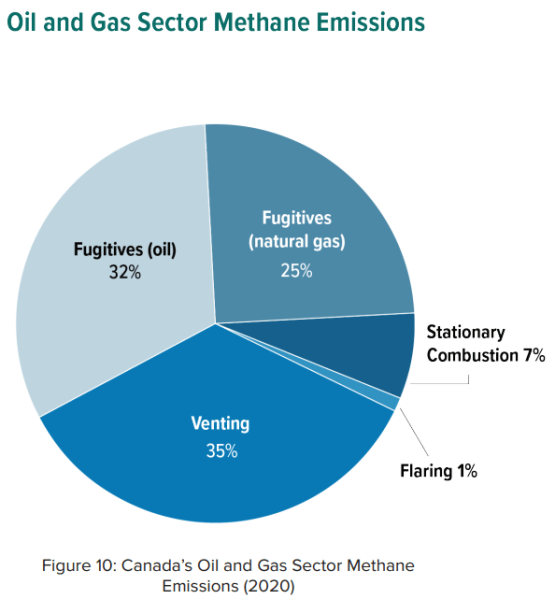
The oil and gas sector is the largest emitter of methane in Canada, responsible for about 38% of Canada’s methane emissions in 2020, as reported in Canada’s 2022 NIR. Many oil and gas industry activities emit methane, including exploration, drilling, production, field processing, gas gathering, refining, and transmission and distribution.
Canada’s Methane Strategy
Categories: Climate Change


 in-sights.ca