
David Brooks’s opinion piece in The Atlantic begins with a question that many people have been asking for a considerable time.

David Brooks’s opinion piece in The Atlantic begins with a question that many people have been asking for a considerable time.

Years ago, veteran war correspondent Robert Fisk warned against equating criticism of Israel with anti-Semitism. He argued that conflating opposition to Israeli government policies with hostility toward Jewish people served to suppress debate and protect the state from legitimate criticism.

Carol Linnitt, co-founder of The Narwhal sent an email to people on the organization’s mailing list. I hope everyone reading this will respond to her plea for financial assistance for their lawsuit against the RCMP about the egregious treatment of Amber Bracken. She was arrested and kept in jail for days for doing nothing more than her job as a journalist…

Minutes after I placed a link on Facebook to the IN-SIGHTS article Road to Dictatorship, the post was removed. Facebook labelled it spam, which is typically defined as irrelevant or inappropriate advertising and messages sent on the internet. The article had no advertising. Instead, it linked to Trump’s White House, The Atlantic magazine, a prestigious research institute at a Swedish university, and a legal resource centre….

I cancelled my subscription to the New York Times when the newspaper seemed to easily accept the horrors inflicted on two million residents of Gaza. Of course, that was not the only fault I perceived in what should be America’s finest newspaper. However, the Gray Lady does produce some compelling material. There is a fine Times piece by Larry David, the brilliant creator of “Curb Your Enthusiasm” and the co-creator of “Seinfeld.” It was directed at Bill Maher after the arrogant former comedian dined with Donald Trump, whom Maher called “gracious.”

Mark Bourrie is a Canadian journalist with an impressive resume. After he earned a BA in history, Ontario universities awarded Bourrie a diploma in public policy and administration, a master’s degree in journalism, a doctorate in Canadian media history, and a law degree. This week, The Walrus published a commentary by Mark Bourrie. He says Pierre Poilievre, the “Canada Is Broken” candidate, faces a changed national mood.
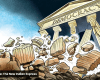
Dan Froomkin is an American journalist worth following. Andrew Coyne is not afraid to speak out, but Froomkin wondered why most people in legacy media don’t appear to believe the current threat to democracy is real.
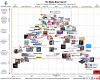
Ad Fontes Media is a non-profit watchdog that rates media for bias and reliability. The name comes from Latin words meaning “to the sources.” The organization concluded its own output is biased, because all reports by humans are affected by personal judgments and preferences…
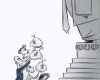
Professor Robert Reich discussed the connections between wealth and power. Oligarchs have used their wealth and power to gain control of legacy media and that control is being used to increase their wealth and power.

This is a reprint from electoral-vote.com, a site for sane commentary about politics in the USA. I don’t always have the resolve to follow American political news but I recommend this website for its discernment of important issues.

Rather than speaking truth to power, legacy media have become stenographers with amnesia, hiding the truth through the use of anodyne adjectives, convoluted phrasing and buried leads. In some cases, they have been explicitly muzzled by media owners.

This is a follow-up to an earlier article that focused on political accountability and the need for journalists to demand it. The main objective of news people is to provide the public with useful information. Thorough reporting on government should involve facts that politicians want to promote and facts they wish to demote and keep out of the public eye. From political pundits, we need interpretive journalism that educates the public about failures in political and corporate accountability. Threats to democracy by authoritarians should be primary concerns.

Politicians no longer answer to voters, since virtually all votes are guaranteed by tribal loyalty; instead they answer to big donors… Shaming politicians has become next to impossible. Thanks to the internet, pols no longer need the traditional media to broadcast their views.

Beware of what you read about BC Hydro in news sites operating to benefit those who aim to privatize billions of public dollars. One example is a Derrick Penner article published by Postmedia. The Vancouver Sun headline screams that BC Hydro cannot deliver the electricity this province needs. The source of that claim is a group funded by private industry, a group that promotes unregulated private business and works to undermine BC’s main public utility…
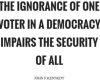
Elections in the next few months will alter governments in three Canadian provinces, as well as in Washington DC, and in all states of the USA. Justin Trudeau will call a Canadian federal election in less than a year. Journalism we can trust is vital at all times, especially in late 2024 and early 2025. Voters can find endless information from many sources, but we need accurate and thorough information to make informed decisions. Democracy cannot survive if voters are uninformed or misinformed.

Froomkin says the party of America’s right-wing — this applies in Canada too — abandoned forthright arguments in favor of dog-whistles and disinformation. In a late 2023 Globe & Mail article, political reporter Campbell Clark wrote about Pierre Poilievre telling lies when the Conservative leader claimed that the Canada-Ukraine free-trade agreement would force Ukraine to adopt a carbon tax. That was untrue. But nowhere does it say bluntly that the Conservative leader was lying. The Globe’s headline writer avoided the harsh description and wrote, “Pierre Poilievre tells tales.”

Dan Rather was a star of the news business for years before he left CBS. From the 1980s to the mid-2000s, Peter Jennings, Tom Brokaw, and Dan Rather were the “Big Three” of TV news in the USA. At the peak, about one in five Americans watched them. Today, about one in twenty Americans see flagship news shows of the legacy networks…

The reality is that media filters reality instead of reflecting it. In authoritarian regimes, control of communication has always been a primary consideration and news is shaped to further the interests of the powerful. The same can be said in corporatocracies. Shaping the news will be more problematic as use of artificial intelligence expands. That is not good for social democracy.

Ali Velshi is a journalist often seen on MSNBC. Promoting a new book, he appeared on NPR’s Fresh Air. The program covers much ground and is worth our attention. The end segment resonates since it cautions us to know the difference between news and nonsense…

Many citizens shape their opinions by paying attention to corporate media. What if those news providers are unreliable?


Let's ask an expert.. Consider The House of EL’s analysis of “thought” as it functions among the AI and business…
If anything could keep sleep-deprived President Trump busy threatening new tariffs it is likely to be Europe’s decision to remove…

Hi Norm, I think you might find this book review, from the New York Review of Books, interesting. I think…
What’s so hilarious about twenty-first century geopolitics? The irrepressible analytical wit of Sarah Paine! https://www.youtube.com/watch?v=JwDGrLRJhQI


Thanks for this article Norm. The BC Greens are breaking new ground this election by promising to introduce a wealth…