



Reading comments on social media and listening to statements by certain politicians, it is apparent that carbon taxes are often misunderstood. These impositions are designed to reduce greenhouse gas emissions and science shows that would improve human health and lessen catastrophic losses resulting from climate change.
For some, hearing talk about axeing any tax suggests their cost of living will decrease. After a few years of rising prices and high interest rates, any promise of a tax reduction appeals. The cost of living has been an ongoing crisis for many in Canada.
Of course, ending carbon taxes will also end carbon tax rebates. Credible analyses show that many Canadian households receive more from the rebate programs than is paid for direct and indirect carbon taxes.
Because of rebate exclusions, carbon taxes burden industries and high-income families. The tax is neutral for middle-income Canadians and the rebates benefit low-income families. However, all citizens and business operations are better off if we reduce carbon emissions and moderate the economic costs of climate change. Climate Action Network Canada says,
By continuing to focus on carbon pricing, we are collectively ignoring the elephant in the room: the costs of runaway climate change.
We are not fooled: some federal politicians and many premiers are shamelessly exploiting Canadians’ very real economic pain for political gain. Climate policies have nothing to do with the hardships Canadians are facing, yet these politicians are ignoring the real causes of the cost of living crisis and scapegoating carbon pricing.
Writing for the Sloan Business School at the Massachusetts Institute of Technology, Sara Brown argues in favour of climate taxes.
- In 2019, more than 3,600 economists signed a letter in support of a carbon tax as the “most cost-effective lever to reduce carbon emissions at the scale and speed that is necessary.”
- Carbon taxes minimize the total cost to society of emission reductions. Those engaged in activities that can cheaply move away from using carbon will do so, and those that can’t will pay the tax. In the end, we reduce emissions to target levels at the lowest total cost.
- Carbon taxes are transparent, enforceable, adjustable, and they create explicit revenues.
If the Conservative Party and its industrial sponsors were interested in addressing climate change, they would follow the advice of scientists and economist and embrace carbon taxes.
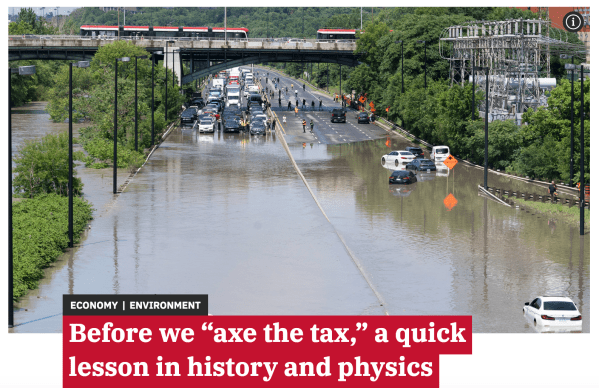
In 2021, nearly 14,000 scientists signed a new climate emergency paper, warning that “untold suffering” awaits the human race if we don’t start tackling global warming head-on, effective immediately.
But then, untold suffering in the future is less important to politicians than a political advantage in the present.
Categories: Climate Change


 in-sights.ca
There seems to be a current developing of willingness to backtrack on the feeble effort that our current carbon pricing policy provides in warding off the destruction wrought by climate destabilization. I don’t hear pols of any stripe proposing anything to take the place of carbon pricing, or showing much of a taste for anything longer term than the next vote, including taking he initiative to inform and convince the electorate of our collective responsibility to act on this crisis, along with economic disparities, ecological collapse, housing, addictions and the generally poor state of much of our infrastructure. Mostly we hear nostrums that are variations on business as usual, to wit, doing more of the same silliness that brought us to this pass in the first place. What, me worry?
LikeLiked by 1 person