


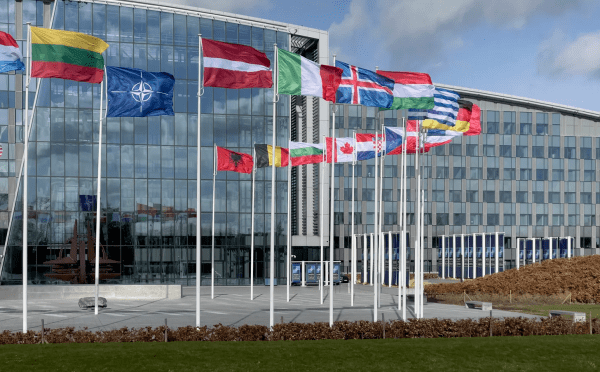
Charlie Angus, a longtime Member of Parliament from Northeastern Ontario, published his observations about recent NATO meetings in Brussels. The MP’s words deserve our attention. We may also ask why Angus, instead of NDP leader Jagmeet Singh, is the most prominent Opposition politician from Canada at this month’s NATO meetings.
“Right now, In Saudi Arabia, the most undemocratic place on the planet, a war criminal and a convicted felon are deciding the future of Ukraine. If we are silent, it will be like Munich 1938 all over. Do we have the determination to speak out for a better world because it is being sold out now, and the American delegation is allowing this to happen.
We cannot allow this to happen.”
I didn’t think it would be like this. I was sure that when Donald Trump started shooting off his mouth about Ukraine and kissing up to Putin, the combined voices of NATO would speak up as a strong deterrent. When he began undermining his allies, I was convinced that Germany, the UK, France, Poland, etc., would rally together to remind the Americans that Europe would not be pushed around.
And I guess I was also hoping that our big European cousins would be there to reassure Canada that everything would be okay.
But that’s not how it went down at the NATO meetings in Brussels.
Even as Trump was tearing down the European peace around them, the senior delegations were trying to tiptoe around the obvious. They sat politely as American MAGA bros lectured them about their failure to defend democracy and listened politely as they were told that the United States was a superior country because everybody had access to a gun.
The Europeans were rattled. They were freaked out. They didn’t expect that Project 2025 would be aimed at them and the future of liberal democracy.
They just couldn’t believe that right before their very eyes the clock was being pushed back to the 1930s.
In Romania, JD Vance is interfering with the country’s election process. In Germany, Musk is promoting the extremist far right. In the Baltic states, there is a deep fear that Trump is going to sell them out to Putin. And in Ukraine, Trump is now blaming Ukraine for the war and pushing for an election to replace President Zelensky.
Coming from Canada, where our very right to exist as a nation has been called into question, I felt the diplomatic niceties were not the order of the day. And over the course of the meetings, I had a few choice exchanges with American Republicans.
In the official interventions that I made, I went hard at the duplicity of Trump and the need for allied nations to stand up for the rule of law.
This blunt language opened doors for representatives from many countries to approach me to discuss what could be done. I told them bluntly that now was the moment where we either stood up for the vision of a democratic West or allowed it to be torn apart.
In the final morning session, I shook up a staid presentation by pointing out that while we were talking about our shared values, two criminal leaders were meeting in Saudi Arabia to sell out the people of Ukraine.
Following my intervention, the Latvian delegation completely dropped the gloves and went hard on Trump. The hall erupted in cheers.
Afterward, the lead Latvian delegate came up to shake my hand, saying:
“We decided it was time to start acting like Canadians.”
I learned in Brussels that Canada has never been more alone than it is today.
Defending our nation from a gangster state is going to be an expensive and long-term commitment. We will have to hunker down and make tough decisions about our economy and national defence.
We are alone, yet we are not truly alone.
Many of our allied countries share our fears. They just don’t know what to do.
But we can resist the Trump/Putin plan. My hope is that in the coming months, nations like Europe, Australia, Japan, Latin America, and Canada can work together to oppose the Trump gang.
Trump is being reckless on so many fronts, and he will trip and fall. And this will be the opportunity in the United States to begin pushing back.
But my advice to fellow Canadians and our international allies is that we can’t wait or hope for America to get its act together. The resistance must start now.
I am hoping that a coalition from around the world will join Canada.
But if not, we will stand on our own.
Canadians will never kiss the gangster ring, no matter how hard the fight.
My current favourite historian, Heather Cox Richardson, issued blunt statements about issues that trouble Charlie Angus. Professor Richardson seems convinced that a Russian asset is seated at the main desk in the White House Oval Office. There was a day when American conservatives would have been furious about Russian influence guiding the American government. That is no longer the case. They have been convinced that plutocrats can do no wrong and should be followed.
Below the separator is most of the Richardson post for February 19, 2025.
The past week has solidified a sea change in American—and global—history.
A week ago, on Wednesday, February 12, Secretary of Defense Pete Hegseth announced at a meeting of the Ukraine Defense Contact Group in Brussels, Belgium, that President Donald Trump intended to back away from support for Ukraine in its fight to push back Russia’s invasions of 2014 and 2022.
Hegseth said that Trump wanted to negotiate peace with Russia, and he promptly threw on the table three key Russian demands. He said that it was “unrealistic” to think that Ukraine would get back all its land—essentially suggesting that Russia could keep Crimea, at least—and that the U.S. would not back Ukraine’s membership in the North Atlantic Treaty Organization (NATO), the mutual security agreement that has kept Russian incursions into Europe at bay since 1949.
Hegseth’s biggest concession to Russia, though, was his warning that “stark strategic realities prevent the United States of America from being primarily focused on the security of Europe.” Also on Wednesday, President Donald Trump spoke to Russia’s president, Vladimir Putin, for nearly an hour and a half and came out echoing Putin’s rationale for his attack on Ukraine. Trump’s social media account posted that the call had been “highly productive,” and said the two leaders would visit each other’s countries, offering a White House visit to Putin, who has been isolated from other nations since his attacks on Ukraine…
Then, on Friday, at the sixty-first Munich Security Conference, where the U.S. and allies and partners have come together to discuss security issues since 1963, Vice President J.D. Vance attacked the U.S.A.’s European allies. He warned that they were threatened not by Russia or China, but rather by “the threat from within,” by which he meant the democratic principles of equality before the law that right-wing ideologues believe weaken a nation by treating women and racial, religious, and gender minorities as equal to white Christian men. After Vance told Europe to “change course and take our shared civilization in a new direction,” he refused to meet with Germany’s chancellor Olaf Scholz and instead met with the leader of the far-right German political party that has been associated with neo-Nazis.
While the Munich conference was still underway, the Trump administration on Saturday announced it was sending a delegation to Saudi Arabia to begin peace talks with Russia. Ukrainian officials said they had not been informed and had no plans to attend. European negotiators were not invited either. When U.S. Secretary of State Marco Rubio and Russian foreign minister Sergei Lavrov spoke on Saturday, the Russian readout of the call suggested that Russia urgently needs relief from the economic sanctions that are crushing the Russian economy. The day before, Hungarian prime minister Viktor Orbán, an ally of both Putin and Trump, assured Hungarian state radio on Friday that Russia will be “reintegrated” into the world economy and the European energy system as soon as “the U.S. president comes and creates peace.”
Talks began yesterday in Riyadh, Saudi Arabia. In a four-and-a half-hour meeting, led by Rubio and Lavrov, and including national security advisor Mike Waltz, the U.S. and Russia agreed to restaff the embassies in each other’s countries, a key Russian goal as part of its plan to end its isolation. Lavrov blamed the Biden administration for previous “obstacles” to diplomatic efforts and told reporters that now that Trump is in power, he had “reason to believe that the American side has begun to better understand our position.”
Yesterday evening, from his Florida residence, Trump parroted Russian propaganda when he blamed Ukraine for the war that began when Russia invaded Ukraine’s sovereign territory. …He also said that Zelensky holds only a 4% approval rating, when in fact it is about 57%.
Today, Trump posted that Zelensky is a dictator and should hold elections, a demand Russia has made in hopes of installing a more pro-Russia government. As Laura Rozen pointed out in Diplomatic, former Russian president Dmitry Medvedev posted: “If you’d told me just three months ago that these were the words of the US President, I would have laughed out loud.”
“Be clear about what’s happening,” Sarah Longwell of The Bulwark posted. “Trump and his administration, and thus America, is siding with Putin and Russia against a United States ally.”
To be even clearer: under Trump, the United States is abandoning the post–World War II world it helped to build and then guaranteed for the past 80 years.
The struggle for Ukraine to maintain its sovereignty, independence, and territory has become a fight for the principles established by the United Nations, organized in the wake of World War II by the allied countries in that war, to establish international rules that would, as the U.N. charter said, prevent “the scourge of war, which twice in our lifetime has brought untold sorrow to mankind, and to reaffirm faith in fundamental human rights.”
Central to those principles and rules was that members would not attack the “territorial integrity or political independence” of any other country. In 1949 the North Atlantic Treaty Organization (NATO) came together to hold back growing Soviet aggression under a pact that an attack on any of the member states would be considered an attack on all.
The principle of national sovereignty is being tested in Ukraine. After the breakup of the Soviet Union in 1991, Ukraine held about a third of the USSR’s nuclear weapons but gave them up in exchange for payments and security assurances from Russia, the United States, and the United Kingdom that they would respect Ukraine’s sovereignty within its existing borders. But Ukraine sits between Russia and Europe, and as Ukraine increasingly showed an inclination to turn toward Europe rather than Russia, Russian leader Putin worked to put his own puppets at the head of the Ukrainian government with the expectation that they would keep Ukraine, with its vast resources, tethered to Russia.
In 2004 it appeared that Russian-backed politician Viktor Yanukovych had won the presidency of Ukraine, but the election was so full of fraud, including the poisoning of a key rival who wanted to break ties with Russia and align Ukraine with Europe, that the U.S. government and other international observers did not recognize the election results. The Ukrainian government voided the election and called for a do-over.
To rehabilitate his image, Yanukovych turned to American political consultant [and Trump ally] Paul Manafort, who was already working for Russian billionaire Oleg Deripaska. With Manafort’s help, Yanukovych won the presidency in 2010 and began to turn Ukraine toward Russia. When Yanukovych suddenly reversed Ukraine’s course toward cooperation with the European Union and instead took a $3 billion loan from Russia, Ukrainian students protested. On February 18, 2014, after months of popular protests, Ukrainians ousted Yanukovych from power in the Maidan Revolution, also known as the Revolution of Dignity, and he fled to Russia.
Shortly after Yanukovych’s ouster, Russia invaded Ukraine’s Crimea and annexed it. The invasion prompted the United States and the European Union to impose economic sanctions on Russia and on specific Russian businesses and oligarchs, prohibiting them from doing business in U.S. territories. E.U. sanctions froze assets, banned goods from Crimea, and banned travel of certain Russians to Europe.
Yanukovych’s fall had left Manafort both without a patron and with about $17 million worth of debt to Deripaska. Back in the U.S., in 2016, television personality Donald Trump was running for the presidency, but his campaign was foundering. Manafort stepped in to help. He didn’t take a salary but reached out to Deripaska through one of his Ukrainian business partners, Konstantin Kilimnik, immediately after landing the job, asking him, “How do we use to get whole? Has OVD [Oleg Vladimirovich Deripaska] operation seen?”
Journalist Jim Rutenberg established that in 2016, Russian operatives presented Manafort a plan “for the creation of an autonomous republic in Ukraine’s east, giving Putin effective control of the country’s industrial heartland.” In exchange for weakening NATO and U.S. support for Ukraine, looking the other way as Russia took eastern Ukraine, and removing U.S. sanctions from Russian entities, Russian operatives were willing to help Trump win the White House. The Republican-dominated Senate Intelligence Committee in 2020 established that Manafort’s Ukrainian business partner Kilimnik, whom it described as a “Russian intelligence officer,” acted as a liaison between Manafort and Deripaska while Manafort ran Trump’s campaign.
Government officials knew that something was happening between the Trump campaign and Russia. By the end of July 2016, FBI director James Comey opened a counterintelligence investigation into Russian interference in the 2016 election. After Trump won, the FBI caught Trump national security advisor Lieutenant General Michael Flynn assuring Russian ambassador Sergey Kislyak that the new administration would change U.S. policy toward Russia. Shortly after Trump took office, Flynn had to resign, and Trump asked Comey to drop the investigation into Flynn. When Comey refused, Trump fired him. The next day, he told a Russian delegation he was hosting in the Oval Office: “I just fired the head of the F.B.I. He was crazy, a real nut job…. I faced great pressure because of Russia. That’s taken off.”
…Trump withheld money Congress had appropriated for Ukraine’s defense against Russia and suggested he would release it only after Zelensky announced an investigation into Hunter Biden…
Now, on the anniversary of the day the Ukrainian people ousted Victor Yanukovych in 2014—Putin is famous for launching attacks on anniversaries—the United States has turned its back on Ukraine and 80 years of peacetime alliances in favor of support for Vladimir Putin’s Russia. “We now have an alliance between a Russian president who wants to destroy Europe and an American president who also wants to destroy Europe,” a European diplomat said. “The transatlantic alliance is over.”
…In The Bulwark, Mark Hertling, who served as the Commanding General of the United States Army Europe, commanded the 1st Armored Division in Germany, and the Multinational Division-North in Iraq, underlined the dramatic shift in American alignment. In an article titled “We’re Negotiating with War Criminals,” he listed the crimes: nearly 20,000 Ukrainian children kidnapped and taken to Russia; the deliberate targeting of civilian infrastructure, including hospitals, schools, and energy facilities; the execution of prisoners of war; torture of detainees; sexual violence against Ukrainian civilians and detainees; starvation; forcing Ukrainians to join pro-Russian militias.
“And we are negotiating with them,” Hertling wrote. Josh Marshall of Talking Points Memo points out that the talks appear to be focused on new concessions for American companies in the Russian oil industry, including a deal for American companies to participate in Russian oil exploration in the Arctic.1
…For his part, Trump appears to be leaning into his alliance with dictators. This afternoon, he posted on social media a statement about how he had killed New York City’s congestion pricing and “saved” Manhattan, adding “LONG LIVE THE KING!” White House deputy chief of staff Taylor Budowich reposted the statement with an image of Trump in the costume of an ancient king, with a crown and an ermine robe. Later, the White House itself shared an image that imitated a Time magazine cover with the word “Trump” in place of “Time,” a picture of Trump with a crown, and the words “LONG LIVE THE KING.”
The British tabloid The Daily Star interprets the changes in American politics differently. Its cover tomorrow features Vladimir Putin walking “PUTIN’S POODLE”: the president of the United States.
Added by IN-SIGHTS:
1 Trump’s objective of weakening and disrupting Canada may be partly explained by his friend Vladimir Putin’s ambition to control the Arctic.
Categories: Democracy, International


 in-sights.ca
I find this less like 1938 featuring Chamberlain and more like September of 1939 with Hitler and Stalin carving up the spoils of the invasion of Poland. We may be that far along, though the shooting wars are thus far consigned to proxies safely removed from the territories of the combatants.
LikeLiked by 1 person
Forget the word salads from our politcans, the real mettle for Canadians will be shown if the government will invest 10% of the GNP into the military for the next decade to bring our military into a real defensive force, then a minimum of 5% of the GNP from then on.
Is Canada ready to go nuclear? Is Canada ready to be on a war footing?
Boycotts aside, will Canadians entertain mandatory military training post high school?
Will Canadians forgo subsidized daycare and alike federally funded social services?
Canada is in a fight for its life, yet our politcans seems asleep at the switch, especially the “Wee P” who has joined far to late the “Canadian” side to have any credibility.
Destiny awaits.
LikeLike