



Always articulate and thoughtful reader Lew Edwardson left a comment on the IN-SIGHTS article THE HEAT BENEATH OUR FEET. I think it needs to be amplified.
BC Hydro’s recent call for power process netted about the same production capability as the Site C dam, derived from ten projects: nine wind and one solar. The announced average price is $74 per megawatt hour. I’ve read that the cost of the Site C power is much higher.1
It seems that much turmoil and damage (political and otherwise) could have been avoided to obtain the same capacity had our leaders and BC Hydro planners kept up to speed on evolving technology. There were many sources urging them to do so, with very limited success.
Another call for power (again for about the same production capability) is scheduled this summer, along with a “Request for Expressions of Interest (RFEOI) to explore large-scale, baseload capacity projects—such as geothermal, pumped storage, and other firm energy solutions—with submissions closing in September.”
[BC Hydro Chair Glen] Clark says, “What will increase rates in the future is the large number of wind farms and a few solar plants.” Given that another large BC Hydro dam project is very unlikely, and the cost of power from the most recent hydro build is higher than the wind and solar just contracted, this seems a rather defensive and disingenuous statement.
Some questions come to mind that maybe Mr. Clark or someone from BC Hydro could answer:
* Are any “Run of River” projects anticipated as a result of the new calls?
* What lessons were learned from the infamous Gordon Campbell-driven IPP contracts BC was saddled with?
* Have the new contracts been structured with those lessons in mind?
* What is BC Hydro’s personnel strategy to ensure the necessary expertise is available to meet rapid advances in technology?
* Will BC Hydro develop in-house expertise to create and maintain cutting-edge energy sources, or will that be left to private industry?
* Who will administer all the new projects? In-house personnel, or outside consultants?
* Given that BC Hydro has spent millions researching geothermal, how many in-house experts in the field does BC Hydro employ, and can you point to any trial installations or exploration conducted by BC Hydro?
* Is power to fossil-fuel production, such as LNG plants, fracking facilities, etc., subsidized, and if so what is the total dollar value per year?
* * Would the subsidizing of fossil fuel production be factored into an analysis of “best in class” energy production?
Norm’s Comments
1 If we accept that the capital cost of Site C was $16 billion, and if we assume the project was financed at 4.12%, the current 10-year rate published by BC’s Municipal Finance Authority, the following annual amounts would pay off Site C’s capital costs:
- 60-year amortization would require an annual payment of $723,400,000.
- 80 year amortization would require an annual payment of $686,350,000.
Site C has six generators rated at 180 MW capacity. When all six are operating, total capacity wil be 1,080 MW.
The 5-year average of electricity produced at Hydro’s two other Peace River dams was 4.7 gigawatt-hours for each megawatt of capacity. In fiscal year 2024, the last year reported, only 3.1 GWh were generated for each MW of capacity.
Drought in northeast BC continues to be a problem. If the situation of FY 2024 continues, Site C will produce about 3,350 GWh, not the promised 5,100.

Because of the unstable ground beneath Site C, I think a 60-year amortization period is appropriate. The numbers suggest the dam’s capital cost for each MWh of electricity produced would fall between $142 and $215. Of course, the utility incurs operating, distribution, marketing, and overhead costs as well. Those could be around $30 per MWh. At the midpoint between possible production quantities, BC Hydro would be paying over 20 cents per KWh for Site C electricity. That is far more than the utility has been willing to admit, and far more than its customers are now paying.
As Lew points out, Site C opponents have been saying for years that cheaper and less harmful sources of electricity were available. BC Hydro and politicians, both BC Liberals and New Democrats, closed their ears and refused to hear the warnings.
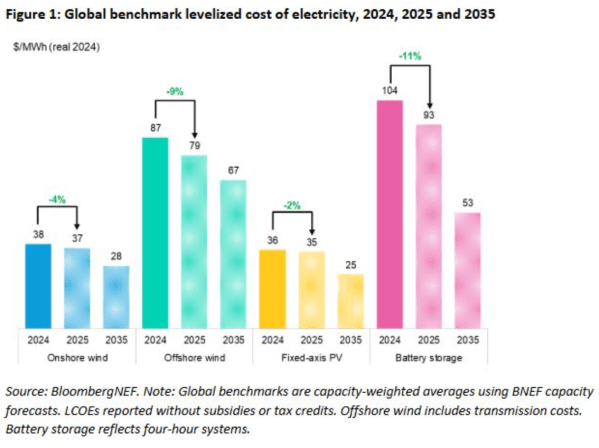
New York/ London, February 6, 2025 – The cost of clean power technologies such as wind, solar and battery technologies are expected to fall further by 2-11% in 2025, breaking last year’s record. According to a latest report by research provider BloombergNEF (BNEF), new wind and solar farms are already undercutting new coal and gas plants on production cost in almost every market globally.
…BNEF still expects the levelized cost of electricity for clean technologies to fall 22-49% by 2035.
BloombergNEF, Global Cost of Renewables to Continue Falling in 2025
Categories: BC Hydro, Site C, Uncategorized


 in-sights.ca