



I have written here about Calgary based Eavor and its effort to have scalable geothermal energy available almost anywhere. The company has begun delivering power to the German grid from its first commercial facility.
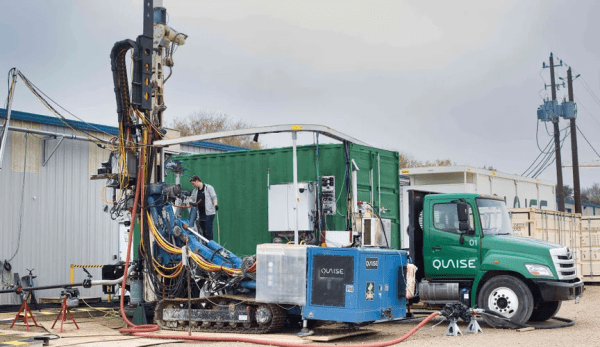
Quaise Energy is also working on delivering clean geothermal energy, using a unique deep-drilling system. The company makes these points:
- Our approach uses the established workforce, assets, supply chains, and regulatory frameworks of the fossil fuel industry.
- We can build a truly equitable, clean energy source on a global scale.
- Deep geothermal energy is at the core of an energy-independent world. It is the only renewable solution with the potential to get us to net zero by 2050. It is renewable, inexhaustible, and available everywhere.
- First, we use conventional rotary drilling to get to basement rock. Then, we switch to high-power millimeter waves to reach unprecedented depths.
- Millimeter wave drilling will unlock the most abundant and powerful clean energy source on Earth by allowing us to drill as far down as 20 km to reach temperatures up to 500° C.
- Deeper geothermal is more universal. At these depths, we can reach superhot geothermal anywhere on Earth, making it a truly global energy source. It provides a path to energy independence for every nation.
- Geothermal does not require any fuels and does not produce any waste. It’s truly renewable, abundant, and equitable for all, even in the most challenging energy environments.
- Deep geothermal uses less than 1% of the land and materials of other renewables, making it the only option for a sustainable clean energy transition.
Quaise is a spinout of MIT Energy Initiative, a major research hub at the Massachusetts Institute of Technology. MITEI reported:
Quaise hosted the first of several live public demonstrations of their drilling technology that proved their technology can drill into the granite outcrop in a quarry with pure energy instead of physical drilling bits.
Quaise’s drilling system centers around a device called a gyrotron that produces millimeter waves and has been used in research and manufacturing for decades.
The September demonstration showed that they can drill through some of the hardest rock in the world at a rate of up to five meters per hour.
The nonprofit Canary Media discussed Quaise Energy in The smell of toasted rock could spell victory for geothermal energy. It makes these points along with others:
The more subterranean heat a geothermal plant can access, the more energy it can generate, and the Earth gets hotter closer to the core. But the intense conditions below a few miles deep rapidly wreck conventional drill bits.
[Quaise] adapted the gyrotron, a tool honed by the nuclear fusion industry that emits millimeter waves, which fall on the electromagnetic spectrum between microwaves and infrared waves. Fusion researchers use them to heat plasma to unfathomably high temperatures.
Quaise has plenty more work to do before it can deliver its transformative promise — and that starts with getting out of the lab and into the field.
Quaise leaders did not disclose a timeline for the company’s first commercial deep drilling. At that point, Quaise will need to build an actual power plant and navigate the myriad permitting and transmission-connection hurdles that face renewables developers broadly. The company is running this development process in-house and already has multiple geothermal leases secured, a spokesperson noted.
“Advanced geothermal technologies could unlock a terawatt-scale resource that can deliver clean energy on demand,” said Jesse Jenkins, an authority on net-zero modeling and assistant professor at Princeton University. “That would be an enormously valuable tool to have in our toolbox.”
Permitting and transmission-connection hurdles face renewable developers broadly. Raising money to gain expertise and moving systems to a commercial stage are also challenges. With geothermal energy, the potential rewards are huge, in both financial and environmental terms. British Columbia should choose to be a leader in this sector.
Categories: Geothermal


 in-sights.ca
Just asking.
Does the UK have enough windfarms yet?
https://www.bbc.com/news/articles/cn9zyx150xdo
“The UK has awarded contracts to build a record amount of offshore wind as part of its efforts to grow the country’s clean electricity.”
“The projects span England, Scotland and Wales, including part of what could become the world’s largest offshore wind farm, off the coast of Scotland in the North Sea.”
“But some analysts warn that despite the record haul of offshore wind, the government will still struggle to meet its 2030 “clean power” target.”
“The government argues that wind projects are cheaper than new gas power stations and will “bring down bills for good”, but the Conservatives have accused its climate targets of raising energy prices.”
The government wants at least 95% of Great Britain’s electricity to come from “clean” sources by 2030, partly to help tackle climate change by reducing carbon emissions from burning fossil fuels. These clean sources include renewables – such as solar and wind – and nuclear energy.”
“Offshore wind is widely seen as the backbone of Great Britain’s future clean electricity system, with plentiful wind resources off the country’s coastlines.”
“The government wants at least 43 gigawatts (GW) of offshore wind by 2030 to help meet its clean power target.”
========================================================================
How soon did India plan to be at least 50% energy reliant on renewables? 2030.
They reached their target 5 years early.
https://timesofindia.indiatimes.com/business/india-business/5-years-ahead-of-target-india-gets-50-power-from-clean-sources/articleshow/122540328.cms
LikeLike
Osmatic Power?
https://www.msn.com/en-ca/news/world/this-invention-may-change-the-world-of-renewable-energy/vi-AA1R2wm8?ocid=BingHp01&cvid=6957ce9d73ef405c981ba17669f2cae5&ei=32
Ocean solar?
https://www.msn.com/en-ca/news/world/this-invention-may-change-the-world-of-renewable-energy/vi-AA1R2wm8?ocid=BingHp01&cvid=6957ce9d73ef405c981ba17669f2cae5&ei=32
Why Australia opted for a multi-purpose wave energy solution.
https://www.msn.com/en-ca/news/world/this-invention-may-change-the-world-of-renewable-energy/vi-AA1R2wm8?ocid=BingHp01&cvid=6957ce9d73ef405c981ba17669f2cae5&ei=32
Energy megaprojects
https://www.msn.com/en-ca/news/world/this-invention-may-change-the-world-of-renewable-energy/vi-AA1R2wm8?ocid=BingHp01&cvid=6957ce9d73ef405c981ba17669f2cae5&ei=32
The US abandons its own success
Belgium creates a huge wind energy consortium.
https://www.msn.com/en-ca/news/world/this-invention-may-change-the-world-of-renewable-energy/vi-AA1R2wm8?ocid=BingHp01&cvid=6957ce9d73ef405c981ba17669f2cae5&ei=32
Flywheel energy storage?
https://www.msn.com/en-ca/news/world/this-invention-may-change-the-world-of-renewable-energy/vi-AA1R2wm8?ocid=BingHp01&cvid=6957ce9d73ef405c981ba17669f2cae5&ei=32
LikeLike