


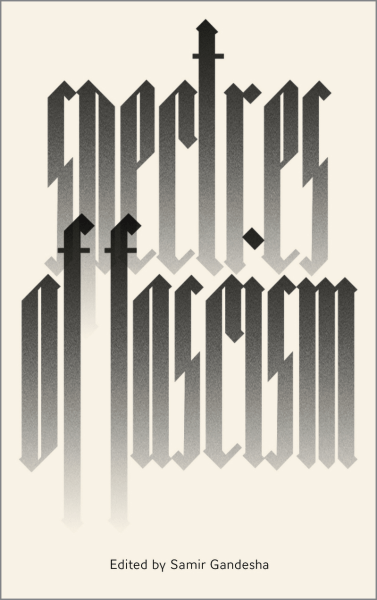
Spectres of Fascism, Historical, Theoretical and International Perspectives is a book edited Dr. Samir Gandesha, Director of the SFU’S Institute for the Humanities. It was published in 2020 but is drawn from a free school presented at the Institute in 2017. The following is taken from Professor Gandesha’s foreword:
The free school can be situated within programming that stretches back several years and specifically addresses the increasingly aauthoritarian cast of politics globally and in Canada in particular. In Canada such an authoritarian turn was closely linked to Stephen Harper’s project of transforming Canada into an “emerging energy superpower.” Broadly speaking, the Institute has focused its attention on the resulting criminalization of dissent in this respect, in particular through the use of strategic lawsuits to limit public participation (SLAPPs) and the Anti-Terrorism Act that was passed in 2015 and was designed specifically to target opposition, particularly from Indigenous communities, to pipeline projects…
Fascism is uncanny insofar as it is a phenomenon that seems to belong to a distant age in a previous century yet has been all too close at hand in the first two decades of the present one..
…The spectre of fascism returns, then, as a response to a particular financial and ecological crisis of capitalism. If twentieth-century fascism, in part, offered a solution to the economic slump via an acceleration of the extraction of absolute and relative surplus-value extraction by smashing independent trade unions and other working-class institutions, today fascism centres on a deepening of resource extraction on the very precipice of massive deskilling of labour, and widespread automation and employment of robotics, machine learning and artificial intelligence, to wit: the prospective obsolescence of humanity itself…
Categories: Fascism


 in-sights.ca
In a January video a federal officer, in uniform, kicks a Renee Good memorial?
Was the video faked?
https://www.msn.com/en-us/news/us/real-video-shows-dhs-officer-defacing-renee-good-memorial/ar-AA1UbOzK?ocid=BingNewsSerp&cvid=6967b121ff304fd4959f253943acf2c5&ei=4
Claim: A January 2026 video authentically showed a U.S. Immigration and Customs Enforcement officer kicking over a flameless memorial candle honoring Renee Good, the woman an ICE agent fatally shot in Minneapolis on Jan. 7, 2026.
Rating: Mostly True (About this rating?)
The video was from January 2026 and did show a law enforcement official twice kicking a flameless memorial candle honoring Renee Good. The incident occurred in Sacramento, California.
What’s False: The officer who kicked over the candle was a Federal Protective Service officer, not an Immigrations and Customs Enforcement agent. The FPS is the subsidiary of the Department of Homeland Security responsible for protecting federal government facilities.
In short, the clip was authentic — meaning it was not AI-generated or created using other video editing tools — and it showed a law enforcement official kicking over a candle at a memorial for Good in Sacramento, California, in early January 2026. However, the official was a Federal Protective Service officer, not an ICE agent. The FPS is the subsidiary of the Department of Homeland Security responsible for protecting federal government facilities. Therefore, this claim contained mostly true information.
=======================================================================
How well qualified are new ICE hires?
https://www.msn.com/en-us/news/us/ice-is-reportedly-hiring-people-who-can-t-read-write-or-pass-fitness-tests/ar-AA1UahqK?ocid=BingNewsSerp&cvid=6967b57c752647398596fe7592600c13&ei=65
A major hiring push at Immigration and Customs Enforcement is drawing sharp criticism after lawmakers revealed that some new recruits are struggling with basic reading, writing, and physical fitness requirements. As ICE races to expand its workforce, questions are growing about whether speed has started to outweigh standards.
During recent oversight discussions on Capitol Hill, senators raised concerns that lowered barriers and accelerated training timelines have allowed recruits into the pipeline who cannot meet fundamental expectations of the job. According to statements entered into the congressional record, some trainees reportedly could barely read or write well enough to pass open book exams designed to test basic understanding of immigration and constitutional law.
Those exams were not meant to be difficult. Recruits were allowed to use notes and reference materials, yet a significant number still failed. Lawmakers warned that if officers struggle to comprehend written legal guidance in a classroom setting, the risks multiply once they are operating in real communities where split second decisions can carry lasting consequences.
Physical fitness has also become a major point of concern. ICE requires recruits to complete modest benchmarks including push ups, sit ups, and a timed 1.5 mile run. Oversight statements revealed that a sizable portion of new trainees failed to meet those minimums. Some were described as severely out of shape despite certifying they were physically capable during the application process.
=======================================================================
But in History it’s not like a healthy state ever deliberately attacked the public…
https://www.britannica.com/topic/Red-Guards
While engaging in marches, meetings, and frenzied propagandizing, Red Guard units attacked and persecuted local party leaders as well as schoolteachers and school officials, other intellectuals, and persons of traditional views. Several hundred thousand people died in the course of these persecutions.
By early 1967 Red Guard units were overthrowing existing party authorities in towns, cities, and entire provinces. These units soon began fighting among themselves, however, as various factions vied for power amidst each one’s claims that it was the true representative of Maoist thought. The Red Guards’ increasing factionalism and their total disruption of industrial production and of Chinese urban life caused the government in 1967–68 to urge the Red Guards to retire into the countryside. The Chinese military was called in to restore order throughout the country, and from this point the Red Guard movement gradually subsided.
=======================================================================
https://www.britannica.com/topic/inquisition
inquisition, a judicial procedure and later an institution that was established by the papacy and, sometimes, by secular governments to combat heresy. Derived from the Latin verb inquiro (“inquire into”), the name was applied to commissions in the 13th century and subsequently to similar structures in early modern Europe. In 1184 Pope Lucius III required bishops to make a judicial inquiry, or inquisition, for heresy in their dioceses, a provision renewed by the fourth Lateran…
=======================================================================
https://www.britannica.com/video/Adolf-Hitler-power-Germany/-192588
NARRATOR: In truth, Hitler plans to govern alone, with only one party – his National Socialist German Workers’ Party. The Nazi leader proposes the Enabling Act to parliament. While preserving the semblance of legality, the act essentially transfers state power to Hitler. His critics are intimidated.
ADOLPH HITLER: “You are self-pitying, gentlemen, and not fit for the present age when you talk already of persecution.”
NARRATOR: On March 23, the majority of delegates vote for their own disempowerment. Farmers’ Day 1934, the unions are destroyed, and other organizations are recognized by the National Socialists. The young people are told lockstep instead of diversity, order instead of liberty. It is not the individual that counts, but the ethnic community, not individual will, but that of their leader.
DORIS SCHMID-GEWINNER: “It was like soldiers. We had to swear to give our lives for Hitler and fatherland although we were only 14.”
NARRATOR: Rituals are used to bring individuals to heel.
SALLY PEREL: “The conformity, the expropriation of the German youth, the destruction of the individual. All this he achieved.”
LikeLike
Very timely. I believe this quote from the Introduction accurately describes what we are witnessing in the U.S. today:
“I consider the survival of National Socialism within democracy to be potentially more menacing than the survival of fascist tendencies against democracy.” – Theodor W. Adorno in a key lecture in the post-war Bundesrepublik.
The impetus for this national socialism within the U.S. is very presciently described in Chapter 13, authored by Joan Braune over six years ago. The role and influence of Steve Bannon here should not be underestimated. Especially since he mentored and introduced Stephen Miller, current Trump Homeland Security Advisor and Deputy Chief of Staff for Policy during Trump’s first campaign and term. Bannon has described Miller as Trump’s prime minister and an evil robot. According to Joan Braune, Bannon has interest and praise for Jean Raspail’s The Camp of the Saints, a genocidal French novel. She says, “All told, the novel is one of the most blatant pieces of racist propaganda imaginable.”
Given the current ICE crackdown and recent comments from Miller about the iron laws of the world, I found this passage about the novel striking:
“At the beginning of the novel, a retired professor casually murders a young hippie before going back into his house for a glass of wine. In his private monologue before the murder, he fantasizes about being a medieval crusader, a Christian soldier at the Battle of Lepanto, a Confederate soldier, a KKK member, a French soldier killing members of the Algerian uprising, and a cop murdering a Black Panther in a police van. As the professor meditates on his murder of the hippie, he considers:
That scorn of a people for other races, the knowledge that one’s own is best, the triumphant joy at feeling oneself to be part of humanity’s finest – none of that had ever filled these youngsters’ addled brains, or at least so little that the monstrous cancer implanted in the Western conscience had quashed it in no time at all.
That ‘monstrous cancer’ is compassion for people not of one’s own race.”
The Trump regime has more than doubled the ICE force just since July and has requested additional funds to continue the buildup. Masked ICE forces will be on the streets killing, abusing, and disappearing citizens and non-citizens alike at the direction and approval of Trump and Miller for some time to come. Rather than tapering off, they are doubling down. And the retired professor from the novel above is their role model.
They aren’t waiting around for the catastrophes envisioned in the Fourth Turning (Is Here) or the Shock Doctrine to periodically occur. They are actively laying the groundwork to create them for exploitation everywhere we look.
My optimism that the midterms will stop them has dissipated. It will take much more than that to stop this runaway, and I’m no longer confident that the American people or their institutions are up to the job. Hope I’m wrong, but Bannon’s dream of total collapse looks likely to become our nightmare.
LikeLiked by 2 people
OK the ICE optics are really bad but it’s not like the Trump admin would lie about China wanting to invade Greenland a nd steal their resources. Resources China has in abundance..
Denmark and Greenland respond.
https://www.rawstory.com/greenland-trump-lying/
“It’s not a true narrative that we have Chinese warships all around the place,” Rasmussen told press after the meeting.
“According to our intelligence, we haven’t had Chinese warships in Greenland for a decade or so,” Rasmussen said, rejecting Trump’s assertion.
Trump has claimed that Russia or China would try to take hold of Greenland if the U.S. doesn’t act and that it’s a matter of national security.
“NATO should be leading the way for us to get it. IF WE DON’T, RUSSIA OR CHINA WILL, AND THAT IS NOT GOING TO HAPPEN!” Trump wrote on his Truth Social platform on Wednesday, just hours before the meeting.
https://www.thedailybeast.com/trump-accused-at-white-house-of-lying-about-greenland-threat/
Even better…
https://www.thedailybeast.com/stephen-millers-dark-message-to-ice-agents-immediately-backfires/
Why didn’t I get the Memo! When did the UK become an American Colony?
With friends like Musk
https://www.politico.eu/article/us-state-department-threaten-uk-probe-elon-musk-x-grok/
US State Department threatens UK over probe into Elon Musk’s X
Official Sarah B. Rogers said “nothing is off the table” if X is banned in the U.K.
LONDON — The U.S. Department of State’s Sarah B. Rogers says “nothing is off the table” if the U.K. government makes good on its threat to ban Elon Musk’s X over concerns about a deluge of AI-generated sexualized deepfakes on the platform.
Rogers, an appointee of President Donald Trump, has repeatedly criticized European efforts to crack down on hate speech. She was involved in last month’s State Department decision to sanction former European Commissioner Thierry Breton and four other European nationals involved in efforts to curb the spread of disinformation.
Speaking to reporters Tuesday, U.K. Prime Minister Keir Starmer’s spokesperson denied the case was about freedom of expression, insisting the U.K. had upheld freedom of speech “for many hundreds of years, and will do in future too.”
https://www.rawstory.com/elon-musk-x-2674892110/
‘We’re not going to back down’: UK hits back at Trump admin over Elon Musk probe
The UK government has hit back at a US administration official’s threat over a probe into Elon Musk and X.
Online safety watchdog OFCOM is investigating the social media app for the sharing of non-consensual sex images which are artificially generated through the Grok tool, Sky News reported. Concerns over the deepfakes spread on the platform have since been aired in the UK’s House of Commons, the elected house of representatives.
Prime Minister Sir Keir Starmer said, “I have been informed this morning that X is acting to ensure full compliance with UK law. If so, that is welcome, but we’re not going to back down, and they must act.”
OFCOM’s powers fall under the Online Safety Act, which states that online platforms have to make sure they’re not hosting illegal content.
If X is found to not comply with the Online Safety Act, Ofcom can issue a fine of up to 10% of its worldwide revenue or £18m, and if that is not enough, can go as far as getting a court approval to block the site.
LikeLike
Heckuvajob ICE!
Those joining ICE get a $50 thousand signing bonus?
https://factually.co/fact-checks/government/ice-agent-50k-signing-bonus-timeline-696961
“The Department of Homeland Security’s recruitment package for new Immigration and Customs Enforcement hires advertises “up to $50,000” in signing bonuses, and reporting from Fortune explicitly states that the $50,000 figure is structured as a payment split over three years
“Multiple official ICE and DHS materials publicize the maximum bonus but do not publish a universal, detailed disbursement schedule; available coverage and agency statements leave gaps about the exact timing of first and subsequent payments”
Not enough? Want more? Would immunity from prosecution also help?
Says who? Steven Miller
https://www.politifact.com/factchecks/2025/oct/29/stephen-miller/ICE-agent-immigration-raids-legal-immunity/
“To all ICE officers, you have federal immunity in the conduct of your duties,” Miller said. “And anybody who lays a hand on you or tries to stop you or tries to obstruct you is committing a felony.”
Miller said his answer applied to any local or state official “who conspires or engages in activity that unlawfully impedes federal law enforcement conducting their duties.”
Says who else? JD Vance.
https://www.commondreams.org/news/do-ice-agents-have-qualified-immunity
“That guy’s [Jonathan Ross] protected by absolute immunity,” said Vance. “He was doing his job. The idea that [Minnesota Gov.] Tim Walz and a bunch of radicals in Minneapolis are going to go after him and make this guy’s life miserable because he was doing the job that he was asked to do is preposterous.”
Did ICE try to hire the wrong ex-soldier? Laura Jedeed.
Ms Jedeed’s Slate Magazine article makes that point…
https://slate.com/news-and-politics/2026/01/ice-recruitment-minneapolis-shooting.html
“You’ve Heard About Who ICE Is Recruiting. The Truth Is Far Worse. I’m the Proof.”
“What happens when you do minimal screening before hiring agents, arming them, and sending them into the streets? We’re all finding out.”
“The plan, when I went to the Immigration and Customs Enforcement Career Expo in Texas last August, was to learn what it was like to apply to be an ICE agent. Who wouldn’t be curious? The event promised on-the-spot hiring for would-be deportation officers: Walk in unemployed, walk out with a sweet $50k signing bonus, a retirement account, and a license to brutalize the country’s most vulnerable residents without consequence—all while wrapped in the warm glow of patriotism.
“At first glance, my résumé has enough to tantalize a recruiter for America’s Gestapo-in-waiting: I enlisted in the Army straight out of high school and deployed to Afghanistan twice with the 82nd Airborne Division. After I got out, I spent a few years doing civilian analyst work. With a carefully arranged, skills-based résumé—one which omitted my current occupation—I figured I could maybe get through an initial interview.”
“The catch, however, is that there’s only one “Laura Jedeed” with an internet presence, and it takes about five seconds of Googling to figure out how I feel about ICE, the Trump administration, and the country’s general right-wing project. My social media pops up immediately, usually with a preview of my latest posts condemning Trump’s unconstitutional, authoritarian power grab. Scroll down and you’ll find articles with titles like “What I Saw in LA Wasn’t an Insurrection; It Was a Police Riot” and “Inside Mike Johnson’s Ties to a Far-Right Movement to Gut the Constitution.”
“Keep going for long enough and you might even find my dossier on AntifaWatch, a right-wing website that lists alleged members of the supposed domestic terror organization. I am, to put it mildly, a less-than-ideal recruit.”
LikeLike