
Our governments believe that resources belong to those who exploit them today and that future generations have no right to a share of the province’s asset values.
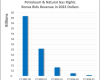
Norway’s oil and gas taxation is far different from Canada’s. The northern country ensures that its future citizens will benefit significantly from resource exploitation, while Canadian governments prefer the immediate privatization of resource values.
Award-winning Indigenous journalist Brandi Morin posted comments about Justice Michael Tammen’s findings in a court case that followed violent and racist actions by the RCMP. Police were serving as a security force for the oil and gas industry, which is just one more hidden subsidy governments provide for fossil fuels. An approaching climate crisis seems not to matter. Unfortunately, the findings of Justice Tammen are unlikely to change RCMP behaviour. The police force has a long history of ‘dirty tricks’ favouring oil and gas companies.
Marc Lee writes that we live in a petrostate. He examined Cedar LNG. That $5.5 billion project promises 100 permanent positions, which is $55 million for each job. The project also represents a capital expenditure of $3.25 million for each one of the 1,700 Haisla Nation members. The Haisla are borrowing all the funding for its half-share of the project…
On Facebook, Northeast BC resident RanD Hadland says he visited the Bennett Dam and gained an understanding of why the downstream Peace River is so low. Behind the dam is the Williston Reservoir. Despite ongoing drought conditions, British Columbia has allowed oil and gas companies to draw water for fracking from waterways in the northeast, including the Peace and Liard rivers.
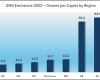
The concentration of greenhouse gases (GHGs) in the atmosphere is a critical environmental issue. One important cause involves the production and use of fossil fuels. Canada’s government just released the National Inventory Report (NIR) detailing GHG emissions for the years up to 2022. It provides useful information, but it is incomplete.
If I told my spouse that I had decided to buy a car for $30,000, then I returned home with one priced at $150,000, she would bar me from the house. The same should happen to every person from bureaucrat to politician who said taxpayers ought to build an oil pipeline.
A peer-reviewed, Stanford-led study involving more than 50 scientists was published this week by Nature. It reveals alarming information about uncontained emissions from oil gas systems. The authors integrated approximately one million aerial site measurements into regional emissions inventories for regions in the USA. They found greenhouse gas releases were about 3x government estimates…
In the 2024 Throne Speech, the government of David Eby claimed that “greenhouse gas emissions are down 5 per cent from six years ago.” The claim is simply untrue. It is made by ignoring vast sources of emissions.
Proponents of the Transmountain Pipeline Expansion (TMX) promise about 34 Aframax tankers will depart each month from the Westridge Marine Terminal on the Burnaby section of Burrard Inlet. After TMX comes on stream, the number of Aframax or Panamax oil tankers visiting Vancouver will rise from about 32 to an estimated 380 Panamax and Aframax tankers or just over one per day. But, can we trust anything Trans Mountain tells us?
Premier David Eby and Ministers of British Columbia spent much time in August 18 news conferences. They talked about dealing with wildfires and assisting the tens of thousands of people affected by the province’s hottest ever time for burning. Politicians spent little time talking about factors that contributed to the current State of Emergency…
In 1996, Norway began depositing oil revenue into a national wealth fund so that current and future generations would benefit from the nation’s oil wealth. Bolstered by oil taxes and by profitable investments in more than 9,000 companies outside Norway, the fund is today valued at C$1.84 trillion.
Part of the trillions of dollars in subsidies to fossil fuel producers reflects governments undercharging supply costs (rights and royalties), but most involve implicit subsidies, including undercharging for environmental costs. Eliminating gifts to fossil fuel producers would raise public revenues while reducing greenhouse gas emissions…
The government of British Columbia issues regular press releases portraying itself as active in fighting climate change. But if we ignore the press releases and examine the science, a more honest picture forms…
With it now costing more than $100 to fill the gas tank of a small car, it is worth remembering a report on fossil fuel subsidies issued in February 2022 by International Institute for Sustainable Development.
The BC NDP government taxes fossil fuels severely to discourage consumption by citizens. That is an appropriate policy choice but the same government turns around and offers huge public subsidies to producers with the aim of increasing production and leading politicians pretend that is free of environmental harm since the fuels will be burned in places other than British Columbia.
Alberta has long been a puppet of the oil and gas business but Kenney’s compulsion to deliver benefits to this private sector is unprecedented. It is as if Alberta’s right wing government looked at what Norway has been doing and decided to do the exact opposite. In the first 13 weeks of the 2019-20 fiscal year, Alberta’s Heritage Savings Trust Fund declined by $156 million to $18 billion. In the last eight weeks, Norway’s wealth fund increased by C$55 billion, a rise of 4% to C$1.46 trillion.
Oil has a massive incumbency advantage. The industry has invested heavily in politicians and corporate media, the fools and tools it needs to keep billions of dollar in subsidies flowing from the public to the private sector…
Norway made a choice to take a material share of oil and gas revenues and distribute the value of its non-renewable resources to citizens over multiple generations. Alberta, British Columbia and Saskatchewan chose to benefit whichever corporations happened to be involved when production of oil and gas took place…
Charles Adler believes we should speak clearly. However, he said nothing about speaking accurately, a quality not always compatible with political propaganda.
Blair Fix at _Economics from the Top Down_ also wrote two very good papers on the converion of housing into…