
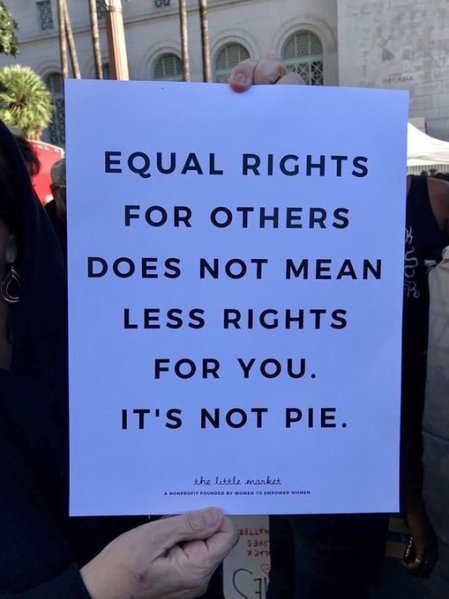


Finland fined wealthy businessperson Anders Wiklöf €121,000 (C$174,000) after he drove his vehicle 30 km/h over the speed limit. Penalties for traffic violations in Finland are based on the severity of an offence and the offender’s ability to pay. Wiklöf had been fined €63,680 in 2018, five years after being hit with a €95,000 ticket for the same offence.

Progressive punishment is not enough to regulate behaviour when an offender has extraordinary wealth. To a corporation like Teck Resources Ltd. — market capitalization $29 billion — inconsequential fines are minor costs of doing business.
A $1 million penalty imposed on Teck corresponds to a fine of $11 levied on a household holding Canada’s median net worth, reported at $329,900 by Statistics Canada in 2019.
Listings below demonstrate just part of Teck’s long history of engagements with regulators and affected citizens. The company is a serial offender but not a single manager or director has served time in prison, despite harms done by the company to people, wildlife and the general environment. Almost certainly, custodial sentences for managers would have changed Teck’s behaviour.
Of course, insignificant fines are not all that Teck pays to further its private interests. There are costs for lobbying politicians and sometimes for hiring an ex-Premier who finds himself suddenly under-employed and is not hindered by BC’s conflict of interest law, which that same Premier neglected to strengthen during five years leading the province’s government.
Observers may no longer wonder why Horgan’s government quietly lobbied senior federal officials to quash a potential Canada-U.S. inquiry into cross-border water pollution from Teck’s coal mines in southeast BC.
A Teck Cominco smelter in British Columbia has a history of problems with the toxic chemical thallium. Maintenance workers in Trail, BC have been undergoing tests to determine how serious their exposure to thallium was. Several have been made ill by their exposure, and they are concerned about their long-term health.
Water reports show thallium levels in the Columbia River have been up to 100 times the limit allowed.
Kivalina residents are suing Teck Cominco Alaska Inc., operator of the Red Dog lead and zinc mine near Kotzebue Alaska. The lawsuit seeks some $60 million in damages, or $27,500 for each of mine’s reported 2,171 violations of the Federal Clean Water Act.
It’s not often that the United States serves as a dumping ground for a foreign factory, but that is happening in the remote northeast corner of Washington.
The Environmental Protection Agency is trying to force a Canadian company to clean up decades of toxic smelter waste that have flowed down the Columbia River into Lake Roosevelt.
The EPA recently broke off talks with Teck Cominco Ltd., saying the Vancouver, British Columbia-based company was not serious about cleaning up the waste, and the federal agency is now pursuing legal action.
The United States Environmental Protection Agency issued an enforcement order against Teck Cominco that requires the company to take part in an EPA-supervised study of discharges from a Trail smelter into the Columbia River, which runs into the United States. Teck Cominco responded that the U.S. agency could not apply its regulations to a facility beyond U.S. borders.
Teck Cominco’s Trail smelter, at the center of a diplomatic dispute between the United States and Canada over Superfund cleanup, has dumped tons of highly toxic mercury into the Columbia River over decades, newly obtained documents reveal.
Teck Cominco Ltd., of Vancouver BC, is arguing [in the 9th U.S. Court of Appeals] it can’t be forced under U.S. Superfund law to clean up millions of tons of slag and toxic metals it released to the river for decades
A federal judge found that the Red Dog Mine violated the Clean Water Act more than 600 times. The lawsuit was filed by Kivalina residents who argued that mine operator Teck Cominco discharged illegal amounts of pollution into a river they use for drinking water and subsistence fishing.
A U.S. study has found an unusually high incidence of gastrointestinal disease in a small U.S. town located downstream from a Teck smelter in Trail. Northport, Wash., is a small community of 300 people, located 35 kilometres downstream from Teck’s Trail operations. Researchers at Harvard Medical School have now confirmed Northport residents have 10 to 15 times the normal rate of diseases such as colitis and Crohn’s disease, which have symptoms including abdominal pain and diarrhea.
In a decision announced late last week, Judge Lonny Suko ruled that, “for decades Teck’s leadership knew its slag and effluent flowed from Trail downstream and are now found in Lake Roosevelt, but nonetheless Teck continued discharging wastes into the Columbia River.” Suko noted that the company admitted treating the international waterway as a free waste disposal service.
A University of Montana study has linked coal mining in the Elk River in southeast British Columbia to high levels of selenium. The study compared water quality in the Elk River, where there are five coal mines, with the neighbouring Flathead River basin, which is largely protected from industrial development. It concluded the selenium levels in the Elk River downstream of coal mines were 10 times higher than naturally occurring levels, when compared with water upstream from the coal mines and with water in the Flathead. The study also found nitrogen levels were 1,000 times higher and sulphate levels were 40 to 50 times higher than natural levels.
Teck Resources is confirming that its smelter in Trail has spilled a chemical solution into the Columbia River that likely contained sodium hydroxide which the plant uses to de-mineralize feed water for the smelter’s boilers. Sodium hydroxide is in an industrial cleaning agent also known as lye or caustic soda and can cause severe skin burns and eye damage.”
For years regulators have been aware of damaging selenium discharges at Teck’s Elk Valley coal operations. While management plans are discussed and measures to deal with the pollution are examined, the company continues to propose and receive permits to greatly expand its operations.
According to a Vancouver Sun listing of Environment Canada’s annual national pollutant release inventory, when it comes to toxic metal releases to air, water and soil, the Trail operations of Teck Metals Ltd. topped the list at 6,365 kilograms, mostly lead, selenium and arsenic. The next four spots on the list were claimed by Teck coal operations in southeast BC.
Environment Canada has assessed fines of $3.4 million to Teck Metals for 13 separate incidents of polluting the Columbia River with water containing substances including copper, zinc, ammonia, chlorine and cadmium at Teck Trail Operations. These discharges happened between November 2013 and February 2015.
A report by the Auditor General of British Columbia stated, “For 20 years, MoE has been monitoring selenium levels in the Elk Valley and over that time has noted dramatic annual increases of selenium in the watershed’s tributaries. MoE tracked this worsening trend but took no substantive action to change it.“
Robyn Allan’s report detailed “decades of neglect in compliance and enforcement activities” within the BC Ministry of Mines and the Ministry of Environment. “The regulators are not protecting the environment from substantial harm or protecting taxpayers from bearing extensive financial cost to fix it. Allan suggested that taxpayers could be picking up billions of dollars of reclamation and water treatment costs in the Elk Valley in the future.
Teck, the largest coal miner in BC with five mines, produced 23 million tonnes of coal in 2008. Producing, transporting and burning this coal produced 51.9 million tonnes of heat-trapping pollution, equivalent to the annual emissions from almost 14 coal-fired power plants, making Teck by far BC’s largest atmospheric polluter.
Nespelem, WA – The Colville Tribes has filed a final brief in its latest 9th Circuit Court of Appeals battle with Teck Metals, a company which dumped toxic waste in the Upper Columbia River for decades. In the past several years, Teck has suffered a series of losses in federal court battles with the Tribes, attempting to avoid liability for polluting the Columbia from its Trail, BC smelter.
Teck Resources pled guilty Thursday to three violations of the federal Fisheries Act for polluting a tributary of the Elk River and was sentenced to pay a $1,425,000 penalty into the federal Environmental Damages Fund, which will help restore fish habitat in British Columbia’s Elk Valley.
Frustrated U.S. representatives on a commission tasked with protecting the quality of water flowing across the Canada/U.S. border have gone public with claims that Canadian commissioners are refusing to accept scientific data that shows an increase in selenium pollution from BC’s Elk Valley coal mines.
A Canadian coal-mining company faces the largest fine imposed under the Fisheries Act after pleading guilty to contaminating waterways in southeastern British Columbia. Teck Coal, a subsidiary of Teck Resources, is to pay $60 million.
Internal documents show the BC government and mining giant Teck Resources quietly lobbied senior federal officials to quash a potential Canada-U.S. inquiry into transboundary water pollution from Teck’s coal mines in southeast BC. A February 2022 document prepared for senior provincial officials states “BC remains opposed” to the possibility of an inquiry into the extensive contamination.
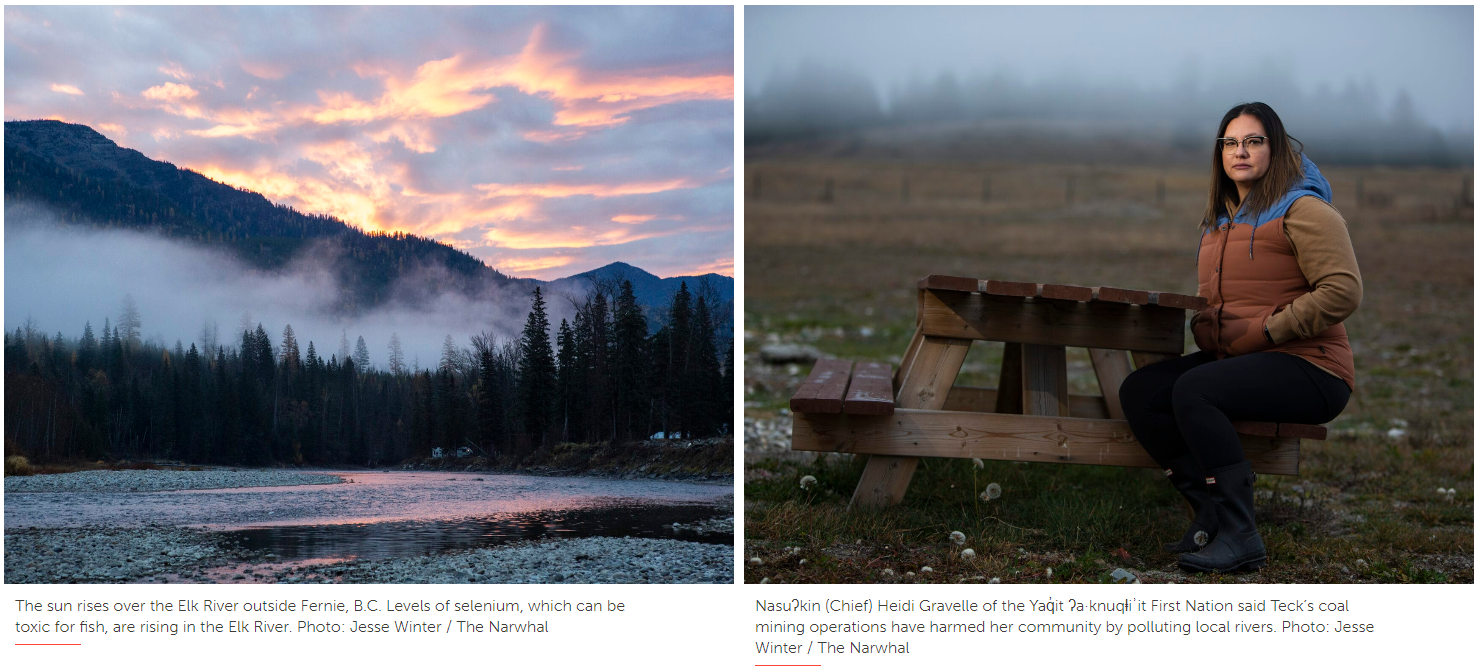
Environment and Climate Change Canada says Teck Metals Ltd., a subsidiary of Teck Resources Ltd., has been ordered to pay $2.2 million in federal and provincial fines for an effluent spill into the Columbia River.
A Canadian mining company has been fined more than $16 million for polluting waterways in BC’s East Kootenay.
Writer James Steidle asked in a Prince George Citizen column:
When our leaders and bureaucrats leave the public service to immediately take plum jobs with large multinational corporations they had influence over, it makes me wonder who they were working for while they were in office.
John Horgan wasted no time showing his true stripes

Categories: Environment, Ethics


Yes we should care and hold them accountable.
Mr nice guy has been a huge disappointment.
May he and his like, rot in the charred remains of our forests..
TB
LikeLike
Teck donated about $2,000,000 to the BC Liberals (who now are hiding in plain sight as BC United) during that party’s reign. And very, very little to the NDP. That pattern mysteriously changed in April 2017 when Teck donated $50,000 to the NDP, and nothing to the BC Liberals. Gee, I wonder what else happened during April of 2017? Can Teck read political polls?
At any rate, Teck didn’t get a chance to continue the largesse directed mainly to incumbents because the NDP banned donations of that sort soon after assuming office. Surely we will be forgiven for wondering if Teck was remembered fondly for the gesture though when the inevitable lobbying efforts transpired.
And for wondering whether future employment opportunities replaced political donations as pay-to-play currency.
LikeLike
regardless of party, most corporations get a pass on matters, when they violate regulations. Its just the way things work or as Mom used to say, there is one law for the rich and another for the rest of us. Must have heard that in the 1960s and not much has changed. New century, some old shit.
Fines based on wealth are always a good idea. Given all the fires in Canada this year, yes its climate change and regardless of what Smith’s musings are in Alberta, its climate change; the only way corporatiions are going to “change their ways” when it comes to polluting the enviornment, etc. is to either fine them in relation to their value or send the C.E.O. to jail for 12 months, not house arrest but jail. Some corporations’ disregard for the enviornment and the health of all living things needs to change. that only happens when it becomes easier to adhere to enviornmental rules than trying to work around them or just violate them.
LikeLike
I am not shocked that Horgan, the global warming denier, joined the board of a coal company, as it truly “demonstrates the NDP philosophy of do as I say and not as I do”.
Horgan had one big chance to prove that the NDP were different than the BC Liberals and he failed miserably. Not only did the NDP fail, they continue to fail with the Bob Skelly clone, David Eby now at the helm of a badly listing province.
Eby is more of the same and even the NDP wanted change but a fiddled leadership convention paved the way for Eby the Denier.
I do not know how many times one gets burned by the NDP to learn that they are just a “right-wing – Lite” politcal party, in bed with the major polluters in the province.
LikeLike
Although this is litany of data that adds to my disappointment with many things, it is goodbto hear of a country using the common sense scalability of fines.
That should be the case for any entity, and in the case of corporations the fine should be upon the corporation itself with similar levies upon those complicit with the offenses within the corporation, with no immunity of position.
That would likely result in relatively rapid reform of many corporate policies.
LikeLiked by 1 person
Some maybe disappointed by the NDP. However, having lived through the Socred years, B.C. Lieberal years, and B.C. United years, I’d have the NDP in office any day. They are not perfect by any stretch of the imagination but they are way ahead of the 3 name party.
Some may have concerns about Horgan, but would you have wanted another 4 years of Christy Clark or el gordo? el gordo came to office and fired 9K women who cleaned hospitals. Its about the largest mass firing of women in Canada. Did things get better? No, hospitals got dirtier and dirtier.
Eby may not be perfect but he is way ahead of Falcon and his flock.
LikeLike
wasn’t at the Eby “coronation” but was at Skelly’s election to party leader. recall Labour not being amused when “their” candidate lost think it was King). It was interesting to watch the movement of certain people as they went to various groups. As each candidate fell due to having the least number of votes in that round, their supporters moved on to another candidate. At the end Skelley had the most votes. Was a tad surprised, but as one person advised me, his campaign manager, Gerry Scott, hadn’t focused on just the first and second ballots but the third and fourth. That is how Skelley won. Gerry Scott was just better at his job than others. He was Harcourt’s caimpaign manager when he became mayor of Vancouver and when he became Premier.
As I recall there were any number of people who wanted Eby to be leader, but he would not run and Horgan was elected. Horgan did a decent job. He was oh so much better than anything the “triple named” other party. Would the Greens been better? They’re not going to be forming government any time soon.
The environemt is very important. However, most people are just trying to get through life, having a school which isn’t over crowded for their kids, having a family doctor, a roof they can afford over their head. The homeless, addicted, pollution are all important to many but they have to ensure their families come first and they are not all that interested in things which may or may not impact them.
LikeLike