


The recent post A bias for action mentioned the 2009 agreement by which wealthy nations jointly committed to mobilize “climate finance” to help poor nations adapt and build resilience to change. US$100 billion per year was promised by 2020.
As usual, politicians and officials are better at making than keeping promises.
Seven years ago, the Organisation for Economic Co-operation and Development stated significant progress had been made. OECD calculated that “climate finance” reached $52 billion in 2013 and $62 billion in 2014.
A 2015 Scientific American article raised doubts about those numbers and quoted Gambian negotiator Pa Ousman Jarju who argued that OECD relied on “very broad definitions” of climate finance. Jarju said only sixteen percent went into adaptation and adaptation actions. The journal stated:
Critics point out that the OECD’s figure included aid that was only tangentially related to climate change. More jarringly, the OECD included the full value of loans made to developing countries in its calculation—including loans that must be fully repaid along with full interest.
A report available from World Resources Institute warns the funding commitment is wholly inadequate:
The total amount of global climate finance needs to increase more than eightfold to reach a Paris-aligned target of $5.2 trillion per year by 2030. [Page 16]
But Oxfam estimates the value of climate finance provided was actually far less than reported:
Developed countries failed to meet the $100bn climate finance goal in 2020 – the deadline for the promise made 13 years ago. They claim that climate finance provided and mobilized reached $83.3bn in 2020 ($13.1bn of which was mobilized private finance). But Oxfam estimates the value of climate finance provided was only around a third of that reported ($21–24.5bn).
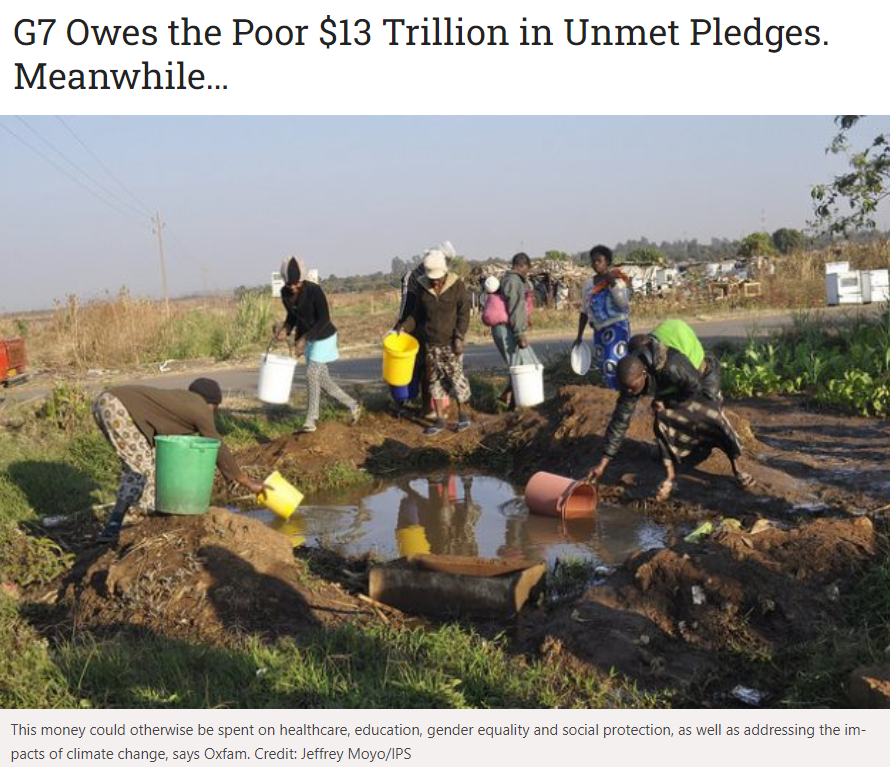
According to analysis by Oxfam published in 2023, wealthy Group of Seven (G7) countries owe low- and middle-income countries $13.3 trillion in unpaid aid and funding for climate action.
Despite failing to pay what they owe, G7 countries and their rich bankers are demanding that Global South countries pay $232 million a day in debt repayments through 2028. This money could otherwise be spent on healthcare, education, gender equality and social protection, as well as addressing the impacts of climate change.
“Wealthy G7 countries like to cast themselves as saviors but what they are is operating a deadly double standard —they play by one set of rules while their former colonies are forced to play by another. It’s do as I say, not as I do,” said Oxfam International interim Executive Director Amitabh Behar.
“It’s the rich world that owes the Global South. The aid they promised decades ago but never gave. The huge costs from climate damage caused by their reckless burning of fossil fuels. The immense wealth built on colonialism and slavery.”
State of Climate Action 2022: Boehm, S., L. Jeffery, K. Levin, J. Hecke, C. Schumer, C. Fyson, A. Majid, J. Jaeger, A. Nilsson, S. Naimoli, J. Thwaites, E. Cassidy, K. Lebling, M. Sims, R. Waite, R. Wilson, S. Castellanos, N. Singh, A. Lee, and A. Geiges. 2022. State of Climate Action 2022. Berlin and Cologne, Germany, San Francisco, CA, and Washington, DC: Bezos Earth Fund, Climate Action Tracker, Climate Analytics, ClimateWorks Foundation, NewClimate Institute, the United Nations Climate Change High-Level Champions, and World Resources Institute.
Categories: Climate Change


 in-sights.ca
I hate this pledge nonsense! It’s all show! Just like MOU ‘s politicians sign at photo ops. Yes…we will agree to and do the following IF the following criteria are met all at once…
And then a list of impossible criteria are presented…kind of like making a promise while crossing your fingers behind your back…
Political show ops…!!
LikeLike