



A reader said I should focus more on “good news” actions to moderate climate change. He pointed specifically to the growing availability of renewable natural gas.
RNG is a product that Fortis offers to BC consumers for a price higher than ordinary methane. According to Fortis, heating my home with RNG would result in a 76 percent increase in the cost of gas. Having seen my unit cost of natural gas soar by 74 percent in the past five years, I am unwilling to move to a “renewable” form of methane without good evidence.
Clearly, I could achieve more by turning down the thermostat, improving insulation, changing furnace filters more often, weatherstripping, and installing more energy efficient windows.
Further, if we in British Columbia use RNG, consumption of regular natural gas would not decrease. Produced fossil fuel would simply be exported and burned elsewhere, thereby increasing global carbon emissions because international shipping remains a huge contributor to greenhouse gases.
Third IMO GHG Study (2014) estimated that shipping contributed 3.1% of annual global CO2 emissions. The latest update to the study projects shipping emissions to increase by up to 120% by 2050, Under a business-as-usual scenario and if other sectors of the economy reduce emissions to keep the global temperature increase below 2 degrees Celsius, shipping could represent some 10% of global GHG emissions by 2050.
What is the impact of shipping on climate change?
Shipping also contributes to climate change through emissions of Black Carbon, tiny black particles, produced by combustion of marine fuel. The highest amounts of black carbon particles are produced by ships burning heavy fuel oil. Black carbon accounts for 21% of CO2-equivalent emissions from ships, making it the second most important driver of shipping’s climate impacts after carbon dioxide. Currently there are no regulations controlling black carbon emissions from shipping.
However, my friend’s comment about “renewable” gas prompted a further look into the fuel. Fortis says, “We partner with local farms, landfills and municipalities to create RNG from diverse sources.” Indeed the company’s sources may be diverse but RNG reality may be more complicated.
RNG is generally produced by capturing methane from landfills and other sites. Once processed, it is chemically identical to fracked gas. When RNG is burned, it releases carbon dioxide into the air, contributing to climate change. However, burning RNG is theoretically better for the climate than letting methane enter the atmosphere directly.
But what if RNG is nothing more than regular natural gas?
For example, Seattle garbage trucks are painted with the slogans “Breathe Clean, Seattle” and “Powered by renewable natural gas.” But according to environmental group GasLeaks, the vehicles are fueled from a supply that includes .3 percent biogas, “with the rest likely consisting of “conventional” methane, mostly from fracking in Canada.”
Caleb Heeringa, the project director of GasLeaks, said RNG could do more harm than good by prolonging the use of fossil fuels as opposed to electrification efforts.
Writing in National Observer, Marc Fawcett-Atkinson explained that Fortis is doing something similar to waste haulers in Seattle. He states that most of the gas that FortisBC Energy supplies to RNG customers “comes from fossil fuel deposits, not a landfill or biodigester.” The gas is branded as “renewable” because it is priced at a premium. FortisBC purchases the “renewable” designation from biomethane generated, sold and used as far afield as Ontario and the U.S.
This designation lets the company supplement the minimal amounts of B.C.-made biomethane running through its pipes with conventional natural gas that — on paper — is considered biomethane. It is a similar designation as carbon offset credits sold by airlines, which let customers offset their portion of a flight’s greenhouse gas emissions by investing in emissions reduction projects elsewhere.
“They’re buying not the (renewable natural gas) molecules themselves, but the environmental attributes of these molecules,” explained Eoin Finn, a researcher with the environmental group My Sea to Sky. “It’s fossil gas with a piece of paper attached saying: ‘Hey, I’m really renewable.'”
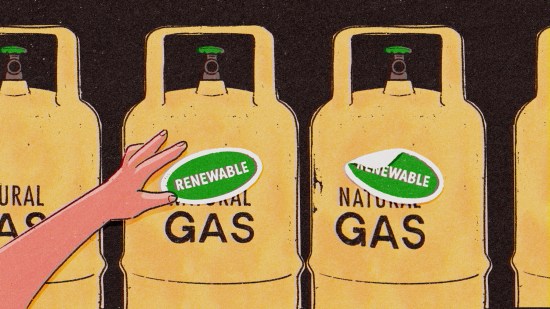
So why are we susceptible to corporate greenwashing?
Reporting on a survey conducted in seven European countries, The Guardian headlined, “Many Europeans want climate action – but less so if it changes their lifestyle.”
Many Europeans are alarmed by the climate crisis and would willingly take personal steps and back government policies to help combat it, a survey suggests – but the more a measure would change their lifestyle, the less they support it.
Turns out that people are like governments that are willing to moderate climate risks, but only if actions are not painful. Seems that cartoonist Walt Kelly was correct when he wrote for Earth Day 1970, “We have met the enemy and he is us.”

Categories: Climate Change


 in-sights.ca
OMG, well it was bound to happen. Renewable gas???? Yes, it is all renewable because we can get more, but that doesn’t mean its good for the climate or water or the earth or a lot of stuff which lives on earth. Gas is gas and none of it is great.
When I was a child, many homes were still being heated by wood and coal furances. Mostly coal though, unless you lived on Vancouver Island, then it was wood. Then people started to convert to oil and it was so much easier. Then along came B.C. Electric, what is now B.C. Hydro, and their gas division started to sell natural gas. They hired a lot of workers and laid mains and service piples and lots of people switched because it cost less and it was delivered by pipe. No need to have the oil man come to fill up the tank.
What is interesting here is, at the time G.E. manufactured a furnace which used so little oil, it was cheaper than gas, even with the employee discount. G.E. stopped making that furnace. Why, well it didn’t break down. My Mom’s lasted 25 years. From gas we went to electtric but then natural gas continued to be advertised and electrical rates went up. Housing built in the 1980s uusually had electrical heating, then homes were built with natural gas again.
When we were younger the siblings used to bet that gas would increase in price, once everyone had pretty much signed on to it.
This new house has gas. Next place: back to electrical–no furnace noise, no blowing air. If I were going to have a back up, it would be a free standing wood fireplace, from Norway
This constant changing of methods of heating is simply to make money and doesb’t benefit the consumers or the enviornment. The gas furnace which was installed in this new house, has a system which causes it to run to keep air circulating. When I had the furnace maintenance person switch that off, the electricity bill fell by 50%
If you want fresh air or to circulate air, open a window.
Its like we are being sold a “bill of goods” with this green washing. None of it is good. If you have solar panels and wind turbines on your property there is less pollution, but then when the panels and turbines break, they become another enviornmental problem
Now the big thing is electric cars. They aren’t environmental either. They use electricity and dams are not enviornmental. I’ve seen all the dams built in B.C. and what was going on at the time. Not in favour. The electric cars need to be built and that uses natural resources. If you look after your gas vehicle, it will go 20 years. If you drive a 4 cylinder or less its better. Walk a bit more and you have even less pollution. Oh, lets not forget those electric car batteries sometimes catch fire. that is very unenvironmental–the car burns, the garage burns and sometimes the house and people burn.
As a kid I knew a lot of this heating and gas stuff was a racket and in my old age I’ve not changed my mind. Government and business tends to try to have us focus on small stuff that works for them or makes them more money. The big stuff, like mountains of clothing which can’t be recycled in other parts of the world, well that gets pretty much ignored. Not too much talking from governments and corporations about open pit mining; how mines destroy the land and the water, same goes for oil.
The feds are reportedly contributing $500M of our tax dollars to help some corporation build a plant which will manufacture electric batteries. That isn’t an environmental step, but hey the company got a few freebies. I’m sure the people of Ontario would see more benefit to have additional funds so their doctors could preform expensive back surgeries or more decent care homes, etc. but no its going to a large corporations, who may pull out of here in 8 years or we find out there is a better way to move our vehicles around, without batteries.
Its all a muggs game.
HAPPY CANADA DAY!
Our country is still one of the best in the world with a whole lot more freedoms than the U.S.A.
LikeLike
100% Norm
A suggested deep dive for those interested..may I suggest “Fracked Up! The Cost of LNG to British Columbia”. Andrew K discusses BC’s fracking report with other subject areas of LNG covered by other authors.
To try and get on the the greener side of things is very difficult if you don’t have deep pockets and government assistance is far more interested in supporting the burning of fracked gas ‘over there’ than helping the citizenry burning less here. As you say it is green washing to call it natural gas. It is fracked gas. Reference to other sources mentioned by Fortis could never be brought up to scale to replace fracked gas for consumption.
Yes ..when the gas hot water tank goes then replace it with electric. Until then try and turn it down a tad and if going away for a bit by putting it on vacation perhaps. Similar to turning a light off when you leave a room.
I have a newer gas stove but can’t afford to replace it with all electric but I covered two of the left burners with a solid bread board and got a good one burner induction plate and have never looked back. I keep the stove because the oven is electric. You can get a double burner plate if it works also. Just put a magnetic to your cooking pots and pans and you may be good to go. I hardly ever turn on a gas burner anymore. Yes the stove still may leak some gas but I am not cooking on gas.
Unfortunately not everyone can afford geothermal so again try and keep the thermostat down and throw on a sweater. Maybe Fortis should try and green wash by selling sweaters with some kind of catchy slogan.
A real going from bad to worse is wood heat. Many people here heat with wood. One source was pellets. That BC industry has now been captured by a UK company and now all BC pellets are shipped to the UK to be burned for power generation and now people using pellet stoves in BC must source pellets from Washington.
W5 did a story on the BC pellet boon doggle and it was a travesty to what was going on in the BC forest. Never mind the burning. Transportation to receive pellets into BC and transportation to ship pellets overseas in containers..
Environment impact ? Go figure.
So allow foreign ownership to capture BC pellet industry that used to serve BC residents to heat their homes by necessity and allow foreign corporations to fish farm the west coast and foreign corporations to drive the LNG industry..here in BC .. we are nothing but a big shopping mall for corporations and they own it. These are some areas that we will not address because it knocks us out of our comfort zone and will impact our unsustainable lifestyle. Our culture lives in political cycles not generational.
Happy Canada Day??
Onwards and downwards.
LikeLiked by 1 person
RNG is a numbers game.
If no-one paid the extra for RNG, more methane would escape from landfills into the atmosphere. It is better to burn it to heat homes which would otherwise burn fossil gas, given the resulting CO2 is not as bad a greenhouse gas as the methane. It also marginally reduces the local demand for fossil gas. RNG customers (like myself) are not burning much (if any) of the RNG themselves, but someone in the Fortis network is, who would otherwise not be.
RNG does cost more per gigajoule than fossil gas, but you don’t pay the carbon tax, which is quite satisfying.
LikeLike