



A 2022 UN report1 contributed to by over 50 experts warned that the risk of wildfires is changing. Climate change and shifting demographics in high-risk areas are material factors.
A wildfire is the result of a complex interaction of biological, meteorological, physical, and social factors that influence its likelihood, behaviour, duration, extent, and outcome (i.e., severity or impact). Changes in many of these factors are increasing the risk of wildfire globally (e.g., climate change is increasing the frequency and severity of weather conducive to wildfire outbreaks, changed demographics in high-risk regions are increasing the potential impacts of wildfires).

Climate change has led to numerous environmental changes that can increase the frequency and magnitude of dangerous fire weather – increased drought, high air temperatures, low relative humidity, dry lightning, and strong winds, resulting in hotter, drier, and longer fire seasons. The increase in the frequency and magnitude of dangerous weather conditions is causing vegetation that would not usually burn (e.g., rainforests, permafrost, and peatland swamps) to dry out and combust.
Areas burned by wildfires in British Columbia have been steadily increasing, and with months remaining in fire season, this year’s destruction by fire is already more than double the average of the ten preceding years.
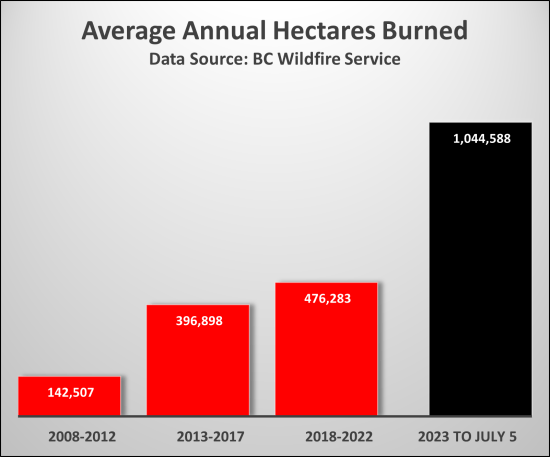
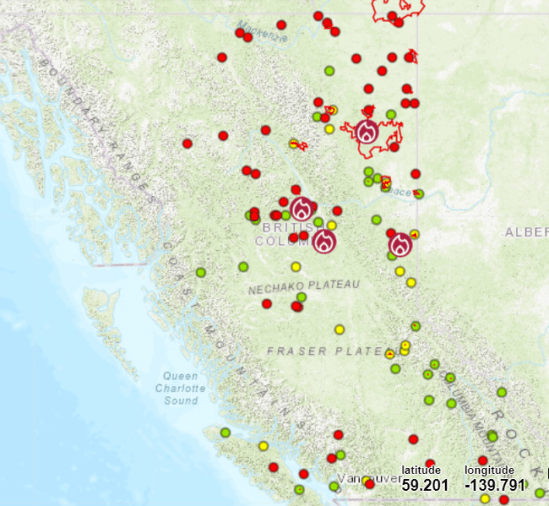
Perhaps not by chance, the region most affected by 2023 wildfire is the location where steadily increasing volumes of fossil fuel products are produced in British Columbia. This may be unfair to all the innocent residents of northeast BC, but Buddhism has an expression: Karma Vipaka (Actions & their Results).
Canada’s Minister of Environment and Climate Change Steven Guilbeault was signatory to a letter published by The Guardian. The science is clear. He and climate change ministers from Australia and New Zealand wrote:
The climate crisis is the biggest single threat we face as a global community.
Too bad Guilbeault’s Liberal government declines to act as if that is true.
1 Spreading Like Wildfire, the Rising Threat of Extraordinary Landscape Fires
Categories: Climate Change


I’ve always trusted you to provide accurate information, but your table comparing “landscape fires” to “wildfires” makes no sense. It looks like it was made up by an elementary school student with a keen sense of right and wrong, and no relevant knowledge.
LikeLike
The table is taken from page 8 of the U.N. report. Check pages 4 and 5 for a list of contributors and reviewers involved in preparing the paper and check the extensive list of references that begin on page 97.
LikeLike
The logging history could assist by not adding fuel to the fire through a better clean up of the logged forest floor areas adjacent to still standing areas. First nations used control burns to reduce the out of control burns we are now experiencing and will continue to experience.
Keep in mind that we are slowly converting the biodiversity of a forest into a one species tree farm. The no value trees are left in the slag heap for the UK company to take on the cheap for production of pellets for power generation in the UK. That is to say the easy to get to slag heaps that are cost effective.
The remaining slag heaps are just cans of gasoline waiting for a match.
Maybe first nations might have a few sobering suggestions.
Maybe just clearcut the whole damn province, Forest fires solved.
LikeLike
And, coincidentally???, pine beetle damage trees. Same area as forest fires.
https://natural-resources.canada.ca/sites/nrcan/files/cfs/assets/image/2887
LikeLike
https://www.cbc.ca/news/canada/saskatchewan/fire-land-connection-indigenous-communities-canada-1.6890768
From the Green Party: Liberal ministers Champagne (Industry) and Wilkinson (Natural Resources) having a friendly sit-down with senior executives and board members of Royal Dutch Shell, at their first “global board of directors meeting”.
Minister Champagne posted: “With a strong and historic presence in our country, Shell is our reliable partner. Together, we can and will pave the way for tomorrow’s green economy.”
Holy smokes.
This is, after all, Royal Dutch Shell. Shell has indeed been a “reliable partner” for years in the fossil industry’s campaign of disinformation, a continual maker of never-to-be-met promises about emissions reduction, a steady hand in delaying climate action, and a war profiteer that made $40 billion of profits last year.
It is astonishing that anyone, let alone a candidate to replace Prime Minister Trudeau when the Liberals finally realize that he is past his best-before date, could even mouth these words to himself, and then say them in public as if he actually believed them.
“Reliable partner”, indeed. Ministers Champagne and Wilkinson should certainly be meeting Shell, but in court, as reliable and consistent adversaries of the public good.
LikeLike