


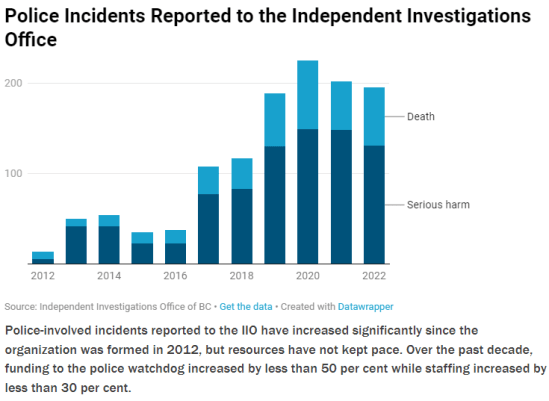
In 2022, 64 people died in incidents involving police in BC, an eightfold increase over a decade ago. Amanda Follett Hosgood reported that Sgt. Kris Clark, senior media relations officer with the RCMP, noted that, “of the cases investigated by the IIO, most concluded that there were no grounds for charges against the officers involved.”
A CBC News investigation that found criminal charges were laid against 18 police officers involved in fatal encounters since 2000, with only two ending in convictions. The research shows 461 people have died in encounters with police over 18 years.
Criminal consequences for police officers are rare when a civilian dies
Radley Balko, an American journalist who often writes about criminal justice and police issues, reports the issue is not unique to Canada. He explains that different approaches after a tragedy would almost certainly result in fewer deadly encounters in the future:
Even a bad shooting by a single police officer is usually the product of institutional failure. Was the officer trained properly? What was the officer’s personnel history? Should the officer have been fired for previous misconduct? Does the police department use an early warning system to flag potentially abusive or trigger-happy officers? If not, why not? If so, why wasn’t that officer flagged?
What if we treated wrongful convictions and bad police shootings the way we treat plane crashes?
Balko suggests sentinel event reviews — like those following aircraft and train crashes — would reduce police violence. The aim would be to identify systemic errors underlying harmful events and to make policy recommendations to reduce recurrence.
Today’s methods of review are inadequate. Mostly these involve police or ex-police investigating police, then making recommendations that may or may not be followed by lawyers representing government. The same government that might be financially burdened when law enforcement officers are found liable.
Balko reckons that policing is a psychologically isolated profession that is “incredibly suspicious of critiques from outsiders.” That leads to police wearing thin blue line symbols and unions that promote US vs. THEM attitudes, which contribute to mistreatment of citizens, particularly marginalized people living on the streets.
Civil rights advocates have long called for serious police reform, but it has been strongly resisted by law enforcement and politicians. Centrist members, like those on the right-wing, want to be seen as pro-police and anti-crime. As a result, police decide what they will or will not do. Unnecessary deaths result.
One example is when Public Safety Minister Marco Mendocino told the RCMP commissioner to prohibit “the use of neck restraints in any circumstance and the use of tear gas or rubber bullets for crowd control.”
RCMP refused the minister’s direction.
Today the New York Times published an opinion piece by Radley Balko. He draws attention to important issues:
In a staggering report last month, the Department of Justice documented pervasive abuse, illegal use of force, racial bias and systemic dysfunction in the Minneapolis Police Department. City police officers engaged in brutality or made racist comments, even as a department investigator rode along in a patrol car. Complaints about police abuse were often slow-walked or dismissed without investigation. And after George Floyd’s death, instead of ending the policy of racial profiling, the police just buried the evidence.
The Minneapolis report was shocking, but it wasn’t surprising. It doesn’t read much differently from recent Justice Department reports about the police departments in Chicago, Baltimore, Cleveland, Albuquerque, New Orleans, Ferguson, Mo., or any of three recent reports from various sources about Minneapolis, from 2003, 2015 and 2016.
. . . It’s no coincidence that the cities we most associate with violence also have long and documented histories of police abuse. When people don’t trust law enforcement, they stop cooperating and resolve disputes in other ways. Instead of fighting to retain police officers who feel threatened by accountability and perpetuate that distrust, cities might consider just letting them leave.
Half the Police Force Quit. Crime Dropped
Will anything change? Not likely. The federal government has shelves full of studies calling for reforms of the RCMP. In recent times, BC courts have complained about police violating civil rights. Coroner’s juries are routinely ignored and law enforcement officers involved in homicides and assaults are allowed to undermine investigations.Even BC Premier David Eby, who sought police reform and accountability when he worked for Pivot Legal and BC Civil Liberties Association is unable or unwilling to affect change. If a centrist politician cannot achieve reform, it cannot be done.
Categories: Justice


 in-sights.ca
Police unions are also a huge factor in this. In fact they are often more belligerent with circle the wagons mentality than the police depts themselves. Understandable to an extent as it’s their job to represent their members. But police officers aren’t just mere employees. As from the military they are the only ones permitted to use deadly force if necesessary. That alone means that when there’s a police involved shooting or a fatality or life altering injury then what’s needed is a process similar to when there’s a plane crash or a workplace fatality. Cops should not be investigating cops and keep the lawyers and the politicians out of it!
LikeLiked by 1 person
Members of the public service (which includes law enforcement) have a constitutionally protected right to a union. If it is good enough for teachers, then it should be good enough for other public servants. You can’t compare policing in the US to Canada. America is an extremely violent country with literally hundreds of millions of firearms. You neglected to include the number of police officers here in Canada killed in the line of duty recently.
https://www.cbc.ca/player/play/2205307971768
LikeLike
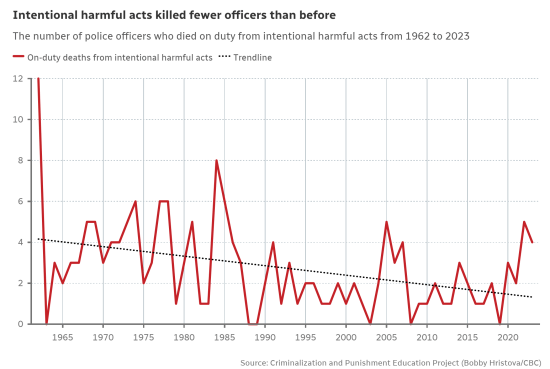
When a police officer is killed in the line of duty it is not uncommon to see hundreds (in some cases thousands) of fellow officers from various jurisdictions attending for a televised public ceremony and funeral procession. The death dominates the news headlines for extended periods. It is easy to get the impression this is a common occurrence. Thankfully it is not, and while even one fatality is too many, fatality rates are actually trending downwards.
https://www.cbc.ca/news/canada/hamilton/police-officer-deaths-trend-research-1.6834737#:~:text=It%20shows%20408%20police%20officers,and%20seven%20deaths%20per%20year.
It is just as dangerous to work in the logging, manufacturing or construction industry. But we see no televised ceremony for any of the more than 1,000 construction workers who die on the job in Canada every year. In fact unless they occur in multiples, we don’t even hear about most of them.
Meanwhile, people are dying at the hands of police in record numbers, and the trend is in the wrong direction.
https://ccla.org/press-release/press-release-police-involved-deaths-on-the-rise-across-canada/
I’m not sure focusing on how many charges are recommended against the officers involved in these fatalities is the best way to measure whether a proper investigation was conducted. Surely much more than criminal behaviour by the front-line personnel contributed to the deaths in most cases. The sentinel event review model seems promising. Achieving buy-in from the police in general and their unions in particular will prove daunting I suspect. We should look for best practice in other jurisdictions.
In that regard I was struck by the comprehensive nature of the following report, as well as the comparatively small number of direct killings in a jurisdiction 1.7 times our population.
https://www.policeconduct.gov.uk/deaths-during-or-following-police-contact-statistics-england-and-wales-2020-21
LikeLiked by 1 person