



A Bloomberg headline too consequential to ignore: European Power Prices Plunge Below Zero as Solar Output Booms.
Power prices in Europe dropped below zero to record-low levels during the weekend as a surge in solar generation pushed supply above demand.
With an increase in the number of solar panels across the region, power grids from Britain to France and Denmark are being overwhelmed by cheap supplies. . .
Had British Columbia committed to wind and solar power eight years ago, it could be experiencing the same low cost energy. Instead, due to the influence of people expecting to grow rich on Site C, BC Hydro has been involved in a decades-long megaproject that will eventually produce electricity at costs 3x to 5x that of less harmful renewable sources.
The main argument used was that wind and solar power was not dispatchable and therefore of little value. Even Site C megaproject proponents knew the contention was false. Indeed, renewable generation needs grid-scale energy storage. But BC’s existing hydropower reservoirs are like gigantic batteries capable of making electricity available whenever wind and solar energy production has a temporary lag.
Until 2020, BC Hydro encouraged customers to install behind-the-meter electricity generation. Solar power was the preferred choice of end-users. But the utility had experienced fifteen years of flat demand and was committed to the 15 to 20 billion dollar Site C dam. More importantly, BC Hydro knew the cost of solar and wind power was on a long downward trend.
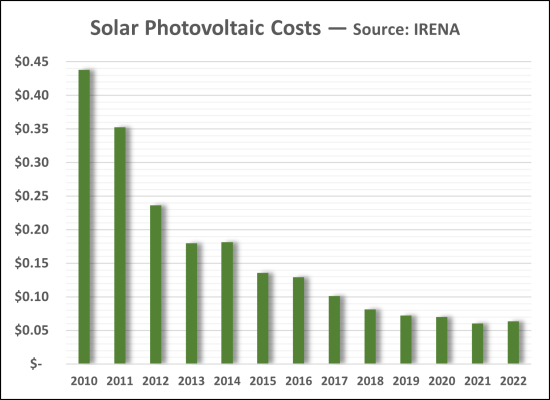

Solar power from less than grid-scale installations could meet this province’s growth in demand for electricity in the coming years. And this could be done without BC Hydro borrowing billions of dollars. Seems a no-brainer? No, these do not have factors that make megaprojects attractive to politicians and empire-building utility managers. As a result, alternatives are actively discouraged.
A net metering program encourages utility customers to install renewable generation to meet all or part of their own electrical load and provides homeowners and businesses with credits for surplus electricity moved to the grid.
In 2020, BC Hydro made changes to deter customers from generating electricity in material quantities. Until then, BC Hydro credited customers for electricity added to the grid at a price roughly equivalent to the average paid independent power producers (IPPs), which was then about 10¢ per kilowatt-hour. BC Hydro cut the price available to customers producing surplus energy to less than 4¢ per kilowatt-hour.
But unstoppable technology will shift future energy markets in material ways. Large power users are increasingly making their own energy.
NEXT converts unwanted infrared and ultraviolet light, enabling buildings to power themselves. PLATIO created an energy-generating paver with a in-built solar panel. HYDROGEN ONE offers a 100% renewable hydrogen plant that it says would allow large energy users to profit while reducing environmental degradation. This week, TOYOTA announced it has simplified production methods, enhanced useability, and lowered costs of solid state batteries. These will first be applied in vehicles but improved batteries will encourage self-generation of energy.
The pipeline is full of energy producing concepts and utilities stuck in the 1960s will either die or be forced to use legislation to prevent customers from adopting their own less expensive solutions.
Categories: BC Hydro


 in-sights.ca
Why does BC only consider wind and solar as ways to create electricity? With several hot springs couldn’t deep geothermal be a way to utilize heat close to the surface without expensive drilling, and provide electricity to nearby towns, reducing need for long transmission lines, and not dependent on sun or wind to be reliable? Similarly, why not import successful wave and tide power from other countries to be used along the coast? Since power dissipates the further from source of creation to use, encouraging more roof-top solar on appropriate buildings to power the buildings releases demand from existing dams and IPPs.
LikeLike
Check out Eavor Technologies (https://www.eavor.com/). They have made incredible advances in advanced geothermal technology.
LikeLike
Norm, thanks for all your insights into BC Hydro.
If ICBC was a dumpster fire, per David Eby, then BC Hydro is like an open-core reactor fire, which has been left to carry on burning every bill payer in BC.
As Norm has shown in the past, electricity demand in BC has been flat for many years, falsifying the business case for Site C.
And yet, customers are disincentivized by BC Hydro’s step 2 rate from transitioning to electrically powered home heating and electric vehicles. That is mad, and so is the lack of use of solar and wind power in BC.
LikeLike
It would be interesting to see how much electricity could be generated by a solar farm equal in size to the coming Site C reservoir… and then to see a cost comparison.
LikeLike
That is an exercise our previous Premier could have and should have ordered up, among other avenues of inquiry that might have led to putting British Columbia in the forefront of jurisdictions developing, manufacturing, and using renewable technology.
But that visionary’s vision appears to have been obscured by coal dust.
LikeLike