



On Twitter, Eudaimonia drew attention to a legal action involving the Province of British Columbia, BC Hydro and Conifex Timber Inc, a company that wants huge amounts of electricity for cryptocurrency mining.
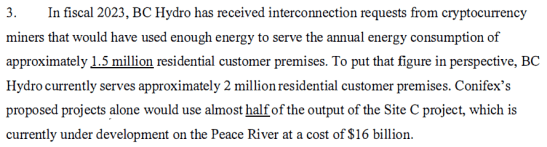
The situation here is unclear because the Conifex petition to the BC Supreme Court states that two planned projects — the “Salmon Valley Site” and the “Ashton Creek Site” — each require “150 megawatts of power.” A megawatt measures the capacity of an electric system, while a megawatt-hour is a measure how much electricity is delivered through that system in an hour.
Since BC Hydro says Conifex’s proposed projects alone would use almost half of the output of the Site C project, that suggests the cryptocurrency projects need 300 MW of capacity. No doubt Conifex wants to pay for that electricity at the low price offered industries such as LNG processors. That price is a fraction of BC Hydro’s marginal cost for new power.
Eudaimonia sees this court case as a serious warning. If 300 MW is half of Site C’s capacity, he assumes BC Hydro is admitting the new dam may have capacity of 600 MW, not the 1,100 MW advertised.
In December 2022, the BC Government ordered an 18 month pause on provision of new electricity service to cryptocurrency mining projects. Conifex is challenging that pause in court. It may have a case since the government order, no matter how reasonable, discriminates against a specific business type. Eudaimonia says, “There’s no legal avenue for bc hydro to pick and choose who uses the power.”
In my opinion, electricity sold below marginal cost of new power is a hidden subsidy that should only be allowed if the customer facility meets targets for creating and maintaining permanent employment. A computer centre for cryptocurrency mining employs very few people and would automatically be excluded. However, LNG processors would also be excluded by a rule that tied pricing to jobs created and maintained.
Perhaps Conifex is expecting to profit in the same way early private power producers did. The trick was to use influence to establish a very valuable contract with BC Hydro and soon after, flip the deal for huge profits with little or no investment.
Conifex, a public company that reported an accumulated deficit of $154 million in its 2023 Q1 report, is trying to supplement its timber operations with cryptocurrency mining.
The company is already an IPP selling electricity to BC’s public utility. This is generated by burning wood, but, by calling the fuel biomass, the output is said to be “clean” energy. Two of the company’s five directors have served as senior officials of BC Hydro. The lucrative private power industry in BC gains about $1.3 billion a year from BC Hydro and many individuals involved have had very useful connections to decision makers.

Michael Costello previously served as President and CEO of BC Transmission Corporation, President and CEO of BC Hydro and Power Authority, as well as acting as both Deputy Minister of Finance and Secretary to the Treasury Board for the Government of British Columbia.

Janine North currently serves as a director for Imperial Metals Corporation, Mercer International Inc., Fraser Basin Council and British Columbia Ferry Services Inc. She is a former director of British Columbia Hydro and Power Authority.

Categories: Energy


 in-sights.ca
So no more annual reports and now only service plans from Hydro?
BC debt 2026 134 b?
Click to access bc-debt-summary.pdf
https://www.bchydro.com/toolbar/about/accountability_reports/financial_reports/annual_reports.html
LikeLike
Always thought WAC took over B.C. Electric so citizens and business would have a reasonable rate and could “grow” the economy. Providing all that power for one customer is crazy. Our tax dollars are paying for that dam. I am in no way good with us subsidizing a crypo currency “producer”. As mentioned they don’t really bring anything to the table or economy.
The government ought to simply tell the crypto currency people to take a hike. Those who worked for B.C. Hydro, too bad there isn’t a rule which precludes them from taking those types of jobs.
As you mentioned there is nothing to prevent them from flipping any contract they obtain and making out like bandits. B.C. Hydro can sell to whomever wants the electricity directly from them, not some company which may simply be trying to con taxpayers out of money so they can enrich themselves. Wonder if that bunch would be interested in any of this if the deal stipulated they were not permitted to transfer their electricity to other companies, or sell, etc.
The provincial government is not “discriminating” against them. The government is simply ensuring the financial well being of the province and hence all of us taxpayers.
As we used to say, just tell them to go blow it up their a….
LikeLike
Transmission rates in BC are not subsidized, residential rates are subsidized because they don’t fully cover the cost of distribution, substations and Transmission required to connect customers.
We need to stop thinking about the energy as the most valuable electrical asset, because the wires are much more costly and valuable.
Cloud computing centres, whether they produce web moderation on blogs like this or crunch numbers for blockchains, service a large percentage of our economy now and larger in the future. The amount of jobs that can be related to the computation industry are only limited by imagination and government bureaucracy.
LikeLike
I have asked the Provincial Auditor General the question why the switch to “Service Plan” from “Annual Report” , as BC Legislation required for all Crown Corps.. No answer yet , probably because I suggested no one would sign an Annual Report for legal accountability reasons, which is expected/required of all publicly listed private corps..
If accountability for politicians is only at voting day , that makes spending the public’s money very easy as there is no financial risk to the minister and executives.
Also there is NERC in this mix, but not disclosed.
LikeLike