



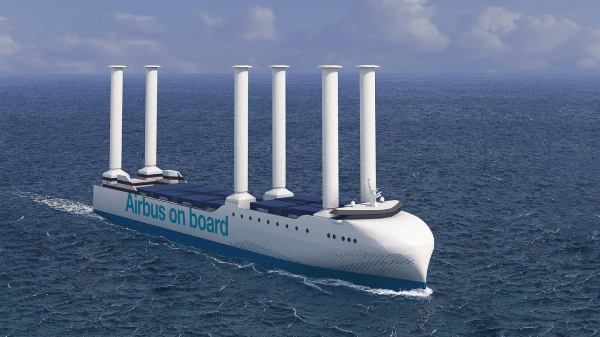
In Canada, more than $100 billion is now being spent to expand fossil fuel production. Meanwhile, other nations are working to mitigate climate change and enable long-term human survival. For example, Airbus ordered new vessels to transport aircraft subassemblies across the Atlantic. The low-emission ships are powered by dual-fuel engines that can run on e-methanol produced from renewable sources. More importantly, propulsion is assisted by six Flettner rotors sails.
Rotor Sails have demonstrated increased vessel efficiency, reducing fuel consumption, bunker costs and harmful emissions. Compared to other wind propulsion technologies, Rotor Sails offer a much greater thrust force to propel the ship per square metre of sail area. This means they can be made more cost effectively and with less impact on vessel operation than traditional sails or wings.
Rotor Sail Technology
Airbus promises future aircraft powered by hydrogen, but is troubled by the lack of truly green production of the fuel. Fossil fuel companies would rather produce grey and brown hydrogen from methane gas and coal.
To further its goals, Airbus has invested in Hy24, an investment fund that will provide capital to large-scale green hydrogen infrastructure projects. The fund is partnered with FiveT Hydrogen and expects to mobilize up to C$30 billion for clean, low and zero carbon fuels.
Airbus is also supporting development of sustainable aviation fuel (SAF). They partnered with DG Fuels to develop renewable hydrogen and biogenic based, synthetic low emissions aviation and diesel fuel.
China remains a large user of fossil fuels but is actively pursuing renewable energy. The country’s utility-scale solar capacity has already reached 228GW, more than that of the rest of the world combined. China is also a leader in developing wind power.
As Europe had been the world’s top wind power producer until 2020, China’s widening lead over the rest of the world in such a tight time frame further cements China’s status as the global green energy leader, and underscores Beijing’s commitment to overhauling its massive energy system at a record pace.
Reuters China widens renewable energy supply lead with wind power push
The top renewable energy producing countries are:
- 1. Iceland – 86.87%
- 2. Norway – 71.56%
- 3. Sweden – 50.92%
- 4. Brazil – 46.22%
- 5. New Zealand – 40.22%
- 6. Denmark – 39.25%
- 7. Austria – 37.48%
- 8. Switzerland – 36.72%
- 9. Finland – 34.61%
- 10. Colombia – 33.02%
As previously discussed at In-Sights, the government’s energy poobahs told citizens that British Columbia could not integrate inexpensive wind and solar power with existing systems. BC Hydro even created obstacles to use of its net metering program. “Independent regulator” BCUC approved the action.
UBC’s Jixiang Wang and Professor M. V. Ramana say Canada is lagging behind other similar countries in deploying wind and especially solar power generation.
There is now near-universal agreement – thanks to declining costs and fast deployment – about the importance of switching to renewable energy to mitigate the negative impact of climate change
Canada needs to accelerate its transition to renewable energy
Sadly, our governments make decisions based on politics, not on science. They play a very dangerous game when they choose short term gain over long-term pain.
Categories: Climate Change


 in-sights.ca
I don’t think we have much to worry about Norm. The clock will do
us in. The link provided on just e-methanol as a possible fit in Bc
as say LNG makes it almost a non starter. The much talked up carbon
capture is just pie in the sky based on the capture quantity required
for EM. Just how much of the contents in these over seas ships ends
up in the landfill. Think of all the junk currently in stores promoting
Halloween or the next calendar event we are habituated to buying
into?
How much taxpayer subsidies all over the world are going into companies chasing these alternate power unicorns? Yes some may help in reducing our fossil fuel addiction but surely implementation to scale to offset our dependency is running up against the clock.
We are at about 8B people heading for 10B and the major consumption
and problems generated from that consumption and energy demands
on a per capita basis is firmly rooted here in NA.
Wouldn’t a quicker scalable and responsible approach to address our
unsustainable lifestyle enabled by our energy demands be a starter here? Would that not cause some reduction in the cargo ships loaded with eventually destined landfill junk be reduced?
I know….when pigs fly. I am afraid the train has left the station and our
species is not on it. It appears we are playing wack-a-mole.
https://wallenius-sol.com/en/enabler-magazine/e-methanol-future-fuel
LikeLike