



Methods of creating or capturing energy near demand points are gaining prominence and threatening the disruption of today’s giant utilities.
A paper from Germany’s Karlsruhe Institute of Technology suggests millions of buildings can be energy self-sufficient with solar power, retrofitting, energy storage systems, and heat pumps. Many single family homes could abandon the electrical grid unless owners stay connected to sell excess power to utilities.
Rising energy procurement costs and declining capital costs for renewable technologies are provoking interest in self-sufficiency for individual buildings. In this study, we evaluate the potential of self-sufficient energy supply for 41 million freestanding single-family buildings under current and future (2050) conditions… Under current techno-economic conditions, 53% of the 41 million buildings are technically able to supply themselves independently from external infrastructures by only using local rooftop solar irradiation, and this proportion could increase to 75% by 2050.
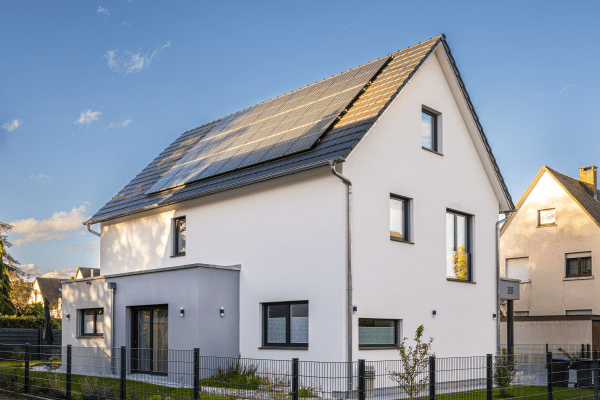
In the last decade, solar panel efficiency increased from mid-teen percentages to above 20 percent. Recent work by the U.S. Department of Energy’s National Renewable Energy Laboratory (NREL) developed a complex solar cell with a 47 percent conversion efficiency rate that promises to exceed 50 percent.
What the world needs are solar cells with high efficiency and simplicity. Effective, low-cost units are in the pipeline. Perovskite, a calcium titanium oxide mineral, can harvest energy from a greater range of the light spectrum. Asian scientists claim Perovskite enables mass production of ultra-efficient, low-cost solar panels.
Calculations by Berlin-based Mercator Research Institute on Global Commons and Climate Change (MCC) found that the plummeting price of electricity produced by solar panels – down 87 per cent since 2013 – means the transition to renewable energy sources is “cheaper than expected”.
The falling costs of batteries and other renewable technologies could also help supercharge the trend towards cleaner energy and meeting climate targets.
Solar panel prices plummet
Europeans are pursuing other options for energy. Wind energy provided 16% of the European Union’s electricity in 2022, and the EU plans to increase wind capacity by 150% by 2030.
The EU hosts more than a quarter of the global pumped hydropower storage capacity and PHS could double according to the Institute for Energy and Transport.
German company UHRIG and others are working on unique energy recovery systems:
Heat from wastewater lies dormant, like a treasure beneath our feet.
The wastewater that we let flow through our sewers day in, day out, contains enormous energy potential. After all, wastewater is available all the time and in large quantities, and wastewater is warm. That means: It still has thermal energy that is far too often lost or unused.
Yale Climate Connections says while not impossible, the odds of keeping global warming to 1.5°C are dwindling fast. Famed climate scientist Dr. James Hansen says the objective is “deader than a doornail.” While short-term weather variations are routine, upward temperature changes over a longer term are concerning.
NASA recently reported that the monthly global temperature in September 2023 was 1.7°C above the 1880-1899 period, which it uses as a benchmark for preindustrial climate. This is the first time a monthly temperature in the NASA database has exceeded the 1.5°C benchmark.
It’s now virtually certain that 2023 will be the warmest year in more than a century of global recordkeeping. In a November 2023 report, the nonprofit Climate Central estimated that the global average from November 2022 through October 2023 was 1.32°C above the period 1850-1900, making it the highest anomaly for any 12 months on record.
Can we still avoid 1.5 degrees C of global warming
However, measures to avoid the catastrophic effects of climate change have been repeatedly derailed or made insufficient by fossil fuel promoters and politicians who are corrupt, indifferent, or uninformed.
If you find value in posts and dialogue at IN-SIGHTS.CA, please consider financial support. It is a simple process explained HERE.
Categories: Energy


 in-sights.ca