


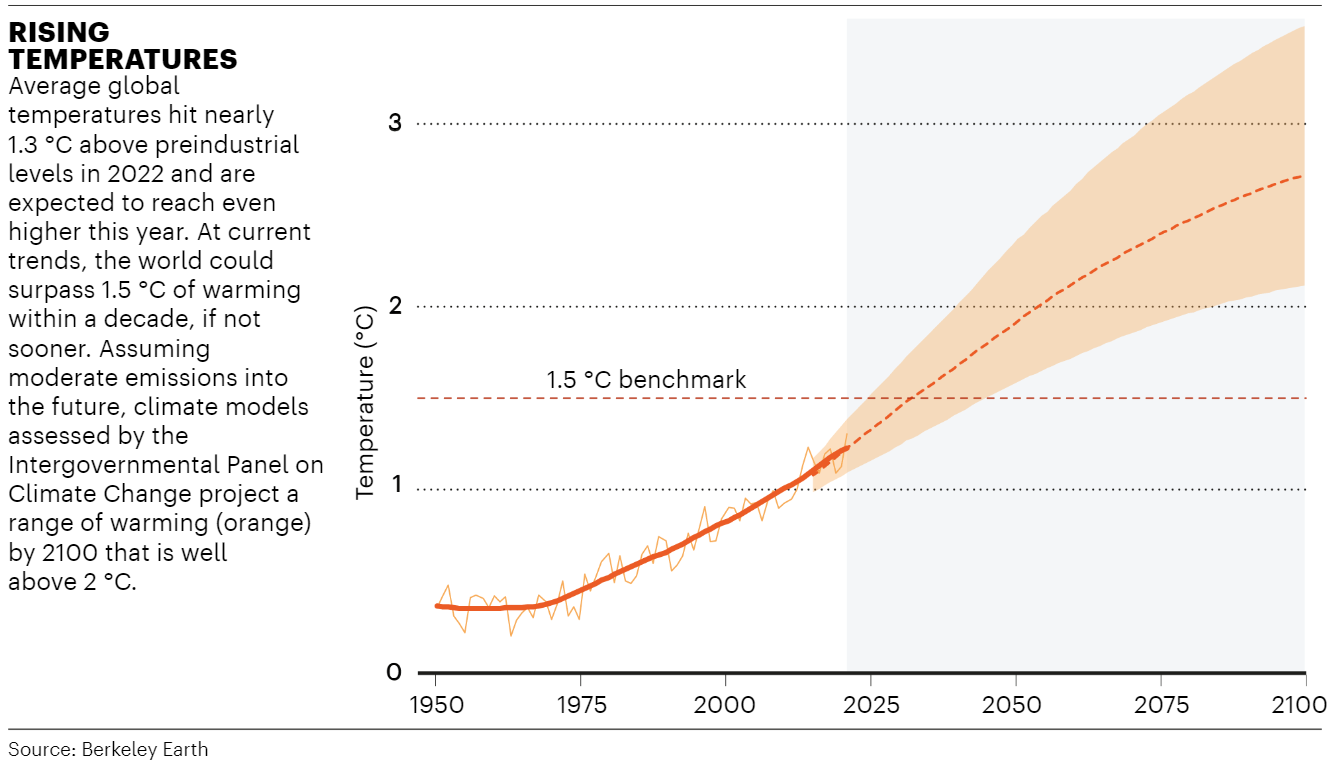
Progress in dealing with climate change is too slow to meet stated goals. The world is on course to see global temperatures rise as much as 2.9°C above preindustrial levels if current climate action commitments remain unchanged.
- Average global temperatures briefly surpassed 2°C above preindustrial levels on November 17, 2023.
- Greenhouse gas concentrations hit record high. Again.
- Forests are being removed at near-record rates.
- Global coal production is at an all-time high.
- Canada is stepping up the pace of oil and gas production growth.
- Fossil fuel-subsidies continue to rise as government require people to pay for their own destruction.
- Canada has some of the highest per capita greenhouse gas emissions worldwide.
- A billionaire emits a million times more greenhouse gases than the average person.
Perhaps the impact that will stir some people to demand climate action is this:
As erratic weather and droughts driven by climate change impact crops and freshwater, beer — the world’s favorite fermented beverage — could take a hit. …In the US, the beer supply could fall by 20%.
Why climate change could be bad for beer
Wine drinkers may be in trouble as well:
At the moment, wine producers all round the world are having important and sometimes-difficult conversations about how best to prepare themselves for a future that looks like being radically different to their past.
Wine and the climate crisis

What can we do, collectively and individually?
- Use your voice and your vote to push for credible climate action.
- Reduce consumption of red meat and dairy products.
- Cut consumption and waste. Repair, reuse, upcycle, and recycle.
- Object to greenwashing.
- Divest from the past; invest responsibly in the future.
- Keep oil, gas and coal in the ground and end fossil fuel subsidies immediately.
- Encourage renewable technologies like solar, wind, wave, tidal and geothermal power..
- Upgrade buildings with insulation, high-performance windows, and other energy efficiency measures.
- Encourage solar energy production and in-home storage of electricity.
- Protect and extend forests and other greenspaces.
- Protect the oceans and wetlands.
- Tax discretionary activities of the polluter elite.
- Encourage public transit.
If you find value in posts and dialogue at IN-SIGHTS.CA, please consider financial support. It is a simple process explained HERE.
Categories: Climate Change


 in-sights.ca
With the almost-doubling of difference between Celsius and Fahrenheit increments, I’m wondering if Americans look at a 2º rise and think “meh…”
“(For example, moving from 20º to 22ºC is equivalent to a jump from 68º to 71.6º Fahrenheit. To rise 2 degrees Fahrenheit from 68º to 70º requires a rise of ‘only’ 1.1º C.)”
Our Carrier thermostat can be set in Fahrenheit or Celsius — but a change of 1º Celsius on the heat pump is much more significant than 1º Fahrenheit. I wondered to our installer why the Celsius setting didn’t have .5º increments.
“Meh…” he said, “a degree is a degree.”
I realized I was going to get nowhere with him, so I’ve left it in Fahrenheit mode.
LikeLike