



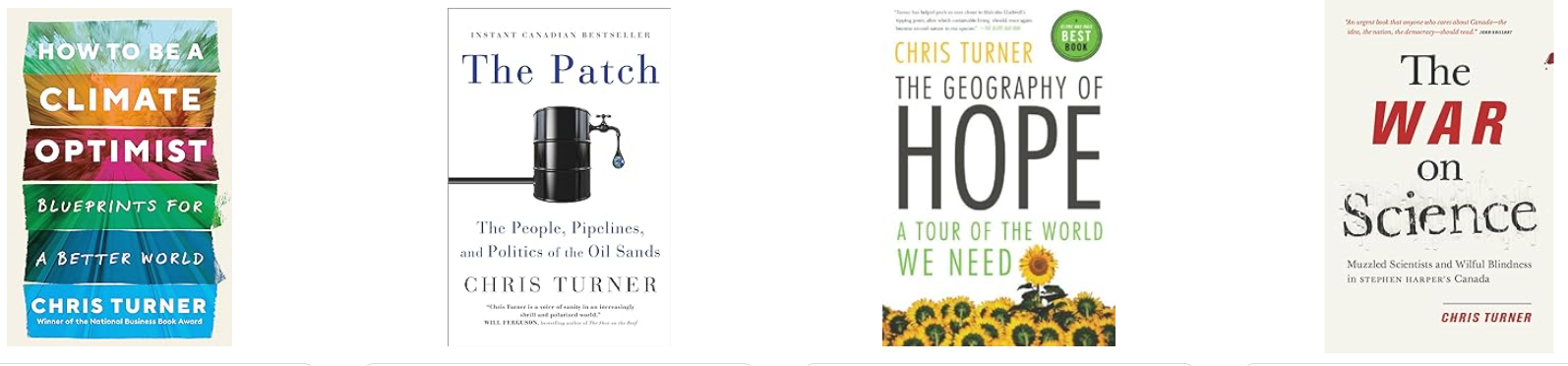
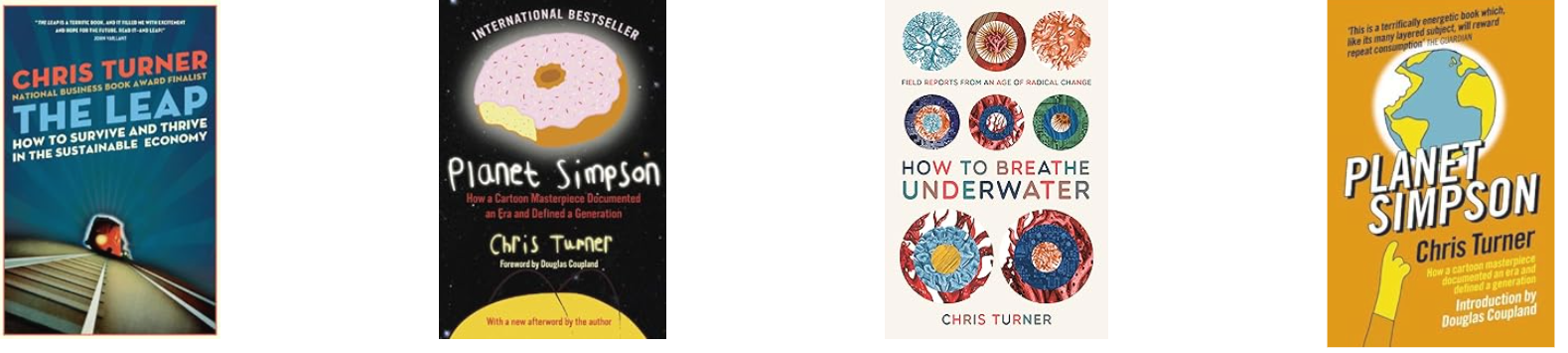
I spent time recently listening to and reading Chris Turner, a Calgary based journalist and author of numerous books.
.
A longer video featuring Chris Turner’s keynote speech to a National Forest Week conference is found HERE. Quite worth 55 minutes of your time, particularly if you are interested in climate actions and wonder if they can prevent an all out crisis.
For years, Turner recognized the potential climate catastrophe. He was convinced there was no public issue as consequential as the collective response to climate change. In more recent times, Turner has become an optimist, writing:
When I say I’m a climate optimist. I mean that in the face of the existential challenge of climate change. I believe the world will develop and implement better systems and technologies to meet our daily needs and reduce our global greenhouse gas emissions to somewhere very near zero in this century.
It likely won’t happen in time to halt the permanent alteration of many of the planet’s ecosystems and prevent significant dislocation and suffering for millions of people, but it will occur with enough speed and thoroughness to leave a foundation for civilization durable enough for future generations to build their dreams on.
And. that’s about the same as any generation has ever done for the ones to come.
How to Be a Climate Optimist – A Blueprint for a Better World
In contrast, I lean toward climate pessimism, the belief that causes will not be fully addressed, at least until catastrophe severely affects powerful groups who today value wealth more than human survival.
But I understand that most people gain comfort from optimism.
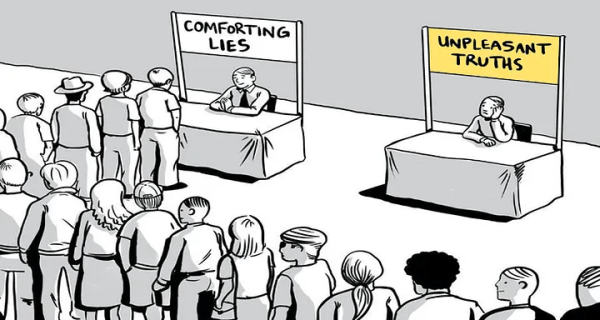
Arguing against pessimism, leading climate scientist Michael Mann says that “doomism today arguably poses a greater threat to climate action than outright denial” (Michael E. Mann, The New Climate War, Page 179).
In his book, Mann describes the exercise of power by forces of denial and delay. Profiting from fossil fuel dependence, they rely on “disinformation, deceit, divisiveness, deflection, delay, despair-mongering, and doomism.” He writes that fossil fuel interests “want to keep the conversation around individual responsibility, not systemic change or corporate culpability.”
Mann says the same groups:
…put their thumbs on the scale by promoting programs that favor fossil fuel energy while sabotaging those that incentivize renewables, and engaging in propaganda campaigns to discredit renewable energy as a viable alternative to fossil fuels…
Part of their strategy is using soothing words and terms – ‘bridge fuels,’ ‘clean coal,’ ‘adaptation,’ ‘resilience’ – that convey the illusion of action but, in context, are empty promises.
A study led by New York University’s Dr. Thomas Marlow reported the fossil fuel industry influences climate denial discourses in traditional media and automated bots amplify it in social media:
- On an average day during our study period, automated bots produced an estimated one-quarter of all original tweets referencing climate change and global warming.
- Bots were more active in some discussion areas than others – including climate denialist messages.
But Michael Mann argues that doomism is wrong because today is not too late to resolve the looming crisis. He believes excessive pessimism legitimizes business-as-usual. Mann says youths are the game-changer advocates fighting to save the planet, although I think that may be overly optimistic since too few youths are involved in demanding meaningful climate actions.
Mann is correct when he says hard-core climate-change deniers are unmovable, with an ideology impervious to facts. He suggests we should instead work to inform victims of disinformation campaigns.
Yet the most recent measurements suggest pessimism may be more realistic.
Roy Scranton writes about the difficulty of being a climate optimist:
It’s easy to forget that 2020 gave us not just the pandemic, but also the West Coast’s worst fire season, as well as the most active Atlantic hurricane season on record. And, while we were otherwise distracted, 2020 also offered up near-record lows in Arctic sea ice, possible evidence of significant methane release from Arctic permafrost and the Arctic Ocean, huge wildfires in both the Amazon and the Arctic, shattered heat records (2020 rivaled 2016 for the hottest year on record), bleached coral reefs, the collapse of the last fully intact ice shelf in the Canadian Arctic, and increasing odds that the global climate system has passed the point where feedback dynamics take over and the window of possibility for preventing catastrophe closes.
I’ve Said Goodbye to ‘Normal.’ You Should, Too
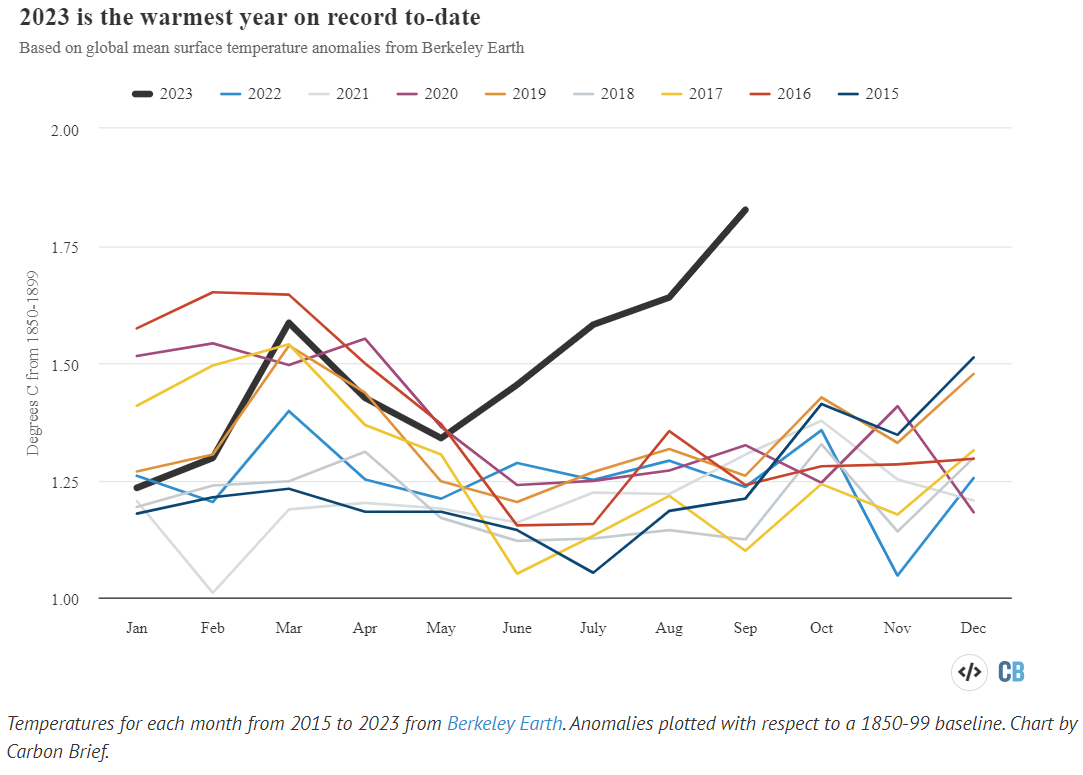
After Scranton’s article, the new normal seems to be even worse. The past nine years, 2015 to 2023, have been the warmest on record, with 2023 setting a new record for the highest global surface temperature changes ever. As another piece of evidence, the land damaged by Canadian wildfires in 2023 was more than 8x the average of the preceding 25 years. In 2023, the world faces a global hunger crisis of unprecedented proportions.

Climatologist Zeke Hausfather of Berkeley Earth wrote in the New York Times that global temperatures shattered records and reached dangerous new highs over and over the past few months. His words:
Staggering. Unnerving. Mind-boggling. Absolutely gobsmackingly bananas.
I study climate change. The data is telling us something new
But heeding advice from Chris Turner and Michael Mann, I intend to examine energy initiatives that might move climate pessimists like me to the side of optimism. Posts about these will follow.
If you find value in posts and dialogue at advertising free IN-SIGHTS.CA, please consider financial support. Significant annual payments for site hosting and subscriptions for software and news sources are looming. Supporting this work is a simple process explained HERE.
Categories: Climate Change


 in-sights.ca
Willful ignorance is today’s mantra. The belief is, if your are ignorant, you are not responsible. Combined with the dismantling of our democratic system by not just unscrupulous politicians but outright corrupt one.
In Canada, democracy is for one day only, every 4 years.
With politicians bought and sold like cheap whores by the oil industry, those who profess to be environmentalists have also sold out to sum very unsavoury characters.
Sadly, I believe it will take a major event over potable water, leading to a major war that just may go nuclear, that will ultimately dictate change.
Privately, the Eye has been told by people in the know, that this is what the military is planning for, when the water dries up, due to Global Warming.
As the globe heats up, water becomes scarce as glaciers melt away and water courses dry up.
Sadly, Water Wars is coming a lot sooner than one thinks and it maybe much closer to us than we wish.
All I can say is plant trees as they are the best way to fight Global Warming.
LikeLike
Perhaps a little insight into Dr MM and his standing among some of his
peers. James Hansen doesn’t have a stick but would still be my go to guy
on climate.
“Unmasking the inaccuracies of Dr. Michael Mann’s Hockey Stick Graph” from icehockeycentral.com
Ice hockey central provided the info..the irony is priceless but the link is worth the read.
LikeLike
So, you’re willing to take the word of some guy who writes about hockey hair over tens of thousands of real scientists doing peer-reviewed work? I am surprised.
NASA reported that 97% of actively publishing climate scientists agree that humans are causing global warming and climate change. Cornell University Chronicle says, “More than 99.9% of peer-reviewed scientific papers agree that climate change is mainly caused by humans, according to a new survey of 88,125 climate-related studies.”
Arguments over the reconstructions of the temperature record of the past 1000 years have been taken up by fossil fuel industry–funded lobbying groups attempting to cast doubt on climate science.
Scientific American magazine reviewed the hockey stick graph and quoted scientist Michael Mann:
Michael Mann wrote respectfully about the now 82-year-old James Hansen:
LikeLike
Norm
Further food for thought. Consider the application of the precautionary principle and read this article by Robert Chris and Hugh Hunt and decide where you would like to be standing.
This could be similar to the way the expert Covid crowd came to agree with the early few who warned about the virus being airborne. It’s science and most conclusions are tentative until changed by new evidence.
Mann’s comments on Hansen are his opinion. Yes, he provided the “hockey stick” graph but contrarians dispute it.
(Editor’s note: Many climate deniers worked to disprove Mann’s famous graph but failed. Most challenges came from people who were not recognized climate scientists.)
Review the concerns about Mann’s work in the article by British academics linked at the top. I have read other criticisms about Mann’s scientific approaches elsewhere in the past.
I don’t get the reference to Hansen’s age. Be careful you might get a call from Chomsky. If you had referenced Biden’s age for effect that would be ok of course:).
Cheers
t
LikeLike
Evil Eye
I think we might have a timeline problem with trees. The quantity required just to get to neutral would be almost impossible to achieve let alone deal with the increase of CO2 continuing upwards at a horrific rate. We can’t even replant clear-cut areas in BC. Keep in mind that deciduous trees drop their leaves and decompose releasing CO2 but that cycle (take in/put out) is balanced but unfortunately, the CO2 bathtub is full from our activities.
The conversation of optimism still focuses on the 1.5 C marker. Does anybody really believe that is still defendable? How about we jump the shark and try to keep it below 2.5. That would give us more time because time is up on 1.5.
Sometimes when the fire is raging and we can’t contain it head on, we give ground and build a fire break down the line. (i,e. plan and protect against 2.0 C or worse.)
1.5 is the rallying cry that continues to be a shout-out because it has a selling false hope component attached to it which is very important in the public sphere such that we could still manage to live as usual. Technology will step up and give us the relief we will need.
However, this illusion is very damaging because it provides a false sense of hope. Besides the shout-out to the major players of CO2 production is falling
on deaf ears.
So the major contribution we all could make if you want the ultimate solution is for the 7B+ people on the planet to just quit breathing:). Long term we seem to be heading that anyway.
LikeLike
It’s not just fossil fuels and deforestation that at the roots of our climate change problems. The population of the earth has doubled before our unseeing eyes since the 1970s — and with that a doubling of all the necessities of life and a surge in all the ‘wants’ of life.
Efforts to encourage (or even pay?) people to NOT reproduce could be as — or more — helpful than planting trees.
LikeLike
Bill Nye suggests that the two biggest things people worried about climate change can do is to keep talking about it and to vote.
https://www.cnn.com/videos/us/2023/12/09/bill-nye-climate-change-src-vpx.cnn
Here’s the problem. Bill Nye the science guy is not a political science guy. The jury may be in on climate change, but it’s still very much out on what’s key to getting elected, and therefore being able to implement the required changes.
Note the chyron on display throughout the interview. It proclaims that the majority of Americans want government action on climate. In support, the results of a poll asking whether the U.S. should work toward cutting greenhouse gas emissions in half by 2030 is shown. Misleading at best.
Because what is not discussed is where action on climate change ranks on the list of issues most on the minds of potential voters. Poll after poll shows that the economy and health care lead the way by far. And notably, younger voters especially are preoccupied with the cost of housing and food. These are the folks some assumed would be voting predominantly to save the planet.
We see the same thing here in Canada, where an astonishingly high number of younger voters are supporting the Conservatives, because they apparently believe that’s the solution to their economic woes. Surely it isn’t because they see Pierre Poilievre as a climate saviour. I’d recommend history lessons all around.
So first things first. To be elected, any political party truly committed to battling climate change (if there really is one) must first convince voters it can satisfy their basic immediate needs like food, shelter, and safety. That would seem a low bar, but it’s where we’re at. As James Carville said in 1992, “It’s the economy, stupid.”
I found Chris Turner’s speech oozing optimism quite interesting, but in a perverse way it could do more harm than good on getting the “right” government in place to fight climate change. Some might ask why they should even factor the issue into the voting equation if everything is already looking so rosy.
Maybe a good dose of pessimism is in order.
LikeLike
Yes, our climate. Things have changed in the past 60 yrs. Its getting hotter and there is less water in some places and too much in other places. Lots of people have ideas of how it all is happening but how to stop the extremes, that is a whole other thing. Its not that 8 billion is too many people, its that many of these 8 billion people do not have access to the wealth created in this world.
It is corporate greed, investor greed, etc. which has contributed to climate change. Have a look at the oil/gas industry; agri business, pesticides, politicians accepting very large donations from corporations who want laws changed so they can make more money at the expense of humans and other animals and the earth and water. Will it change? Not unless people vote for change and in some countries voting isn’t an option. Canada could reign in our mining corporations who operate in other parts of the world for a start
On the other hand, why bother. We have two major wars going on in the world and who knows when the next one will start. As we used to say, One nuclear bomb can ruin your whole day. And speaking of wars, they don’t do much for improving the enviornmemt, just the manufacturing of the weapoms use a lot of resources.
Read something about cruise lines, if one large corporation has all 67 or so cruise liners out on the water they emmit as much sulphur as all the cars in europe. If that is true, we will really need to have a look at how we live.
On the ohter hand, governments may decide we can’t afford how we live. Micro plastic and smaller is getting into sea animals and its killing them–less for us to eat and upsetting the balance im the oceans. We’ve hear of tiny bits of plastic being found in breast milk. Thats not going to work for babies or the adults they become. Now researchers are suggesting that this micro plastic, nano plastic, that very tiny stuff, is getting into human bodies and may be causing Parkinsons and dementia. We have seen a rise in it, even taking the growth in population into account.
LikeLike