



Responding to a mention of climate scientist Michael Mann (U of Pennsylvania), reader Tim Smith linked to an article by independent researcher Robert Chris and Hugh Hunt (Cambridge). It is titled: The disagreement between two climate scientists that will decide our future.
Mann is known for the “hockey stick” graph created in the 1990s. It shows global temperature changes over hundreds of years. Professional climate change deniers have regularly criticized data used for this chart. Writing in Scientific American, David Appell said later investigations justified the work:
The “hockey stick” graph has been both a linchpin and target in the climate change debate. As a plot of average Northern Hemisphere temperature from two millennia ago to the present, it stays relatively flat until the 20th century, when it rises up sharply, like the blade of an upturned hockey stick. Warming skeptics have long decried how the temperatures were inferred, but a new reconstruction of the past 600 years, using an entirely different method, finds similar results and may help remove lingering doubts.
Novel Analysis Confirms Climate “Hockey Stick” Graph
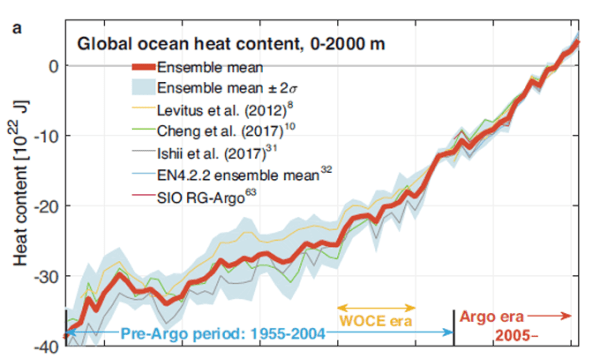
The Chris/Hunt article focuses on the conclusion by James E. Hansen (Columbia) and other scientists that the goal of limiting Earth’s surface temperature rise to 1.5°C above the pre-industrial level is dead. Hansen and colleagues published a paper in November 2023 that maintains global warming is accelerating:
The proximate cause of ongoing global warming is Earth’s energy imbalance (EEI). Earth is now absorbing more energy incoming from the Sun than the planet is sending back to space as reflected solar light and emitted thermal (heat) radiation. As long as that imbalance is positive – more energy coming in than going out – Earth will continue to get hotter. Factors that alter Earth’s energy balance are called climate forcings.
Mann takes a less alarmist position, stating that global warming stops when carbon emissions reach zero. But despite knowing for more than fifty years about the need to reduce greenhouse gas emissions, humans have failed miserably.
Hansen says it once seemed conceivable that emissions could decline, that a drawdown of atmospheric CO2 could help restore energy balance and stabilize climate. However, since then, fossil fuel emissions have grown, and Earth’s energy imbalance has approximately doubled.
Awareness of the greenhouse effect dates back to the 1960s. In this 1989 video, famed science fiction writer and professor Isaac Asimov discussed climate change.
.
Chris and Hunt report that Dr. Hansen supports dimming the sun as well as reducing greenhouse gas emissions. One suggestion is to use high-altitude air tankers to create a persistent, artificial haze like that which follows a major volcanic eruption.
The British authors are not neutral observers. They are associated with the Centre for Climate Repair and SPICE (Stratospheric Particle Injection for Climate Engineering), a project promoting the placement of particles into the stratosphere to reflect sunlight.
Solar geoengineering is controversial. Hundreds of scientists from around the world have signed a call for an International Non-Use Agreement on Solar Geoengineering:
Solar geoengineering is highly controversial. It is risky and uncertain. It does not address the root cause of climate change, that is, greenhouse gas emissions and concentrations. Instead, solar geoengineering focuses on ‘symptom treatment’, seeking to limit global warming by merely masking the effect of greenhouse gas emissions...
Other examples of solar geoengineering are:
What is Solar Geoengineering
- Marine cloud brightening: this would make clouds brighter, to reflect more sunlight back into space. Mostly, this aims at more regional effects.
- Cirrus cloud thinning: this would make cirrus clouds thinner, which on average trap more heat than they reflect back into space.
- Space mirrors: this outlandish idea proposes to place mirrors in space to reflect sunlight, aiming to cool the whole planet. It is not widely researched nor taken seriously.

Science is working as it should when experts analyze the work of others and disagree. However, while there is evidence that emissions reductions would not damage Earth, there are reasonable expectations that injecting mass amounts of material into the stratosphere would cause negative side effects.
This reminds me of a personal experience. Until 45 years ago, I was a pipe smoker. Our family doctor bluntly said, “Stop smoking now or face very painful consequences in the future.” He might have offered an easier alternative, “Enjoy your tobacco but pray that we’ll have a cure for mouth and throat cancer someday.” With difficulty, I stopped smoking. Much later, I said to others that curing the addiction was only hard for the first dozen years.
There is a Latin saying from the 13th century worth considering:
It is better and more useful to meet a problem in time than to seek a remedy after the damage is done.
Instead, governments prefer to follow the four-stage strategy:
If you find value in posts and dialogue at advertising-free IN-SIGHTS.CA, please consider financial support. Significant annual payments for site hosting and subscriptions for software and news sources are looming. Supporting this work is a simple process explained HERE.
Categories: Climate Change


 in-sights.ca
1 reply »