



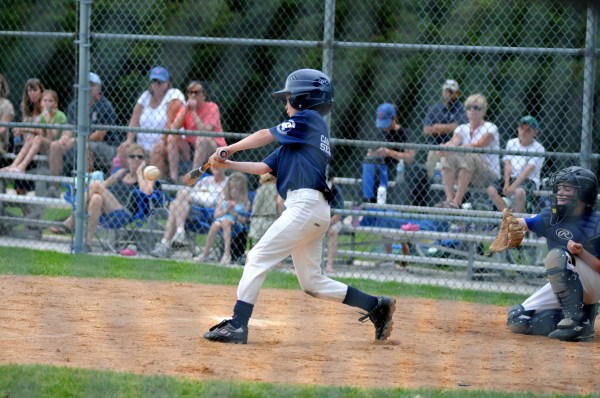
I spent a few hours this weekend watching a grandson and other nine-year-olds playing in a Little League baseball tournament. Moving toward adolescence, these children are beginning to gain physical and mental skills that allow them to play the game effectively.
Coaches and parents were not expecting perfection so the atmosphere was positive. At this level, the focus is on fundamental skills and the qualities of teamwork, sportsmanship, discipline, and fair play.
This will change as the children grow older and competition becomes more intense. Sports physician Jordan D. Metzl of New York’s Hospital for Special Surgery believes this is a good thing:
The challenges of high school sports helped me grow. In the process of combining physical work and mental toughness to push myself to the limit and then try to go beyond, I learned, and still learn, much about myself. The lessons from sports apply to life in general. Pushing toward a goal, striving for extra courage and strength, is what allowed me to succeed, both as a person and as a physician.
Dr. Metzl says that sports participants develop resilience and learn the value of teamwork and perseverance. Others are less sure than Dr. Metzl. They know that potential benefits from organized athletics are not always achieved.
Dr. Marika Lindholm, a sociologist, professor and writer, warned about psychological risks of playing youth sports:
- Who your child is as a person shouldn’t be tied closely to the ability to hit home runs or score touchdowns. If it is, that’s a guaranteed set-up for feelings of failure and low self-esteem.
- Too often, a win-at-all-costs mentality devastates young athletes… The best coaches inspire through positive reinforcement and role modeling, not harassment and bullying.
- There is a strong chance that an athlete will face a sport-ending injury or simply burn out. Make sure that your athlete has other interests and doesn’t believe that sports are the only route to success.
- Too many parents become over-invested in their children’s athletic pursuits, which can lead to unconscious behaviors that will hurt young athletes… Love and affection should never be tied to athletic performance. In fact, children need you most when they fail to perform well.
- Sports psychologists are in high demand because parents, coaches, teams, and schools put undue pressure on young athletes to perform well every time they step on the field, court, or track. Remember, they’re children, not professional athletes.
- Our society’s obsession with sports puts a premium on athletes and athleticism, which can imbue young athletes with an inflated sense of self… Parents need to be vigilant for signs that their young athletes lack humility and empathy.
Dr. Lindholm does not oppose youth sports. She believes that, done right, these activities offer psychological benefits:
- The ability to take criticism and work collaboratively.
- Skill-building in sport enhances self-esteem, which carries over into other areas of life.
- Sports require effort and commitment, both traits that serve us well in adulthood.
- Our contemporary addiction to social media and adulation of seemingly “perfect”-looking people can wreak havoc on children’s body image. While not always a perfect antidote, sports can make young athletes feel proud of their bodies and what those bodies can do.
- Overprotection undermines the development of resilience. Youth sports provide a nice balance since parents can’t protect athletes from defeat and hardship. It’s good for your kids to learn how to both lose and win.
- Combining sports and school requires an ability to self-regulate. Getting to practice on time with the proper equipment helps student-athletes learn to organize themselves and say no to other activities, such as video games, social media, and excessive socializing. Learning when to say no is a great skill to carry over to adulthood.
While watching youngsters playing in the Little League games, I remembered the great times when my young sons played team sports. But I also remembered the problems. These seldom involved young players. Adults were the usual culprits.
After my grandson’s ballgame, I listened to music by English rock group Supertramp. One song suggests that we may be mistaken when we take little children out of the sandlots, dress them in uniforms, and put them on a field marked with formal lines, staffed by paid umpires, and governed by a rulebook prepared in some far-off place
The Logical Song was the lead single from the album Breakfast in America, a top seller in the 1970s. Composer and singer Roger Hodgson lamented the loss of childhood idealism. His song offers a caution for adults influencing the activities of children.
When I was young, it seemed that life was so wonderful
A miracle, oh, it was beautiful, magical
And all the birds in the trees, well they’d be singing so happily
Oh, joyfully, oh, playfully watching me
But then they sent me away to teach me how to be sensible
Logical, oh, responsible, practical
Then they showed me a world where I could be so dependable
Oh, clinical, oh, intellectual, cynical…
Composer and singer Roger Hodgson wrote about his lyrics:
The Logical Song was born from my questions about what really matters in life… Throughout childhood we are taught all these ways to be, and yet we are rarely told anything about our true self. We are taught how to function outwardly, but not guided to who we are inwardly. We go from the innocence and wonder of childhood to the confusion of adolescence that often ends in the cynicism and disillusionment of adulthood.
Competition can be very healthy for kids. It motivates them. It keeps them focused on a goal. It teaches them how to win and lose, the value of teamwork, and perseverance. Whether kids engage in competitive sports or academic contests or compete in other ways, they learn to push themselves and work through obstacles to complete the task at hand. All of this results in resilience, new skills and passion.
When competition turns toxic, however, kids suffer...
How Toxic Competition Is Ruining Our Kids – and What to Do About It
Categories: Sports


 in-sights.ca
I think school sport should be part of the curriculum, but it should be sport that one does not have to wear armour, such as helmets and padding.
Oops, there goes Hockey, Lacrosse, and Football.
But then there is soccer, rugby, swimming, basketball, volleyball, track and field, etc.
Also, out of province scholarships should be banned and the same for sport scouting! I have witnessed players injured on the field, so the star player can win a scholarship. NOT GOOD.
Rugby is my sport and my two sons played and one still plays. rugby is a true team sport with 15 players (and with up to 10 subs), where one learns to “take it”. Rugby is essentially a passing and tackle (full wrap) game and not a “hitting” game such as Hockey and American/Canadian football. Rugby is also a true team sport where making a play to set your “mate” up for a try is just as important as scoring.
it is a tough game on the players soon find out that just playing rugby, you are a winner.
Sports also not only provide fitness, but also a mental acuity and it also teaches you to lose with grace.
The problem with child sport is simple, we have made it into a business and that is not good. Far too often the talented player gets all the attention and the rest are ignored because the talented players make the team and sport look good, yet it is the not so talented player that that often pays the price for the benefit of the the chosen few.
In sport, the kids know who is good and who isn’t, so why do we have to interfere. Let us organize the sport, but keep it fun and keep it simple.
LikeLike