


I have been reading about the history of British Columbia’s forest industry. I lack thorough expertise, but I think it is fair to say that short-term thinking by self-interested industrialists and politicians has caused serious damage to public assets that were vital building blocks of this province.
In 2017, Tolko closed its Merritt sawmill, leaving 200 families in distress. John Horgan told townspeople, “The closure never would have happened under an NDP government.”
Fast forward to 2024 and the last Merritt mill is closing. This time, 100 families are affected.
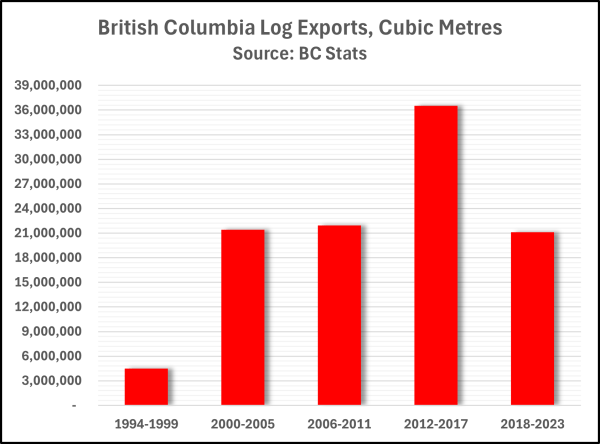
Raw log exports are a factor. Companies harvesting timber find that loading logs on ocean-going ships is more profitable than building facilities to add value to wood products. While log exports have declined from the time Christy Clark was Premier, they are now more than four times the volume being exported in the 1990s.
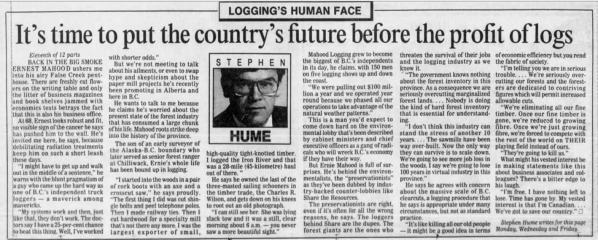
I came across a newspaper article written in 1990 by Steven Hume about an uncle of mine who talked about forest practices in this province. Decades later, British Columbia is still suffering because forest management science has had too little importance. Short-term business goals have been prioritized; science has been neglected.
Excerpts from Steven Hume’s article:
[Ernie Mahood] a guy who came up the hard way as one of B.C.’s independent truckloggers — a maverick among mavericks.
He’s worried about the present state of the forest industry that has consumed a large chunk of his life. Mahood roots strike deep into the history of our province.
The son of an early surveyor of the Alaska-B.C. boundary who later served as a senior forest ranger at Chilliwack. Ernie’s whole life has been bound up in logging…
Mahood Logging grew to become the biggest of B.C.’s independents in its day, he claims, with 150 men on five logging shows up and down the coast…
This is a man you’d expect to come down hard on the environmental lobby that’s been described by cabinet ministers and chief executive officers as a gang of radicals who will wreck B.C.’s economy if they have their way.
But Ernie Mahood is full of surprises. He’s behind the environmentalists, the “preservationists” as they’ve been dubbed by industry-backed counter-lobbies like Share the Resources.
The preservationists are right, even if it’s often for all the wrong reasons, he says. The loggers behind Share are the dupes. The forest giants are the ones who threaten the survival of their jobs and the logging industry as we know it.
“The government knows nothing about the forest industry in this province. As a consequence we are seriously overcutting marginalized forest lands… Nobody is doing the kind of hard forest inventory that is essential for understanding.
“I don’t think the industry can stand the stress of another 10 years… The sawmills have been way over-built. Now the only way they can survive is to scale down. We’re going to see more job loss in the woods…”
He says he agrees with concerns about the massive scale of B.C. clearcuts, a logging procedure that he says is appropriate under many circumstances, but not as standard practice.
“It’s like killing all our old people — it might be a good idea in terms of economic efficiency but you rend the fabric of society.
“I’m telling you we are in serious trouble… We’re seriously overcutting our forests and the foresters are dedicated to contriving figures which will permit increased allowable cuts.
“We’re eliminating all our fine timbers. Once our fine timber is gone, we’re reduced to growing fibre. Once we’re just growing fibre, we’re forced to compete with the rest of the world on THEIR playing field instead of ours.
“They’re going to kill us.”
What might his vested interest be in making statements like this about business associates and colleagues? There’s a bitter edge to his laugh.
“I’m free. I have nothing left to lose. Time has gone by. My vested interest is that I’m Canadian… We’ve got to save our country.”
Ill fares the land, to hastening ills a prey,
Where wealth accumulates, and men decay:
Princes and lords may flourish, or may fade:
A breath can make them, as a breath had made;
But a bold peasantry, their country’s pride
When once destroy’d, can never be supplied.

— Oliver Goldsmith, The Deserted Village —
Here at advertising-free IN-SIGHTS, followers are not asked to subscribe, but financial support from readers enables the site to continue. If you find value in the content here, please make a contribution. Methods are described HERE.
Categories: Forestry


 in-sights.ca
The demise of the BC forest industry was prophesied over thirty years ago and yet the loggers swallowed all the company rhetoric hook line and sinker.
Some forty years ago some German lumber buyers visited the Carrier mill, which was state of the art, in Price George.
At that time the planer had to be slowed down as lumber was scorched as it shot out of the planer!
The mill was so efficient the Germans said it could lay waste to the Black Forest in a few months; a joke yes , but!
The efficiency in logging itself has increased dramatically, with robotic logging equipment that can operate in places too dangerous for a man to work.
The policing of logging operations is also suspect ; I’ve heard that good timber ‘had’ to be felled as to gain access to the cutting of beetle killed trees in the interior.
Alas we have seen it all before with the fishing industry!
Over fishing lead to fish farms just as over cutting lead to fibre farms.
Strangely over pumping of crude oil lead to the blight of Tarsands!
TB
LikeLike
I am the 7th and last generation to have worked in the forest industry. My father was a UBC graduate forester and my great grandfather was both a mill manager of the Chemainus sawmill and the Genoa Bay sawmill until he passed in 1923.
We can trace the family linage to loggers cutting pit props for the coal mines in Nova Scotia and the family migrated west, first to Ontario, then Minnesota and finally to Vancouver island.
Logging is in my blood.
My father, a middle manager at Canfor, forecasted the demise of the forestry industry from the mid 60’s to his forced retirement in 1984, when the forest industry got rid of all the degree holding foresters because they were wanting good forest practices, contrary to the accountants, who wanted quick profits.
Abetted by both the provincial and federal governments the major corporations got their way and literally stripped our forests for corporate profits.
Today, we have a forest industry largely sending raw logs to Asia for processing and/or reducing logs for fuel pellets for the energy industry. we have squandered our forest industry for?
Personally I think the provincial and federal are criminally liable for the industry, by allowing the forest industry to rot.
It seems how government operates today; not in the public’s interest but the international corporate interest.
LikeLiked by 2 people