




Beware of what you read about BC Hydro in news sites operating to benefit those who aim to privatize billions of public dollars. One example is a Derrick Penner article published by Postmedia. The Vancouver Sun headline screams that BC Hydro cannot deliver the electricity this province needs.
The source of that claim is a group funded by private industry, a group that promotes unregulated private business and works to undermine BC’s main public utility.
Years ago, editors and fact-checkers guaranteed worthwhile content was published in daily newspapers. Penner’s column shows Vancouver Sun no longer has processes that ensure news reports are well written and accurate. Without evaluating statements made, Penner repeats claims by Resource Works and its associate Energy Futures Initiative.1 Both industry groups are now promoting uranium mining and nuclear energy.
After an opening paragraph that might have been crafted by a grade 9 student, Penner mentions BC Hydro’s capital plans:
Since the plan’s broad strokes where (sic) published in January, the province has rolled out more detailed schedules for $14 billion worth of projects intended to beef up distribution systems that struggle to accommodate higher demands of electric vehicle charging and new heat pumps in older neighbourhoods, as well as expand transmission networks for growth. (emphasis added)
I can excuse the editing mistake in the first few words, but much of the remaining is wrong. Deliberately wrong. BC Hydro reports the quantity of electricity sales in its Annual Service Plan reports. These numbers may be the only reliable sales numbers issued by the utility because they must correspond to audited sales revenue. Postmedia doesn’t bother to examine those figures.
Does this look like BC Hydro is struggling to accommodate electric vehicles and heat pumps?
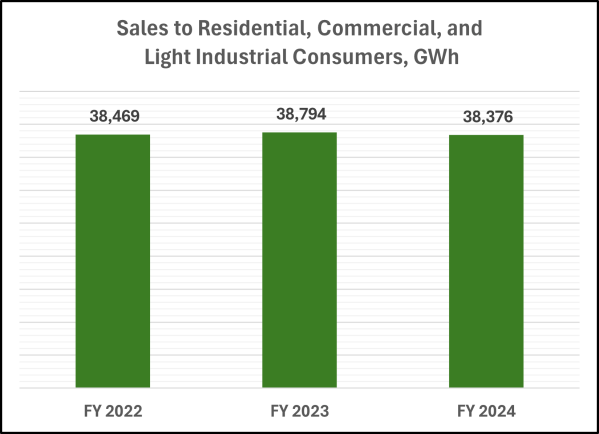
In fact, the demand for new electricity now comes from the expanding fossil fuel industry
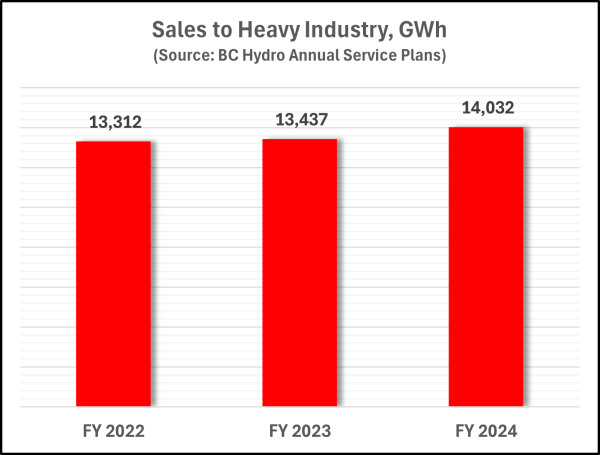
Not that I am defending the management of BC Hydro. President and CEO Chris O’Riley ought to be fired and the Board of Directors replaced because it has failed in its duty to establish long term energy policies that serve the people of British Columbia.
The public utility ought to have been embracing solar, wind and geothermal power a decade ago. These technologies are proven to provide non-destructive, risk-free, competitively priced energy.

Despite the claims of Resource Works, nuclear energy is not a solution for the immediate future.
Despite proponent and industry claims, small modular reactors (SMRs) are still too expensive, too slow to build, and too risky to play a significant role in transitioning away from fossil fuels, according to the latest Institute for Energy Economics and Financial Analysis (IEEFA) report.
The Institute for Energy Economics and Financial Analysis (IEEFA)
The Site C reservoir has begun to fill and 83 kilometres of the Peace River valley will be flooded, destroying the north’s best farmland. It is predicted that food production will have to shift north as climate change makes it too hot for crops to thrive in southern regions.
More importantly, flooded lands of the Peace River valley include traditional territories that have been important to Indigenous people for millennia.
1 Resource Works did not choose the name of Barry Penner’s group by accident. It is almost identical to https://energyfuturesinitiative.org/, a credible organization based in Washington DC. Unlike Resource Works, the american organization is led by principals with decades of experience and proven records in government, academia, and private sector business. The American non-profit has no association with the similarly named Canadian group.
Categories: BC Hydro, Journalism


 in-sights.ca
I’ve seen articles and heard on CBC recently that BC buys a significant amount of electricity from Alberta. Is that true?
LikeLike
Because BC Hydro does not make public timely export/import information, I cannot answer the question with certainty. However, one of their webpages says:
My suspicion is that this does not reflect activities in fiscal 2024. We can hope that they are not importing large quantities from Alberta because, according to Canada Energy Regulator, 85% of electricity in that province is generated by burning fossil fuels.
LikeLiked by 1 person
Thanks, Norm.
LikeLike
Page 98 of this document shows that import of electricity is not all that unusual for B.C. Hydro. Periodic 15% of total supply has not been uncommon going back several decades. There’s no specific breakdown for import from Alberta, but the general alarm being raised about imports by the usual suspects appears to be specious and self-serving.
https://www2.gov.bc.ca/assets/gov/british-columbians-our-governments/government-finances/financial-economic-review/financial-economic-review-2024.pdf
LikeLike
BC’s population grew roughly a third from 2003 to 2023, so the flatness of BC Hydro demand must indicate a considerable improvement in efficiency of appliances and lighting etc.
BC Hydro attempts to promote efficiency with its step 2 rate, which has the unfortunate effect of deterring electrification of home heating. Every time BC Hydro surveys me about step 2, I complain about it, as we usually exceed step 1 with an average family of four’s usage, and it would be even more with a heat pump. Step 2 takes no account of what you are doing with the electricity or household size.
Recently I saw a proposed option to not have 2 steps. Naively, I assumed BC Hydro would just charge the step 1 rate on all usage, but no, the option was to be charged a middle rate between step 1 and step 2 on all usage. They will have their money either way, and to hell with the climate.
LikeLike
Indeed, efficiency in the ways we use electricity has moderated demand. LEDs began replacing incandescent lighting around 2010. These use 75% less energy. Small motor efficiency has improved as well. However, since we have already adopted those technologies, we are unlikely to benefit from future efficiencies in the short term. With EVs replacing gas-burning vehicles, the need for electricity is certain to grow.
The question is how new electricity will be generated. Solar can provide part of that new supply, wind will provide another part. Calgary company EAVOR looks to have a viable way of using geothermal. Wind power is not dispatchable so it needs battery storage but in BC, we already have giant batteries. They are the existing hydro reservoirs.
Pricing of electricity is a controversial issue. Fossil fuel companies have been promised energy from BC Hydro at a fraction of what Site C power costs the utility. Residential users have to make up for those losses. The current step 1 rate of 11 cents per KWh that homeowners face is insufficient. Expect to pay more.
LikeLike
Its BCUC that should set demand targets as BCHydro has year after year failed to be correct.Also require website posting of reports on time.
How much debt does BCHydro have?
I cant even find any press release for any quarterly or annual report in media center
LikeLike
BC Hydro’s sales to BC consumers have been climbing slowly but the utility’s liabilities have been soaring. In FY 2004 those totaled $9.96 billion. In FY 2024, liabilities were $41.75 billion.
LikeLike
I have noticed that Barry Penner and Resource Works are getting their message out there a lot lately, and it seems very much agenda driven. It seems they want a frantic race to build every conceivable power project and transmission line possible ASAP. Probably good messaging for Independent Power Producers to get large sums of public money into private hands.
LikeLike
Who believes anything from government these days? Sadly all we get is government speak, carefully crafted to camouflage the lies and deliberate misinformation from government bureaucracies.
Evidently the truth is now an obsolete, almost revolutionary term.
LikeLike
Facebook users may have noticed that former B.C. Premier Glen Clark added this comment to a post that linked to this article:
“Thanks Norm. I confess to being surprised (shocked even) that people are advocating nuclear power in BC.”
LikeLike