



Last week, the British Columbia Coroners Service reported unregulated drug toxicity deaths of at least 192 people in July 2024. The leader of the BC Conservatives believes this is largely a matter of criminality. He wants to imprison chronic drug users. People who actually know something about substance use disorders know there are better ways.
The European Union Drugs Agency (EUDA) publishes a comprehensive list of responses to this widespread problem. Worldwide, overdose is the leading cause of avoidable death among people who inject drugs.
The groups most likely to experience an overdose are people with an opioid dependency and those who inject them. It has been found that overdose deaths are more likely to occur in specific situations, for example the period shortly after prison release, hospital discharge or completing a course of residential detoxification or recovery treatment.
Other risk factors for opioid overdose include using opioids in combination with other central nervous system depressants, such as alcohol or benzodiazepines, and using them unaccompanied. The type of opioid used also plays a role. In some countries (in particular the United States and Canada), overdose risks have substantially increased because of the circulation of fentanyl-laced drugs. The high potency of even small amounts of fentanyl, a synthetic opioid, in combination with its unknown concentration in drug mixtures, presents an elevated risk of overdose (see Spotlight: Fentanyl).
Solutions are not as simple as hiring more police and throwing users in jail. The National Institute on Drug Abuse (NIDA) provides insights into addiction:
- Drug addiction is a complex disease, and quitting usually takes more than good intentions or a strong will.
- Drugs change the brain in ways that make quitting hard, even for those who want to.
- Brain changes can be persistent, which is why drug addiction is considered a “relapsing” disease.
- Most drugs affect the brain’s “reward circuit,” causing euphoria as well as flooding it with the chemical messenger dopamine.
- As a person continues to use drugs, the brain adapts by reducing the ability of cells in the reward circuit to respond to it.
Risk factors:
- Biology. The genes that people are born with account for about half of a person’s risk for addiction. Gender, ethnicity, and the presence of other mental disorders may also influence risk for drug use and addiction.
- Environment. A person’s environment includes many different influences, from family and friends to economic status and general quality of life. Factors such as peer pressure, physical and sexual abuse, early exposure to drugs, stress, and parental guidance can greatly affect a person’s likelihood of drug use and addiction.
- Development. Genetic and environmental factors interact with critical developmental stages in a person’s life to affect addiction risk. Although taking drugs at any age can lead to addiction, the earlier that drug use begins, the more likely it will progress to addiction. This is particularly problematic for teens. Because areas in their brains that control decision-making, judgment, and self-control are still developing, teens may be especially prone to risky behaviors, including trying drugs.
Drug addiction cannot be cured, but it can be managed. Research has shown that prevention programs involving families, schools, communities, and the media are effective for preventing or reducing drug use and addiction.
EUDA lists numerous documents that cast light on addiction and drug-related deaths. These are not products of rage-farming politicians who spent no time studying the science of addiction.
Overview of documents on drug-related deaths issued by the United Nations system since 2012:
| Commission on Narcotic Drugs: Promoting measures to prevent drug overdose. | Member States to include effective elements for the prevention and treatment of drug overdose, in particular opioid overdose, in national drug policies, and to share best practices and information on the prevention and treatment of drug overdose |
| WHO guidelines: Community management of opioid overdose | The guidelines recommend that people who are likely to witness an opioid overdose, including people who use opioids, and their family and friends should be given access to naloxone and training in its use so that they can respond to opioid overdose in an emergency if a medical response is not available. |
| Sustainable Development Goals | Reduce premature mortality from non-communicable diseases through prevention and treatment and promote mental health and well-being’. |
| EU Drugs Action Plan 2009-2012 | Ensure access to harm reduction services, in order to … reduce the number of drug-related deaths. |
| EU Action Plan on Drugs 2013-2016 | Ensure that treatment and outreach services incorporate greater access to risk and harm reduction options to lessen the negative consequences of drug use and to substantially reduce the number of direct and indirect drug- related deaths. |
| EU Action Plan on Drugs 2017-2020 | Provide access to authorised pharmaceutical dosage forms of medicinal products containing naloxone specifically certified to treat opioid overdose symptoms by trained laypersons in the absence of medical professionals. |
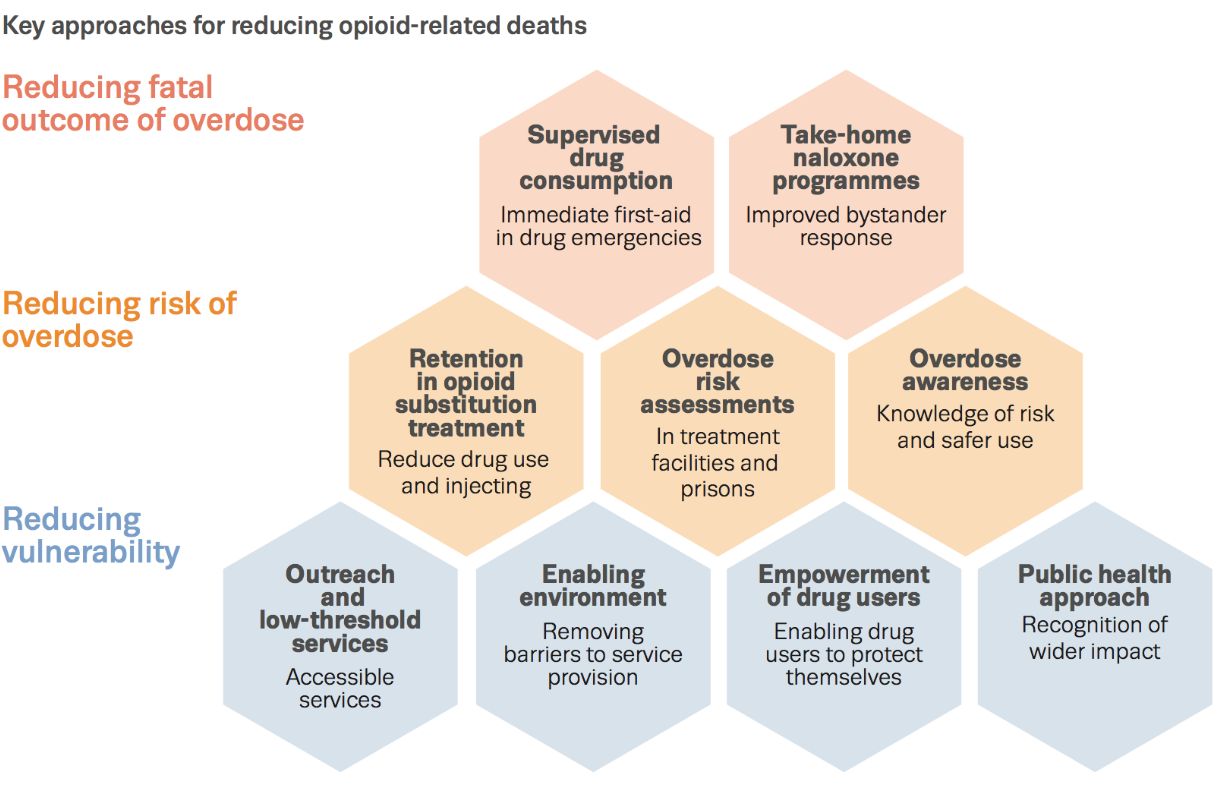
Effective communication with users can act as a catalyst for reducing harm. Ideally, overdose prevention, education and counselling interventions would be provided by trained professionals as a matter of routine in the relevant healthcare and primary care settings. Screening for overdose risk by those treating heroin users may contribute to reductions in overall mortality, while the use of overdose risk assessment interventions can assist the early identification of high-risk individuals.
Several interventions are recommended to help reduce the high number of overdose deaths among former prisoners in the period shortly after leaving prison. These include pre-release education on overdose risks and prevention, continuation and initiation of substitution treatment, naloxone distribution and improved referral to aftercare and community treatment services.
Supervised drug consumption rooms have shown to reach marginalised high-risk drug users and connect them to the wider network of care, to reduce the acute risks of diseases and overdose deaths associated with injecting or inhaling drug use, and to reduce public drug use. Drug consumption rooms are highly targeted services, usually integrated within facilities that offer a broad range of other health and social services.
Human networks, with appropriate training and awareness raising, can be utilised to prevent overdose deaths.
People who are likely to witness an opioid overdose should have access to naloxone.
Drug overdose deaths are preventable, and there is good evidence to show that specific interventions can both reduce the occurrence of overdose events and prevent fatal outcomes in overdose situations.
We can only hope that voters do not fall for policies advanced by merciless politicians. The next victim might be close to any one of us.
Substance use disorders will be an insoluble problem for many, but with comprehensive medical and social interventions, a great many lives can be saved.
Categories: Health


 in-sights.ca
You make some very good points, Norm, on an incredibly important topic. 6-7 people per day are dying in British Columbia due to drug overdose. It is the highest cause of death in men between the ages of 18-54. It is important to note we are in the midst of a toxic drug crisis NOT an addiction crisis. The unregulated street drug supply chain is highly contaminated with fentanyl or analogues. 85% of overdose death victims typically have fentanyl in their system.
People use drugs for many different reasons including recreation, pain management, mental illness and historic trauma. Not that it should matter, but drug users are not always street people. In fact, where I live in Surrey, 64% of overdose victims die in a nice home and likely have a family and a job.
Both the Chief Coroner and the Public Health Officer have released playbooks on actions that should be taken immediately to reverse this tragic crisis. Their solutions include regulated distribution of safe supply coupled with a continuum of care. The NDP and the BC Cons, in their arrogance, have completely rejected the Chief Coroner and Public Health Officer reports. Consequently, 6-7 people per day will continue to die in this province. The BC Green party stands alone in supporting evidence-based solutions.
LikeLike
Guy Felicella lays out the consequences of the backward BC Cons plan to deal with the toxic drug crisis. For what it is worth, the NDP plan isn’t much better.
LikeLike