



BC Hydro waited until the last days allowed by law to release the utility’s second-quarter report for the fiscal year ending March 2025. The utility’s financial reports show politicians consciously misinform the public about BC’s need for electricity.
We have been told that the demand for electricity by BC’s growing population requires BC Hydro to spend tens of billions of dollars to expand its plant and equipment assets. The company has committed tens of billions more to private power producers. This is primarily for the benefit of large industrial companies.
BC Hydro’s constant refrain has been that demand is growing by 40 percent in 20 years. Sales numbers tell a different story.
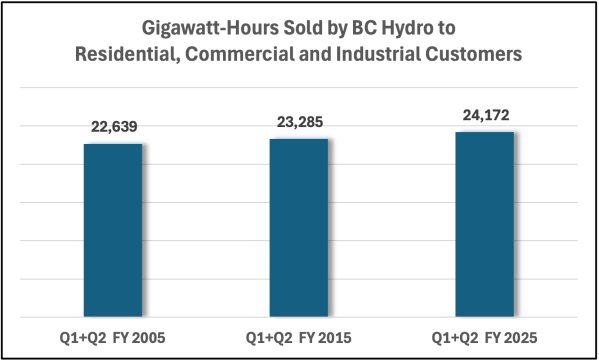
Instead of increasing by 40 percent, the quantity of electricity sold by BC Hydro to its regular customers rose 7 percent between the first two quarters of FY 2005 and the same six-month period of FY 2025.
In the past three years, sales to customers other than heavy industry have been almost unchanged.

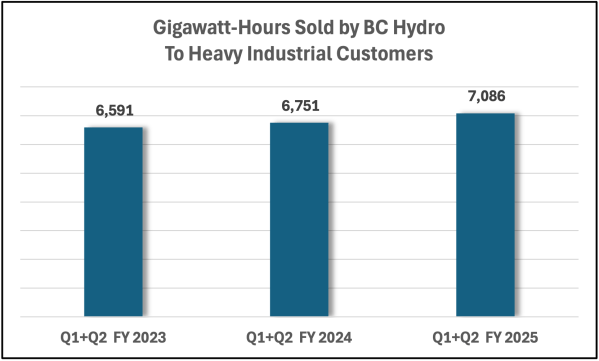
Consumption of electricity by companies that produce, process, and transport natural gas has resulted in a 7.5 percent increase in recent electricity sales to heavy industry. It is worth noting these sales in the current fiscal year were at an average rate of 6.5¢ per kilowatt-hour. Compare that to the residential sale average of 11.5¢ per kilowatt-hour.
With Adrian Dix now BC’s energy minister, his old pal and former roommate Glen Clark is taking over as Chair of BC Hydro. It is worth looking at the makeup of the Board of Directors:
| Glen Clark, Board Chair | Director Canfor and coal exporter Westshore Terminals, former BC Premier and former President of Jim Pattison Group. |
| Brynn Bourke | Executive director of the 40,000-member BC Building Trades. |
| Donald Kayne | Director and former CEO of Jim Pattison’s lumber and wood pellet producer Canfor Corporation. |
| Clarence Louie | Chief, Osoyoos Indian Band. |
| Nadaine Morin | Vice-President, Skeena Gold + Silver. |
| Merran Smith | President, New Economy Canada, which brings together organizations such as Teck Resources, GE Vernova, EllisDon Construction, and others. |
Notice the complete lack of a person likely to represent the interests of residential consumers. No surprise that the unrepresented group pays almost double the unit price for electricity.
It is also worth noting that private power producers (IPPs) were paid 10¢ per kilowatt-hour, which is 55% more than the average selling price to heavy industry. This is a subsidy that pleases BC Hydro’s Directors and the corporations they favour.
Categories: BC Hydro


A well-written report on BC Hydro.
Pricing to the various consumer types is a demonstration of “combine/monopoly” pricing, which is always deliberate , not accidental. Some few customers more equal than others.
I don’t understand why the “Anti Combines Board ” lets this type of pillaging go unchallenged. Being a Crown Corporation should not exempt them from being fair.
LikeLike
Happy New Year Norm.
Good to see that the interest of large consumers take precedence. Residential ratepayers(voters) are taken for granted and abused. Ratepayer groups would be wise to make submissions to the BC Utilities Commission regarding this discrepancy as rate increases due to hit as more production comes online from the very expensive Site c dam.
LikeLiked by 1 person
A cynic might wonder if Mr. Rustad will have David Williams checking to see if there’s any wiring being done by BC Hydro on a certain back deck. And in the unlikely event there is whether the new Minister of Energy would find a pre-dated memo to file authorizing it.
LikeLiked by 1 person