



Months ago, journalist Andrew Coyne wrote an article for the Globe and Mail that deserved more attention.
[Carbon pricing,] a policy that, however superior as policy, was hard to explain to the public, while the Conservatives are congratulated, explicitly or otherwise, for shamelessly exploiting popular confusion around the tax.
How else to explain how Pierre Poilievre’s recent remarks that the tax, when fully implemented, would lead to a “nuclear winter” of “mass hunger and malnutrition,” a dystopian nightmare in which seniors are forced to turn their thermostats down to 13 C and people are left unable “to leave their homes or drive anywhere,” could have been reported straight-up, and not as lunatic hyperbole, wholly unworthy of a supposed prime-minister-in-waiting.
The conservative defeat of carbon pricing is the defeat of economics, and of conservatism
Coyne notes that credible estimates placed the economic costs of an effective carbon tax at .05 percent of annual GDP. Cost of the regulation-first approach promoted by Conservatives was estimated at .80 percent of GDP. Eliminating the carbon tax would also eliminate the rebate program that offsets the tax for 80 percent of Canadians. Coyne continues:
So not only is the carbon tax more efficient than alternatives, but it is also more fair. Indeed, if we are so foolish as to scrap it, having already gone to the trouble and expense of implementing it, most households will be made worse off, since they lose more by eliminating the rebate than they gain from eliminating the tax...
Andrew Coyne says carbon tax critics who ignore rebates are dishonest. They are eager to damage the Earth and the Canadian economy if a political advantage can be gained. Duplicity may be a useful tool for politicians but it damages our democratic institutions. Beyond that, maligning the carbon tax impairs Canadian efforts to deal with climate change. That has real consequences.
Deadly winter wildfires in Los Angeles illustrate the need for effective action throughout the world. Changing climate is making wildfires more ferocious, long-lasting and destructive. We are on a path that guarantees more and greater disasters.
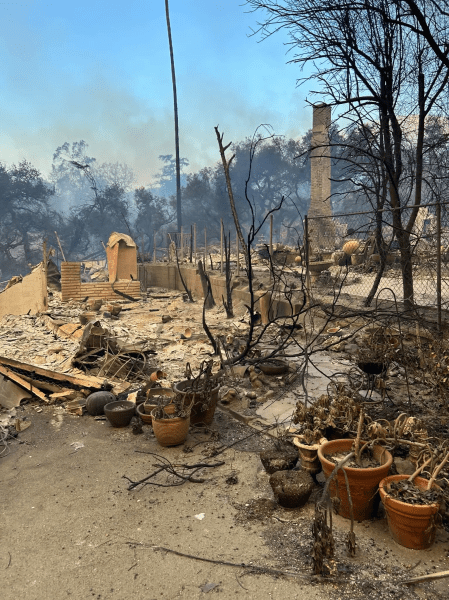
Dr. Peter Kalmus, a climate scientist at NASA’s Jet Propulsion Lab, chose to leave the Pasadena area where he lived for 14 years. He wrote in the New York Times:
I moved my family away two years ago because, as California’s climate kept growing drier, hotter and more fiery, I feared that our neighborhood would burn. But even I didn’t think fires of this scale and severity would raze it and other large areas of the city this soon. And yet images of Altadena this week show a hellscape, like a landscape out of Octavia Butler’s uncannily prescient climate novel “Parable of the Sower.”
One lesson climate change teaches us again and again is that bad things can happen ahead of schedule. Model predictions for climate impacts have tended to be optimistically biased. But now, unfortunately, the heating is accelerating, outpacing scientists’ expectations...
As a Climate Scientist, I Knew It Was Time to Leave Los Angeles
Climate and environmental reporters Raymond Zhong and Brad Plumer demonstrate the need for urgent action:
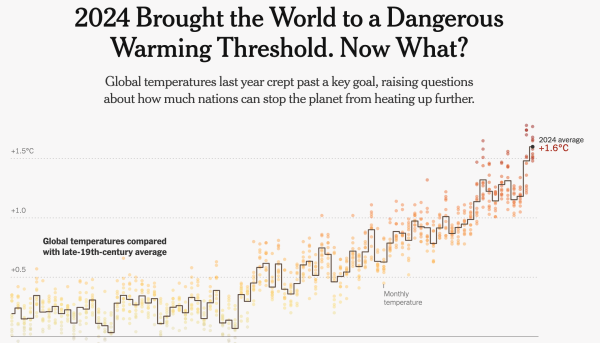
At the stroke of midnight on Dec. 31, Earth finished up its hottest year in recorded history, scientists said on Friday. The previous hottest year was 2023. And the next one will be upon us before long: By continuing to burn huge amounts of coal, oil and gas, humankind has all but guaranteed it…
Globally, despite hundreds of billions of dollars invested in clean-energy technologies, carbon dioxide emissions hit a record in 2024 and show no signs of dropping.
One recent study published in the journal Nature concluded that the absolute best humanity can now hope for is around 1.6 degrees of warming. To achieve it, nations would need to start slashing emissions at a pace that would strain political, social and economic feasibility.
The disastrous California wildfires are another undeniable sign of the dangers of climate change. Sadly, climate change denial will not be affected. The powerful oil and gas lobby exercises dangerous influence over political leaders in Ottawa, Canada’s three western provinces, and throughout the USA.
Can we be anything but pessimistic about the future?

Categories: Climate Change


 in-sights.ca
Canadians may think the fires in Los Angeles will have little effect on their lives. Incorrect! After six days of burning, damages in California are estimated at US$150 billion. The number will continue rising.
Major insurance companies have stopped issuing new fire policies for some California homeowners. Others have left the California marketplace entirely. Insurance premiums everywhere will increase by substantial percentages.
Insurance and reinsurance companies are aware of increased risks arising from climate change. It is not a regional problem. The entire developed world is affected. Get ready to pay more when your home insurance is renewed. But that’s not all. Industrial and commercial enterprises will pay more to insure their operations. The result? Inflated prices that affect us all.
LikeLike
In answer to your last question Norman, short answer is no. There is simply no reason for hope at this point. If you can figure out a way to change the minds of committed Reformers, we need to hear it now.
LikeLike
Being around the climate change subject for now over 40 years, I can say the current Carbon Tax is a fraud, a placebo for government which is doing nothing about climate change, but pretend they are for strictly politcal purposes.
If you want to reduce carbon emissions, one must provide alternatives to the car, and i don’t mean electric cars. It is called rail.
We build rapid transit to win elections, not to move people; we ignore using our established railways to move goods and passengers.
The failure to both electrify our national railways and provide both regional and national rail passenger service.
Example: Norway, population 5.5 million, railway system comprises 4,109 km of 1,435 mm (4 ft 8+1⁄2 in) (standard gauge) track of which 2,644 km is electrified and 274 km double track. There are 697 tunnels and 2,760 bridges.
The Norwegian Railway Directorate manages the railway network in Norway on behalf of the Ministry of Transportation. Bane NOR is a state enterprise which builds and maintains all railway tracks, while other companies operate them. These companies include Vy and subsidiaries Vy Gjøvikbanen and CargoNet, Flytoget, Go-Ahead, SJ Norge, Green Cargo, Grenland Rail and Hector Rail.
Norway carries over 45 million passengers annually.
Just compare to BC, with a 3 times weekly passenger service and on very limited commuter service (5 trains in and five trains out) every weekday.
Pathetic!
LikeLike
Carbon taxes, like that implemented here in Canada, manage to induce shrill complaints — including those by corporatized mainstream media. Except for high-income earners, Canadians are more than reimbursed via federal government rebate, yet the whining persists.
Meanwhile, many drivers of superfluously huge and over-powered thus gas-guzzling vehicles seem to consider it a basic human right. It may scare those drivers just to contemplate a world in which they can no longer readily fuel that ‘right’, especially since much quieter electric cars are for them no substitute.
Such disturbing mass addiction to fossil fuel products by the larger public undoubtedly helps keep the average consumer quiet about the planet’s greatest polluter, lest the consumer be deemed hypocritical. There’s a continuance of polluting, if not destroying, the natural environment with a business-as-usual attitude, like it all is somehow absorbed by the planet without repercussion to human wellbeing.
Also, here in the corpocratic West, if the universal availability of a renewable energy alternative would come at the expense of the traditional ‘energy’ production companies’ large profits, one can expect obstacles, including the political and regulatory sort. If something notably conflicts with corporate big-profit interests, even very progressive motions are greatly resisted, often enough successfully.
Greatly exacerbating this already serious problem is the large and growing populace who are too overworked, underpaid, worried and rightfully angry about food and housing unaffordability for themselves or their family, to have energy left to criticize big industry for the environmental damage it causes/allows, especially when not immediately observable.
It all must be convenient for big industry’s profit interests — particularly when neoliberals and conservatives remain overly preoccupied with vocally criticizing one another for their relatively trivial politics and therefore divert attention away from some of the planet’s greatest polluters and pollution, where it should and needs to be sharply focused.
LikeLike