



Climate scientist Zeke Hausfather wrote, “2023 and 2024 were exceptionally warm years, at just below and above 1.5C relative to preindustrial in the WMO composite of surface temperature records, respectively.” He also said that last year was the hottest the Earth has experienced since the start of global temperature records in the mid-1800s – and likely for many thousands of years before.
The year 2024 was the first in which average global temperatures at the surface of the planet exceeded 1.5C above pre-industrial levels in the majority of leading datasets. “A sizable portion of 2024’s elevated temperatures were driven by a moderately strong El Niño event that peaked in November 2023.”
For this reason many of us expect that 2025 will be cooler than both 2023 and 2024, and is unlikely to be the warmest year in the instrumental record (though it will very likely be in the top three warmest years).
However, at least at the start of the year nature seems not to be following our expectations. Global temperatures were in record territory for the first three weeks of the year in the Copernicus/ECMWF ERA5 dataset…
January 2025 beat the prior record set in January 2024 by a sizable margin… An unexpected record to start things off may presage higher temperatures this year than many of us thought.
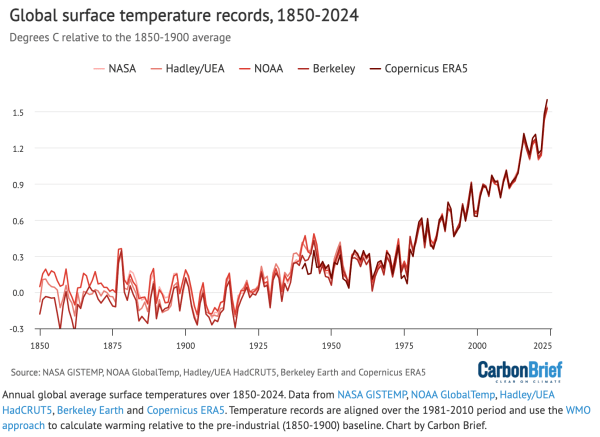

Noteworthy findings from this 2024 review include…
- Global surface temperatures: It was the warmest year on record by a large margin – at between 1.46C and 1.62C above pre-industrial levels across different temperature datasets and 1.55C in the World Meteorological Organization (WMO) synthesis.
- Exceptional monthly temperatures: Global temperatures set a new record each month between January and June, extending a 15-month record-setting stretch which began in 2023.
- Warmest over land: Global temperatures over the world’s land regions – where humans live and primarily experience climate impacts – were a record 2.3C above pre-industrial levels.
- Warmest over oceans: Global sea surface temperatures set a new record at 1.1C above pre-industrial levels.
- Ocean heat content: It was the warmest year on record for ocean heat content. In 2024, the oceans added 25 times more heat than all annual human energy use.
- Regional warming: It was the warmest year on record in more than 100 countries – including China, Canada, Mexico, Germany, Brazil, Greece, Malaysia and South Korea – and in areas where a total of 3.3 billion people live.
- Unusual warmth: The specific causes behind the exceptionally warm, record-setting temperatures in both 2023 and 2024 remain an open scientific question, with human-caused greenhouse gases, variability in El Niño and changes in the reflectivity of clouds all playing a role.
- Comparison with climate models: Observations for 2024 are above the central estimate of climate model projections in the Intergovernmental Panel on Climate Change (IPCC) sixth assessment report, but well within the model range.
- Heating of the atmosphere: It was the warmest year in the lower troposphere – the lowest part of the atmosphere – by a large margin.
- Sea level rise: Sea levels reached new record highs, with notable acceleration over the past three decades.
- Shrinking glaciers and ice sheets: Cumulative ice loss from the world’s glaciers and from the Greenland ice sheet reached a new record high in 2024, contributing to sea level rise.
- Greenhouse gases: Concentrations reached record levels for carbon dioxide (CO2), methane and nitrous oxide.
- Sea ice extent: Arctic sea ice saw its seventh-lowest minimum extent on record, while Antarctic sea ice was at the second-lowest level on record for much of the year.
- Looking ahead to 2025: Carbon Brief predicts that global average surface temperatures in 2025 are likely to be the third warmest on record after 2024 and 2023, at around 1.4C above pre-industrial levels. However, large uncertainties remain given how exceptionally and unexpectedly warm the past two years have been.
.
More alarming news:
Policy makers and wider society should be aware that the rate of global warming over recent decades is a poor guide to the faster change that is likely over the decades to come, underscoring the urgency of deep reductions in fossil-fuel burning…
Categories: Climate Change


