



We can use our purchasing power to support local people practicing small-scale agriculture. This is particularly important because British Columbia’s government is focused on subsidizing and facilitating the climate-destroying fossil fuel industry.
While disturbing events fill the news, today’s email from Diane Exley of Cedar Isle Farm shows individuals contributing calmly and positively to our world. Excerpts are repeated below the separator line.
At The Tyee five years ago, Christopher Cheung wrote about the farming endeavours of Diane and her partner Jim Grieshaber-Otto.
Established in 2009, Cedar Isle Farm Organic Grains CSA provides the Lower Mainland with locally produced grain and flour. The grain crops are all grown and cared for at a family farm in Agassiz, B.C. and all products are certified organic.
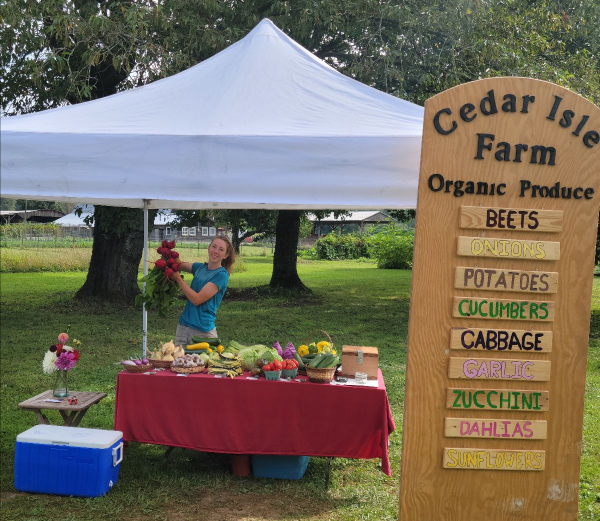
There was a new adventure at Cedar Isle Farm last year. Our daughter, Hannah, finished her master’s degree at the London School of Economics in the fall of 2023 and returned home with her mind full of new experiences. It was definitely a change for a rural Canadian to live in the heart of central London for a while. It was an even bigger adjustment as she began to research the global governance and politics of agriculture within international institutions such as the Food and Agriculture Organization of the United Nations.
Hannah’s thesis emphasized the critical role of small-scale farms in providing nutritious food to local communities all over the world. It also highlighted the mechanisms by which small-scale farming is disregarded by international organizations in favour of large-scale industrial agriculture. Rather discouraged about the prospect of working in the agriculture policy realm, Hannah decided to practice small-scale agriculture herself following her graduation. She turned her organized mind from politics to produce and her new organic vegetable venture was born.
Although we have grown grain crops for many years now, and have always grown a large home garden for ourselves and friends, Jim and I really had little idea about what makes a successful vegetable farming operation. Our friend, Yoshi Sugiyama, grew vegetables here for several years and we watched with interest but it wasn’t until Hannah’s ideas were spread out in front of us on the kitchen table that we had a better inkling of what was involved.
One of the biggest issues for growers of perishable vegetables is how to sell their produce when it is fresh and ready to eat. There are limited opportunities for farmers markets at this end of the valley so Hannah was delighted to be asked to grow bulk vegetables for an existing CSA box program run by two amazing people, Miranda Chiasson and James Stobbe from Sweet Earth Farms in Ryder Lake, Chilliwack. Their farm is nestled in the mountains with some challenges for soil and water so they were pleased to partner with a grower with access to the fertile valley floor. In turn, Hannah was keen to draw on their invaluable experience and knowledge as she began her first season.
With her main market established, the next question was… what to grow? In discussion with Miranda, and her own preferences, Hannah decided to focus on alliums (onions of many kinds, leek and garlic), root vegetables (radishes, beets, turnips, parsnips and carrots) and some brassicas (different kinds of cabbages, kale, and broccoli). As well, she planted smaller amounts of vegetables for an on-farm veggie stand and, when the planting spreadsheet was finished, it included a wide alphabet of veggies from beans, cucumbers, eggplant and herbs to potatoes, squash, tomatoes and zucchini. It was going to be a busy time.
Before we knew it, Hannah had ordered her seeds and the packets began to arrive. By early February, the first seeds were planted in the greenhouse. By March, the greenhouse was filling up and by April it was time to prepare the fields and start planting out the seedlings. Field plans were made and then adjusted and still it was a puzzle how to fit everything in.

| And, throughout it all, Hannah had to contend, of course, with the vagaries of the weather: too cold, too wet, too hot, too dry, too wet again… There were decisions about equipment, compost, irrigation, row cover and endless hours of weeding and bunching, eased a little by the efforts of friends and family. There were early mornings, late evenings and the odd disaster but week after week we marveled as Hannah harvested boxes of beautiful organic vegetables. |
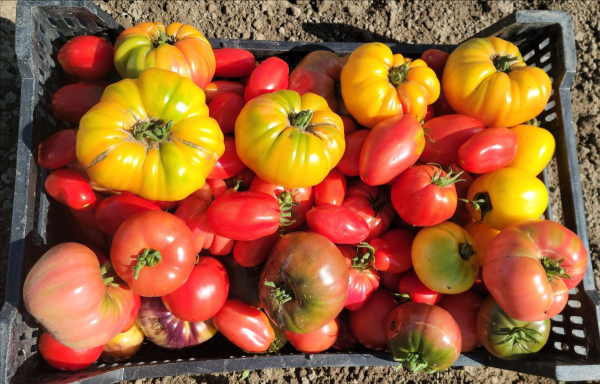

Her farm stand garnered some loyal followers who stopped by regularly to see what was fresh for dinner in the week ahead and the Sweet Earth folks enjoyed their veggies all season.
…Reinforcements from the Fraser Valley Watersheds Coalition worked on areas we had previously tackled. The dedicated FVWC team and their brush cutters cleared blackberries from slough banks that are too steep for the mower to handle and generally prepared these riparian zones for planting with trees when spring arrives.
This work was funded by a program called Farmland Advantage which supports farmers to enhance natural areas on their land for the benefit of everyone and we are thrilled to be part of it. We’ll look forward to sharing more photos with you as the project moves ahead.
Just before we sign off, we wanted to let you know about an exciting local grain-related event coming up on February 25th. The Canadian Baking Association is hosting a Farmer-Miller-Baker summit focused on highlighting and celebrating the benefits of sustainably sourced, freshly milled flour. We are looking forward to learning about whole grain baking from our friends Vadim Mugerman (Bad Dog Bread), Tommy Aird (Tommy’s Whole Grain Bakery) and Mark Hart (Rise Baking Lab), and Hannah is excited to give a presentation on our experiences growing and distributing grain in the Fraser Valley.
The summit will be held at the University of the Fraser Valley’s Chilliwack campus between 9:00 and 5:00 on February 25th. If you are interested, you can register to attend at the following link and we look forward to seeing you there!
Spend an inspiring day dedicated to elevating your products with the nutrition, texture, and quality today’s customers crave. Discover the unique characteristics and benefits of sustainably sourced, freshly milled, local flours, and master advanced techniques from artisan baking experts. Connect with fellow bakers on the grains-to-table journey, exchanging insights on farming practices, grain processing, artisanal baking and consumer engagement.

For now, though, best wishes from all at the farm and take good care in the weeks ahead.
Diane
The entire message from Cedar Isle Farm is available HERE.
Categories: Agriculture


 in-sights.ca
Hi Dave Just napped
LikeLike