



After writing about geothermal energy, I made a remark on Facebook regarding a Western Canadian company having to go to Bavaria to launch its first commercial clean energy project. I said that was because European policies are not dictated by existing oil and hydropower interests.
That led to a response by Glen Clark, Chair of BC Hydro:
Not really true Norm. As you know, we have literally the lowest electricity rates IN THE WORLD! And it is almost entirely renewable. The challenge of geo-thermal is that it is dramatically more expensive and, in the case of Canada, unproven. Hydro and others have spent millions researching geo-thermal. Personally, I’m hopefully that new technology (ironically invented for fracking) will start to make geo-thermal competitive.
A conversation followed involving individuals knowledgeable about the provincial utility’s operations:
Glen Clark, you are correct in saying we have some of the lowest rates in the world. However, this is only because of Hydro’s ongoing use of deferral accounts. BC Hydro will defer over a billion dollars of costs in the next three years without the independent approval of the BCUC and how sustainable is this? So, while they are low in comparison to many other jurisdictions, it’s only because costs are being deferred to avoid rate shock to customers.
Laila Yuile
Not true Laila. It was true under the Liberals. But the multiple deferral accounts today are reasonable and really just smooth out rates. If you eliminated them you would see wild swings which would be terrible public policy. Every single deferral account has an audited payback attached to it. What will increase rates in the future is the large number of wind farms and a few solar plants- all of which i strongly support but are way more expensive than our legacy hydro.
Glen Clark
Laila Yuile, if the definition of “renewable” includes respect for Indigenous rights, ecological integrity, and intergenerational sustainability, then Site C does not fully meet that standard. It may produce renewable energy, but at a non-renewable cost to the environment and communities.
Scott Scholefield
I think it is time for a new and independent analysis of the geothermal vs hydro debate on financial impacts, environmental and social impacts, and the relative benefits of each. For example, the externalities of large hydro are immense and should be accounted for in a decision-making process. With 15 countries quite happy to be using their geothermal generation and many more using geothermal heating, we should be wondering why BC Hydro chose not to develop some pretty good resources in BC.
RanD Hadland
RanD Haldand, for sure, hydro is exploring geothermal! It would be a terrific addition, though very expensive compared to our current generating capacity.
Glen Clark
Glen Clark, “Almost entirely renewable…” BC Hydro reported a year ago that it had purchased $1,330.9 million of market energy. Can we conclude that fossil-fuel-burning producers outside the province are no longer material providers to the provincial utility?
Norman Farrell
Norman Farrell, sure. Some was fossil fuel. But lots of solar, hydro, wind. We are definitely still suffering from drought. In spite of that (and the remaining small diesel plants in remote areas), we are overwhelming renewable (98%). Again, best in class in the world.
Glen Clark
Scott Scholefield, have you heard anything recently about the Fort Nelson First Nation geothermal start up? At a recent conference in Fort St John, Warren told a local news group the project is awaiting an electronic purchasing agreement from BC Hydro before drilling can begin.
RanD Hadland
Good for them. Nations need to lead the way not Hydro flooding valleys.
Scott Scholefield
Glen Clark, it seems to those of us along the length of the Peace River that if we are to call an energy system renewable, then the components of that system must be renewed at some point. The valley’s renewals themselves are neither scheduled nor have their costs been accounted for in Hydro’s pricing system for power. There is the option to do so in the form of decommissioning costs similar to nuclear plant removal and clean-up. I mentioned earlier the environmental and social externalities that aren’t covered in our low-cost electricity. Decommissioning is only one of those.
RanD Hadland
My first comment is that I appreciate these respectful engagements, which show that people can disagree on social media without resorting to rude statements. Each of the commenters comes from a different place, with unique and valid information inputs.
In the original article, I mentioned that corporate inertia played a role in BC Hydro’s decision-making.
Understanding Corporate Inertia
Overcoming Corporate Inertia and Executive Frustration
Corporate inertia refers to an organization’s tendency to stick with established routines, processes, and strategies, even when they are no longer effective. It’s a common problem, particularly in long-standing companies that have enjoyed success in the past. The belief that “what worked before will work again” can be deeply ingrained, leading to a reluctance to adopt new methods or technologies. This resistance to change can be subtle, manifesting as slow decision-making, endless rounds of meetings, or a lack of urgency in pursuing new opportunities.
BC Hydro has delivered reliable and low-cost electricity for decades. In the days of W.A.C. Bennett, the company constructed hydropower facilities that provided a long-term supply of affordable electricity. Fifty and sixty years ago, the province was generating more electricity than it was consuming. As time passed, the utility gained billions of dollars from the sale of surplus power, but more importantly, BC had a continuing supply of low-cost energy.
BC residents and businesses have enjoyed low electricity rates because of decisions made three generations ago, not because BC Hydro’s business strategies are wise today. The Bennett Dam has 2.5x the capacity of Site C, yet the newer dam cost almost 25x as much.
BC Hydro tends to use word games to defend its policies. The phrase “powered by water” is included in many of the utility’s promotions. Yet, the company is buying power from Alberta and the USA, much of it generated at gas, coal or nuclear facilities.
RanD Hadland, a native of the Peace River Valley, made important points when he mentioned environmental and social externalities. These costs are routinely ignored by those in the business of disrupting rivers and flooding vast areas of land.
Externalities are effects not evidenced in the economic transaction of an operator that is producing or purchasing it but interfere with parties not involved in the transaction. Hydropower is a renewable source of energy that typically generates several positive and negative externalities affecting multiple stakeholders. Commonly, in big HPPs (installed power of more than 100MB) the basin impoundment and occupation is the main component of the overall externality.
The idea that geothermal power is “very expensive” is flawed. We ought not to compare the cost of geothermal energy to the cost of electricity produced at the 57-year-old Bennett Dam, or the average cost of power at all of BC Hydro’s legacy projects. Better to compare to the cost of power from the newly built Site C.
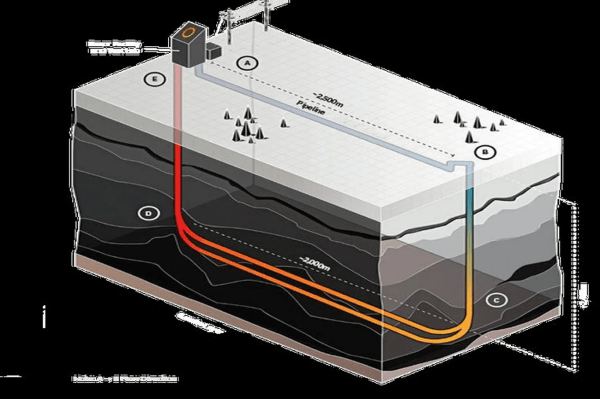
Another consideration is that Eavor’s Closed Loop Geothermal technology is in its infancy, although the drilling techniques have been proven in the oil and gas industry. I remember when newly developed home video players cost almost $7,000 in today’s dollars. As the technology matured, unit costs plummeted. We can expect that the costs of grid-scale geothermal energy will decline significantly as these power plants become more common.
The real value of geothermal energy is that it is dispatchable, very low-carbon and non-destructive. Eavor may be about to prove that reasonably priced geothermal energy can be widely harvested.
Categories: Geothermal


 in-sights.ca
Mr Farrell, point taken. Geothermal is overdue.
If anywhere in Canada qualifies naturally then BC and the West coast is an ideal location for geothermal plants.
Since mountains don’t rise to the clouds by themselves, they are lifted.
Vancouver Island didn’t just fall asleep and drift off shore, it was shifted.
Every year BC experiences about 804 earthquakes. BC is tectonically active
Geothermal technology is being employed throughout the world.
Renewable? There is no way geothermal energy will suddenly become unavailable or too costly to sustain.
Unlike its competitors, continued dependency on Oil and Gas makes a much sense as demanding that automobiles must be banned to protect the horse and buggy industry. Hydro is becoming obsolete. Gas and Oil are too toxic.
As for who could show us the way ahead? Iceland is one option. Closer is California. As far back as the 1960’s California began their geothermal experiment. Where they are now is outlined at this site
https://storymaps.arcgis.com/stories/26196042ba8a437a851ebf23efc3f6ab
Additional sources.
https://www.enelgreenpower.com/learning-hub/renewable-energies/geothermal-energy/advantages
https://www.un.org/sustainabledevelopment/climate-change/
https://www.eia.gov/energyexplained/geothermal/where-geothermal-energy-is-found.php
https://www.energy.gov/eere/geothermal/geothermal-basics
https://www.bc-er.ca/what-we-regulate/geothermal/#:~:text=British%20Columbia%20is%20situated%20on,to%20the%20surface%20by%20pumping.
https://www.energy.gov/eere/geothermal/geothermal-basics
Mr McCutcheon is right,
“We have the work force, knowledge and equipment but our government continues to focus on building out the fossil fuel industry. We could own this industry.”
Making billions from selling oil didn’t stop California from employing geothermal. The same process needn’t prevent BC from following suit.
LikeLike
Wow, Mr. Clark, still at the public pig trough, nice work when a NDP government is in power.
To be frank, I would not believe a word that Mr. Clark says, as the Eye is well aware of his many exaggerations of the truth.
GeoThermal power is one of the largest, environmental friendly power sources we have, yet we do a lot to discourage development in this part of the world.
The NDP, past and present are not interested in the environment, except to tax people in its name.
LikeLike
When I mentioned the respectful tone of comments on Facebook, I didn’t expect a different response here.
Glen Clark has had a years-long record of success as a senior manager at one of British Columbia’s most successful businesses. That followed 13 years of serving the public in the Legislature, including more than three years as Premier.
I’m sure he does not need to sit on the BC Hydro board for its relatively modest financial rewards
I am also sure that no other BC Hydro Chair before Clark has bothered to engage in a public conversation with long-time critics of the company. Long before this, Mr. Clark agreed to meet me for coffee to talk about the province’s energy policy and the directions he’d like the utility to take in the future.
I believe that in his present role, Glen Clark aims to do the best for BC residents that he can. It is not productive to direct insults at public servants if you hope to have them consider a different course of action.
LikeLike
What I find very disappointing with Glen Clark’s comments is the simplicity and error filled content. Mr. Clark has access to BC Hydro’s numbers and you would hope he would be truthful, however, it appears he has slipped into his political suit again and applied some serious spin. Comparing the cost of building out advanced geothermal today against legacy hydro is completely ridiculous and Mr. Clark should know better. It is insulting to me, and I’m sure a number of your readers, that Mr. Clark’s comments weren’t rooted in more reality. There were an awful lot of omissions and half-truths. Completely ignoring the benefits of geothermal, such as base load, energy sovereignty, small footprint and completely being renewable is not acceptable. I expect much better from a person with Mr. Clark’s background.
LikeLiked by 1 person
BC Hydro’s recent call for power process netted about the same production capability as the Site C dam, derived from ten projects; nine wind and one solar. The announced average price is $74 per megawatt hour. I’ve read that the cost of the Site C power is much higher. It seems that much turmoil and damage (political and otherwise) could have been avoided to obtain the same capacity had our leaders and BC Hydro planners kept up to speed on evolving technology. There were many sources urging them to do so, with very limited success.
Another call for power (again for about the same production capability) is scheduled this summer, along with a “Request for Expressions of Interest (RFEOI) to explore large-scale, baseload capacity projects—such as geothermal, pumped storage, and other firm energy solutions—with submissions closing in September.”
Mr. Clark says, “What will increase rates in the future is the large number of wind farms and a few solar plants.” Given that another large BC Hydro dam project is very unlikely, and the cost of power from the most recent hydro build is higher than the wind and solar just contracted, this seems a rather defensive and disingenuous statement.
Some questions come to mind that maybe Mr. Clark or someone from BC Hydro could answer:
* Are any “Run of River” projects anticipated as a result of the new calls?
* What lessons were learned from the infamous Gordon Campbell-driven IPP contracts BC was saddled with?
* Have the new contracts been structured with those lessons in mind?
* What is BC Hydro’s personnel strategy to ensure the necessary expertise is available to meet rapid advances in technology?
* Will BC Hydro develop in-house expertise to create and maintain cutting edge energy sources, or will that be left to private industry?
* Who will administer all the new projects? In-house personnel, or outside consultants?
* Given that BC Hydro has spent millions researching geo-thermal, how many in-house experts in the field does BC Hydro employ, and can you point to any trial installations or exploration conducted by BC Hydro?
* Is power to fossil-fuel production such as LNG plants, fracking facilities, etc. subsidized, and if so what is the total dollar value per year?
* Would the subsidizing of fossil fuel production be factored into an analysis of “best in class” energy production?
LikeLiked by 1 person
Good points Lew. You bring up the BC Hydro call for power. This is clearly an under-the-table strategy to slowly privatize BC Hydro. This makes no sense. Look south of the border where most power utilities are private. Customers are paying 2-3 times what we are and service disruptions are far more frequent. BC Hydro should build and own all future power generation capacity.
LikeLike
Two questions:
Mr Edwardson observes..
“ Given that BC Hydro has spent millions researching geo-thermal, how many in-house experts in the field does BC Hydro employ, and can you point to any trial installations or exploration conducted by BC Hydro?”
Mr McCutcheon adds…
“BC Hydro should build and own all future power generation capacity.”
Add a third question: why wouldn’t BC Hydro and the BC Government encourage such projects?
Five Geothermal projects current1y are ongoing in BC. .
1 / Vancouver International Airport YVR) Expansion
===========
2 / South Meager Geothermal Project [Pemberton]
https://meagercreek.ca/project/
“Meager Creek Development Corporation holds the only geothermal lease in British Columbia. This lease grants the holder the ability to generate geothermal power.”
“BC is one of the few jurisdictions in Canada with a geothermal regulatory framework. Currently the provincial government is considered to own the “right, title and interest in all geothermal resources”.
===========
3 / Kitselas Geothermal [Terrace]
https://www.kitselasgeo.ca/project_updates.html
“Kitselas Geothermal is a majority owned First Nations company that has been advancing the project for over 10 years with exploration and permitting support from Borealis Geothermal. Using results from recently completed field work, the project is now moving towards development. This will be a first of its kind project for Canada and is modelled after a Maori approach to geothermal energy development in New Zealand.”
===========
4 / Valemount Geothermal Project
https://www.miningandenergy.ca/read/meet-the-forestry-town-striving-to-become-canadas-first-geothermal-village
“Borealis hopes to build a 15-megawatt power plant that will supply power back to the BC Hydro grid but the community envisions a “holistic energy development program,” as Dunn put it, that will support a whole host of community-led projects.”
“Places like Iceland are getting more and more use of what is called heat-cascading,” Dunn said. “So you have a high-temperature resource that may be used for power, then it may be used for brewing applications, and then greenhouses and in the end it may be used to make sure your sidewalk doesn’t freeze.”
“Beyond that, Dunn said locals already have plans for the residual heat leftover from the proposed 15-megawatt power plant Borealis wants to power with steam-driven turbines.”
“That creates an opportunity for what looks like an eco-village or a geo-park…That means we can have a number of organizations like greenhouses, fish farming, brewery, silviculture, or timber industry applications in close proximity and they can actually take advantage of each other’s opportunities, trading CO2 with each other if necessary from the brewery back to growing operations.”
===========
5 / Tu Deh-Kah Geothermal Project [Fort Nelson]
https://barkley.ca/project/tu-deh-kah-geothermal/
“This trailblazing project is 100% owned by the Fort Nelson First Nation through its economic development corporation, Deh Tai LP.”
“The project is situated on a 40+-year-old gas field that has long been a cornerstone of the regional economy but is now facing economic decline.”
“Fort Nelson’s islanded electricity grid is currently 100% reliant on fossil fuels. By repurposing this depleted gas field into a renewable energy source, this project aligns with the Province of BC and the Government of Canada’s net-zero by 2050 carbon emissions target.”
===========
Four above are First Nation community driven. Clearly these groups understand the benefit of disconnecting from oil and gas dependency.
In as much as these communities are demonstrating the way forward how does the province or BC Hydro support these projects?
LikeLiked by 1 person
I am new to this blog so hope that what I will say is helpful to the discussion.
On reading the contributions I note that the issue of public ownership of generating facilities is absent and there seems to be the assumption that BC Hydro should acquire all of its future energy from private power developers. I question this approach and also the accounting that is often used to compare the costs of new generation.
What is absent normally is the long term value of acquiring generation assets. When projects such as wind and solar are public, the assets also end up being public.
When BC Hydo purchases power from private developers the assets are private and in the long term provide an ongoing stream of revenues to the owners beyond when the initial contracts expire.
Cost comparisons are often like comparing buying or renting. If it costs $2,000 per month over 20 years to rent and $2,100 per month over the same period to buy it can appear cheaper to rent. But after 20 years the renter has no assets while the home owner has a house.
Yet in many of the cost comparisons, BC Hydro’s costs do not include the long term value of acquiring an asset. Ken Davidsons’s excellent study Zapped in 2019 outlined the enormous extra costs of Gordon Campbell’s push to promote private power by forcing BC Hydro to acquire it at prices far higher than the market price.
Now BC Hydro is saddled with the resulting costs which are blended into the very cheap public power that was built by WAC Bennett and his successors.
BC Hydro should not be treated as a collection agent for private power developers but rather as a valuable publicly owned asset with the capacity to develop the power the province will need in the future.
There is no reason why BC Hydro should not be building solar or wind, other than the legacy of the ban on it doing so implemented by previous governments.
It is not in the interests of BC ratepayers for the system to be incrementally privatized or for its policies to be shaped by private interests intent on maximizing shareholder profits. New generation can be public, but only if there is the political will to do so.
LikeLiked by 1 person
Thanks for this post John. You are absolutely right that BC Hydro should be building, owning and operating 100% of its power generating capacity. In the run, this is the most cost effective path. South of the border most power utilities are private and customers are paying 2-3 times what we are.
Privatizing power also dilutes our energy sovereignty. This is very dangerous. The power company has leverage when negotiating new contracts and they will use it to negotiate sweeter deals and less regulation. We also find ourselves badly exposed if the power company goes bankrupt or its sloppy maintenance has led to frequent blackouts.
Essential services such as energy and water should never be privatized.
This is a topic that needs a higher profile and more discussion.
LikeLike