



Twenty-four Canadian, American, and Chinese researchers contributed to an alarming study published by the prestigious journal Science in 2024. The team included scientists from Environment and Climate Change Canada, National Research Council Canada, Yale University, Harvard University, and Peking University.
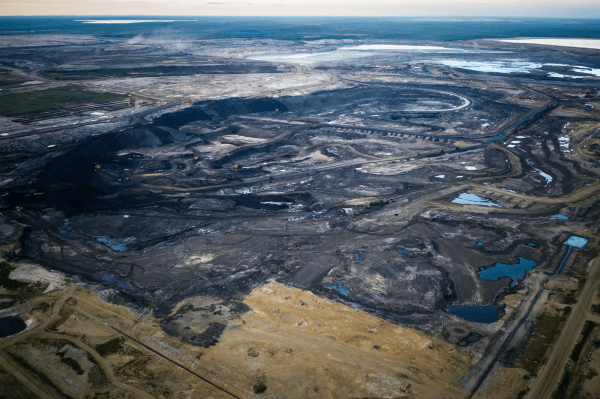
Their study found that emissions from Alberta’s oilsands may be far greater than regulators and the public have been led to believe. Aircraft measurements revealed gas-phase organic carbon emissions up to 64 times higher than official estimates reported by the industry.
Total organic carbon emissions in Alberta are equivalent to those from all other sources across Canada combined.
Gaseous organic compounds are associated with considerable air quality and environmental impacts through exposure to primary emissions and/or after their photochemical reactions and multigenerational oxidative transformations. The latter leads to secondary air pollution, including tropospheric ozone and secondary organic aerosol (SOA)—a principal component of particulate matter (PM2.5) linked to major health and climate effects.
Of course, this study has been ignored by the governments of Canada and Alberta, as was a 2016 study that also warned about pollution from tar sand vapours.
Categories: Climate Change, Tar Sands


Thank you Internet.
In any time before ours a tricky question likely would go unanswered –
– is it possible to employ a network of pipelines to solve dozens of enormously complex environmental problems simultaneously?
Incentive?
With sea levels rising, irreplaceable ground water resources are being depleted, employed for agriculture, to run industrial processes, and to keep a growing human population from expiring via dehydration. Simultaneously there’s too much undrinkable water rising around us and not nearly enough of the good stuff left. It’s Dickens best and worst of times.
That conceded, imagine our worst imaginable water crisis on an enormous scale in a region in much worse condition. Imagine a country with more than 1 billion people many concentrated where there has never been sufficient water.
Lacking alternatives China tackled this problem with an effort to reduce the ever-expanding Gobi Desert.
The video below’s title? Provocative.
It suggests a hare-brained mega-project so completely absurd it had to fail. Nowhere on earth was there technology sufficiently advanced to cope. What could China do but invent it.
China Pumped BILLIONS Of Litres Of Ocean Water Into A Dead Desert — What Happened Next Was Shocking
See for yourself.
To cope with the Gobi Desert various seemingly unrelated Sciences were merged: Physics, Hydrology, Desalination, Engineering, Biology, Forestry, Biochemistry, integrated on a scale never before seen. The results are shocking.
As for stuck-in-a-Political Dark Age Canada.. It’s humiliating.
Canada and BC? We must become a fossil-fuel Energy Superpower! Priority One!
Affordability? Crime? Poverty? Joblessness? Healthcare? Housing? Homelessness? Back burner. Not relevant to a Superpower on the rise!.
Yes, we’re busy paralyzing our Plutonomy financially trying to justify spending billions on Data Centre Mania. Because? Apparently selling information is highly profitable to investors. AKA the One Percent who really matter.
Watch the video, step back and review what was accomplished. The success of that analytical process should signal every other country to reassess what they’re doing. Why they need to understand what the effort cost, what worked, and how many millions were saved from irreparable harm.
Then? Copy the Science and implement it.
Instead? Canada must build pipelines. To ship toxic bitumen. That said Alaska is ready to build an undersea pipeline or two — to Russia.
[The closest distance between the mainland coast of Alaska (Seward Peninsula) and the mainland coast of Russia (Chukchi Peninsula) is approximately 55 miles (88.5 kilometers)]
The cost benefit to Alaska? No vessels involved. No vessel crews, fuel, maintenance, or insurance costs, nor bureaucratic overhead. Whatever flows through the pipeline to Russia is what it costs.
Back East? What does Irving Oil do to maximize their profits? They refine crude.
How much?
[Irving Oil’s Saint John, New Brunswick facility is Canada’s largest oil refinery, with a processing capacity of 320,000 barrels of crude oil per day. Additionally, the company operates the Whitegate Refinery in Ireland, which has a processing capacity of up to 75,000 barrels per day.]
No way angry, suffering, longing to be free of tyranny (as US State 51) Alberta, could ever imagine refining their own bitumen! Never!
Stay tuned.
LikeLike