


The Tyee and Canada’s National Observer consistently produce independent journalism worth our attention. While browsing recent stories at The Tyee, one stood out. It’s an account of a billionaire family receiving a tax break for a long-vacant Vancouver property that once housed hundreds of low-income residents.
Today, Little Mountain is devoid of residents, despite years of promises that affordable housing would return.
The Tyee story is about more than a tax concession. It illustrates how politics in British Columbia has shifted over time.
Founded on principles of economic equality and public responsibility, the BC NDP now accommodates large private capital interests. Policies that once would have been challenged as favouring wealth and privilege are increasingly defended as pragmatic governance, leaving many traditional social-democratic ideals at the margins.
The result is an environment in which policies benefiting wealthy property owners coexist with a persistent shortage of affordable housing.
Vancouver Tenants Union member Nathan Crompton wrote in 2023 about the history of the Little Mountain property near Main Street and 33rd Avenue:
…Little Mountain was born from a working-class struggle in the 1940s and ‘50s that went against the odds, accomplishing what had been declared impossible and utopian: a public program to build social housing and a plan to begin prying Vancouver’s housing away from the imperatives of profitability, corporate greed, and private ownership.
The years immediately after the war in Vancouver saw the beginning of an unprecedented mobilization that forced planners, city councillors, and federal politicians to reluctantly break with the market-oriented housing policies of the previous decades.
…In 1970 Little Mountain became the first tenant-run social housing in Canada, operating within a framework of tenant self-management and user control. Despite its limitations, this model was unthinkable in private rental housing both then and (especially) now.
British Columbia could have embraced the style of Vienna. The Austrian city has a population larger than Vancouver, although Metro Vancouver has more residents than the Vienna region.
Leadership in 20th-century Vienna embraced public ownership. More than half of residents live in subsidized or city-owned public housing. CBC reported in 2016 that Vienna had eight times as much social housing as Vancouver. The result in 2026 is a city where housing is relatively affordable when compared with other major European centres.
Nathan Crompton explained why public housing at Little Mountain remains a low priority for politicians who hold the levers of power.
…Prominent social democrats had switched entirely to the other side of the housing conflict, symbolized in Jim Green’s public relations campaign on behalf of the property developer at Little Mountain.
…The social democrats who had overseen the decline of the left were now sharpening their knives on the corpse of Little Mountain.
…In late 2009, Vancouver’s “progressive” city council (under the leadership of Vision Vancouver and then-Mayor Gregor Robertson) granted the demolition permit for the 224 units of on-site social housing, collaborating with the provincial government’s sell-off of Little Mountain.
…To this day, the vast swathes of land that sit empty throughout Vancouver are a living testament to the social tragedy of neoliberalism, but also a testament to the failures of center-left brokerage politics in Vancouver and across BC.
The Tyee updates the sad story of Little Mountain:
A patch of long-delayed development land in Vancouver has been temporarily turned into dog parks and a community garden. To some neighbours and critics, it looks less like a public amenity than a way to lower the tax bill on land that has sat unfinished for years.
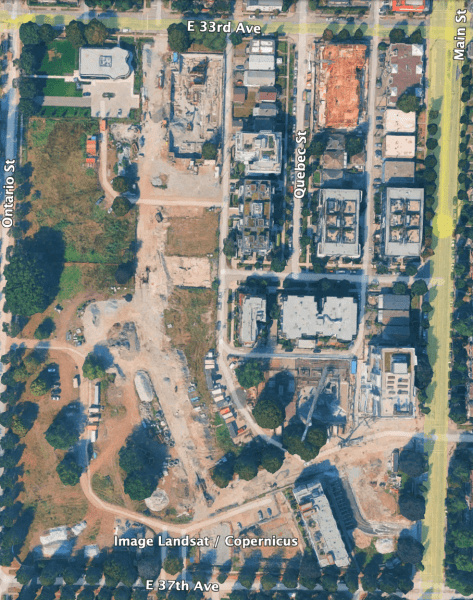
The land is part of the Little Mountain redevelopment, a 15-acre site near Queen Elizabeth Park bought from the province in 2008 by Holborn Group, a company owned by a Malaysian billionaire family.
…The land was being taxed at a business rate. But in the fall of 2025, Holborn converted two portions of it to community gardens and dog parks, which are taxed at a lower rate.
And Holborn isn’t the only developer getting a tax break by shifting how the land is used. A recent City of Vancouver report says this year 10 properties were reclassified, a decision that will force other taxpayers to make up a tax shortfall of $913,300. Two Holborn properties accounted for roughly $315,000 of that total.
…For neighbours, the tax numbers add to frustration with a site where the developer made big housing promises that have remained unfulfilled for years.
…Holborn had paid only $35 million of the $334-million purchase price by 2021 and received an interest-free payment extension to 2026 as well as an $88-million low-interest loan to complete the social housing…
Categories: Housing


Saying isn’t doing.
The latest Federal/Provincial Housing Initiative jointly announced by Mr Carney and Mr Eby hasn’t swayed those most affected. An estimate of why the Provincial NDP went so far off its Social Housing Promises is in your report
The CBC takes analysis a step further,
=====================================================================
https://www.cbc.ca/news/canada/british-columbia/bc-ottawa-housing-deal-municipal-analysis-9.7245322
Question of priorities
The first is what this plan doesn’t do — directly build new non-market housing, something local governments mostly lack the budget to deliver in meaningful numbers.
“If this program helps deliver below-market units, that’s very good. But we really need to look at ensuring that some of these really traditional, rent-geared-to-income, deeply-subsidized housing projects are still getting built in the province,” said Pachal.
Pachal and Johnstone were critical of the province investing $1.6 billion in this new plan, months after pausing or cancelling $1.4 billion in investments through the Community Housing Fund that were primarily geared toward non-profit housing projects.
• ‘Catastrophic’ decision to scrap affordable rental program leaves projects in limbo
“We will get the market housing built, but we still need the federal government to get back into the business of building non-market housing,” said Johnstone.
“I’m old enough to remember when there was a mayor of Vancouver who used to say this quite often, who now has a role where I think he has his fingers on some levers,” he added, referring to federal Housing Minister Gregor Robertson.
The second reason is that in Metro Vancouver, the new money will lower taxes on new developments — called “developer cost charges” — which local mayors had gone back and forth on in recent years as the best way to pay for the required infrastructure upgrades that come with new developments.
=====================================================================
Conservative Leader Pierre Poilievre held a Property Rights Town Hall in West Vancouver at the Kay Meek Arts Centre. During his Metro Vancouver tour, he did not explicitly advocate for high rises; instead, he criticized dense urban towers and condemned a joint federal-B.C. government plan to purchase empty Vancouver condos for affordable housing as an unfair “bailout” for developers.
=====================================================================
https://www.cbc.ca/news/politics/poilievre-carney-eby-bc-condos-bailout-metro-vancouver-9.7243786
Recent data from the Canada Mortgage and Housing Corporation shows that as of last month, there were 4,376 completed condos sitting empty in Metro Vancouver, a 76 per cent increase from the same period a year ago.
The prime minister did not say if the government plans to buy up units in bulk at below-market value.
Carney said by lowering development charges for multi-unit housing by up to 50 per cent, builders could save up to $40,000 per unit, and governments would fund infrastructure such as water systems, wastewater systems and local roads.
Poilievre said the prime minister “wants to privatize the profit and socialize the losses. In other words, make you pay the price…. There’s no free lunch here. Someone has to pay for the loss.”
=====================================================================
The YOU who must “pay the price”? Apparently consists of horrified people living in West Vancouver.
Too frequently what politicians mean is a natter of undisclosed definitions,
1/ How affordable is Affordable? What is the range of monthly rents?
2/ Affordable for who? Who qualifies? Specifically who gets the benefits? (Other than relieved Developers faced with mountains of Debt and vacant units…)
LikeLike
https://www.cbc.ca/news/canada/british-columbia/bc-ottawa-housing-deal-municipal-analysis-9.7245322
Last Thursday, Prime Minister Mark Carney and B.C. Premier David Eby announced they would spend $3.2 billion over 10 years to lower development charges in multi-unit housing, and “leverage innovative financing tools” to “convert” more than 2,200 empty condo units.
—————————————————————————————————————————
https://pressprogress.ca/bc-public-schools-facing-budget-shortfalls-as-private-schools-receive-half-a-billion-in-public-subsidies/
The BC NDP has been criticized for subsidizing private schools by $500 million annually, which is more than double the amount provided in 2000. This funding, which includes tax exemptions and property tax breaks, is allocated to religious schools and high-tuition elite prep schools. The subsidies have led to a significant increase in the number of private schools, which have been reported to collect nearly half a billion dollars in public funding from the B.C. government each year.
This funding is more than double the amount provided in 2000, even adjusting for inflation. The subsidies have also led to a chronic underfunding of public K12 education,with special education funding only covering about two-thirds of school districts’ actual spending.
The BC NDP’s budget has been criticized for not addressing the many issues throughout B.C.’s healthcare system with the urgency it requires, and for not taking accountability for the rising cost of living and the lack of progress in the province.
—————————————————————————————————————————
In 10 years the province and feds (together) will have spent $3,2 billion on housing.
In 10 years BC’s NDP government will have spent $5 billion subsidizing private schools.
How did this become such a huge priority for David Eby?
LikeLike