



It may not always be apparent to IN-SIGHTS readers, but I read widely—books, newspapers, magazines, blogs, social media, and, not least, emails from highly informed readers who keep me apprised of facts and perspectives seldom found in conventional media.
I recently stumbled across an American website: A Moveable Feed from buttondown.com. It promises to deliver “Blunt, funny takes on today’s biggest stories from a recovering DC insider.” This week, the website published Smoke, Fire, And What We Pretend Not To See. I found the full article engaging. Below the separator are excerpts.
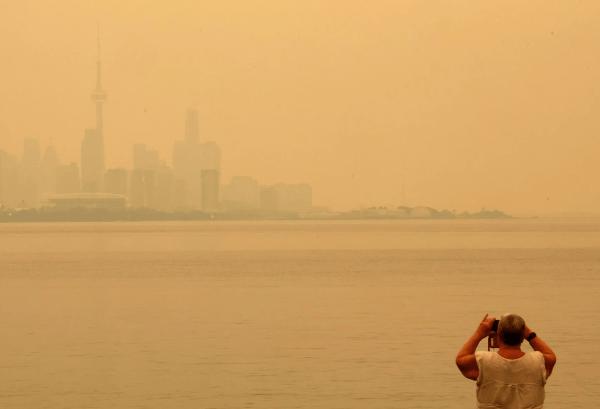
Canadian wildfire smoke is once again pouring into the United States, spreading from the Great Lakes through New England, triggering air quality alerts and health warnings across a broad swath of the country. Air quality indices in major metros have spiked into unhealthy territory..
The story is familiar now. Canada’s fire season, intensified by dry conditions and high temperatures, pushes smoke thousands of miles south. It blankets U.S. cities in a haze that looks cinematic and feels vaguely apocalyptic. Flights are delayed, outdoor events reconsidered, and the morning run suddenly seems like a questionable idea. For many Americans this is not an abstract climate narrative, it is a physical irritant in the eyes and throat.
What is interesting is less the meteorology and more the emerging narratives around it.
On the broad center, the dominant framing is pragmatic and mildly alarmed. Public health agencies and mainstream outlets are focused on immediate risk and basic resilience…
Within that centrist framing, climate change appears as a kind of background operating system… The implicit lesson is that we have moved from occasional anomalies to a new pattern. And patterns demand systems thinking, not once off emergency response…
On the political right, the narrative bifurcates.
One strand focuses on competence, or the lack of it. Wildfires are framed as a management failure, not primarily a climate story…
Another strand, more cultural than policy oriented, treats the smoke almost as another sign of a world out of joint…
For executives and operators, however, there is a different lens worth applying, one that sits somewhat orthogonal to left, right, and center. The wildfire smoke story is less about climate as ideology, and more about climate as infrastructure stress test.
A few non obvious reframes.
First, this is an unpriced cross border externality that already behaves like a supply chain shock. Air quality does not respect jurisdictional boundaries, and neither do the second order effects…
As more people regularly consult environmental metrics to decide whether to send a kid to soccer, they normalize data driven judgments about climate related risk. The audience for environmental dashboards is suddenly living inside the dashboard.
Third, this is a live case study in shared sovereignty… For globally oriented businesses it is already familiar. Environmental phenomena are simply joining capital flows and cyber threats on the list of things that ignore lines on a map…
The smoke will clear, as it always does. Headlines will move on. Yet the pattern remains. Fire in one country, health warnings in another, and a long chain of decisions, from land management to energy policy, sitting behind each hazy sunrise.
It is tempting to discuss this only in moral or partisan terms, but for senior operators the more productive question is simpler and more demanding.
Given that shared environmental risk is here, and not abstract, what kinds of organizations are you building. Are they designed as if the air is reliably clean and the sky reliably clear. Or are they designed with the understanding that, from now on, you are operating inside the smoke.
Categories: Climate Change


When a severe climate crisis event occurs we can reliably count on our political leadership and mainstream media to roll out the “We need to build resilience” narrative. They consistently fail to connect the climate related event to the climate crisis. An analogy might be a patient presenting with pneumonia and our medical system responding with a large amount of tissue and cough syrup, completely failing to deal with the underlying cause.
LikeLiked by 1 person
Hi Norm,
There was a short interview with David Wallace-Wells on MSNow yesterday (Chris Hayes program) that you may have missed. He, among a few others, (starting of course with James Hansen in the NYTimes in 1988), have been trying to get our attention about what’s coming for some time…I also follow (on FB) a site called appassionati di eventi e temperature estreme,@extremetemps,extremegrou that is the work of an Italian meteorologist called Alessandro Stefani. He usually posts in both Italian and English and I’ve followed his work religiously for years…We are truly in deep deep trouble…Cheers
LikeLiked by 1 person