



I don’t know why private industry should object to government involvement in megaprojects. Eventually, and inevitably, taxpayers get hosed, while the world’s wealthiest citizens grow even wealthier. Governments spend billions acquiring, building, and improving assets. Then the privatizers gain power and sell completed, publicly financed assets to private interests.
The public shoulders the risks; private investors inherit the opportunities.
Mark Carney’s career suggests a strong preference for private markets, financial mechanisms, and private management of large-scale operations. That raises an obvious question: will taxpayers retain the assets they paid to build—or merely the bills?
Carney’s plan for private investors to operate Canada’s four largest airports illustrates the Liberal government’s direction of travel.
Boeing demonstrated the potentially deadly consequences of allowing commercial priorities to override public safety. The investigation into two crashes that killed hundreds of people documented cost pressures, concealment of critical information, and failed regulatory oversight.
As Canada invites private investors into airport operations, it should remember that protecting passengers and maximizing investor returns are not the same objective.
After Mark Carney’s rich friends come for our major airports, they will not end their moves.
In its December Fall Economic Statement, the Liberal government indicated plans to ease rules restricting privatization of municipal utilities. Currently, private sector ownership is capped at 10%. Investors have been eyeing the steady revenues from residents’ water and hydro bills for a long time.
Will Mark Carney continue the Liberals’ pro-privatization agenda?
The consequences of privatizing utilities are well-documented: higher user fees and reduced public revenues for municipalities.
The Trans Mountain Pipeline is another example.
The federal finance minister said the government does not plan to be the long-term owner of the pipeline and expects the project to be transferred to private sector investors “at an appropriate time”.
Canada to buy Kinder Morgan pipeline project assets
The Liberals will insist that Trans Mountain itself is not for sale—only its operations. Such an arrangement would allow private investors to collect returns while taxpayers retain the long-term risks, including ownership of an asset that will be stranded when the needed transition away from fossil fuels destroys its commercial viability.
The Institute for Energy Economics and Financial Analysis (IEEFA) is a global team of energy finance analysts, communications experts, and management professionals, based around the world. IEEFA directs its analyses to those who influence markets and energy policies. IEEFA recently published: Canada should learn from the Trans Mountain Expansion pipeline’s fiscal issues.
The conclusion:
Oil infrastructure development, once seen as a financial boon, is beset by rising costs and lower price trends. As the Canadian government experiences pressure to pay industry infrastructure costs from public coffers, it’s time to step back and take a hard look at the energy questions Canada faces.
Such scrutiny should be based on full transparency. The rigorous analysis should include a realistic examination of the potential consequences for Canadian debt of a massive, taxpayer-subsidized pipeline buildout.
The lessons of the Trans Mountain project should be learned—not forgotten—and the missteps should not be repeated.
A short history of Trans Mountain projects:
The pipeline opened in 1953 after private companies constructed it for a cost of $93 million (2026 equivalent = $1.1 billion). The BC to Alberta pipeline was initially operated by the Trans Mountain Oil Pipe Line Company. This company was acquired by Terasen (formerly known as BC Gas) in 1994, then purchased by Kinder Morgan in 2005 for $550 million (2026 equivalent = $850 million) and by the Canadian federal government in 2018 for $4.5 billion (2026 equivalent = $5.6 billion). source
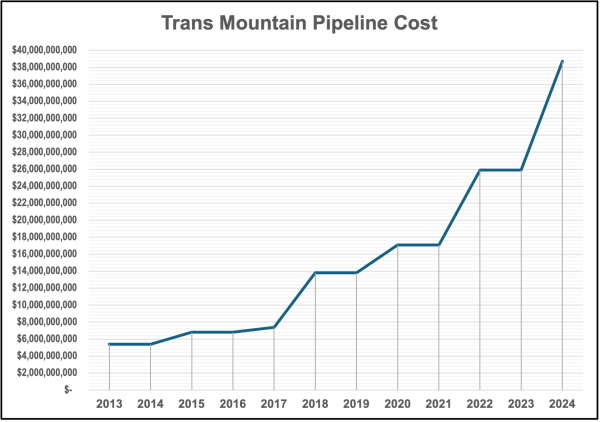
- 2013 — Initial application to National Energy Board
- 2015 — Revised company estimate
- 2017 — Pre-sale company estimate
- 2018 — Federal purchase year ($4.5B acquisition cost)
- 2020 — Post-nationalization update
- 2022 — Construction and financing pressures
- 2024 — Completion cost reported by CDEV
Categories: Privatization


