



September 22, 2026
Written by Pat McCutcheon
patmcc@mailbox.org
My wife and I decided in 2023 to electrify our house. Our house is a typical detached house in the Cloverdale neighbourhood. This project involved removing the natural gas furnace and hot water tank and closing our Fortis BC account. We replaced these items with an electric heat pump and hot water tank. Because of the increased electrical load, we also had to upgrade our electrical service from 100 amps to 200 amps.
Our decision to embark on this project was partially driven by the climate change-driven heat dome in 2021. The summers were clearly getting warmer, and air conditioning was now becoming a necessity. Moral values also influenced our decision.
Climate scientists around the world have made it abundantly clear that society has to rapidly reduce its greenhouse gas emissions if we are to leave a livable planet for future generations. By electrifying our house, we believe we are doing our part to reduce our carbon footprint.
It was clear what we had to do. However, that didn’t prepare us for the sticker shock. The total project cost came in at $26,931. Fortunately, there were some rebates available totaling $12,100, resulting in a final cost of $14,831. Below is a detailed breakdown of the project’s cost.
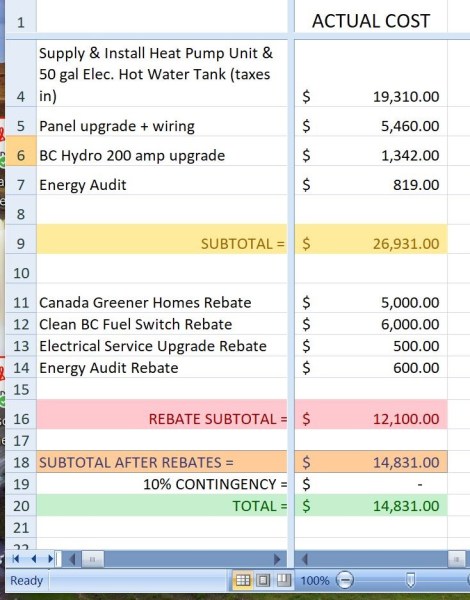
As is evident from the above cost breakdown, it is extremely expensive to retrofit an existing house fitted with natural gas heating and hot water. Most people will struggle to cover the cost. It is far cheaper to electrify new residential construction when it is being built rather than retrofit down the road.
Surrey has to stop pretending that the effects of climate change are a distant problem for someone else to deal with. Climate change-related events are upon us and will continue to worsen until our global civilization reaches net-zero carbon emissions. Surrey has to become part of the solution, not carry on as part of the problem.
Most climate scientists will tell you that this past summer will be the COLDEST summer you will experience for the rest of your life. Summers will continue to get hotter, and people will be forced to retrofit their homes at a crippling cost. By allowing builders to continue hooking up new residential homes to natural gas, Surrey is committing the new owners to an expensive retrofit down the road along with the continued greenhouse gas emissions associated with burning natural gas.
All of Surrey’s municipal parties are completely ignoring this issue. For a city that brands itself as ‘The Future Lives Here,’ this policy on natural gas hookups represents a major failure. Other cities in the lower mainland, including Vancouver, Burnaby, and West Vancouver, have developed building codes that restrict new residential construction from being hooked up to natural gas.
Surrey and other local governments are climate change laggards. This needs to change, and voters should keep this in mind on October 17.

Categories: Climate Change


Thanks Norm
Good article. I have little doubt that addressing climate change will once again be pushed to the back burner while short term economic concerns are front and center in the upcoming municipal and provincial elections. Meanwhile, addressing climate change issues should be the elephant in the room, and is critical for our long term economy.
LikeLiked by 2 people
Foot dragging?
Know of anywhere with a huge coastline, lakes and rivers, lots of tourists wanting to sightsee, lots of people wanting to fish, and lots of companies reliant on diesel who are being ruined by operating costs?
How have other countries employed some novel tech to reduce costs?
Europe has them.
America has them.
If BC can build huge naval vessels, icebreakers for the Arctic, seems like we have enough smarts to build some new tech right here.
https://www.theguardian.com/environment/2026/oct/29/us-electric-ferries
Replacing diesel-powered ferries with electric vessels could reduce emissions and improve air quality
Cutting through New York Harbor in the shadow of the Statue of Liberty, the small white boat we were riding on caught the attention of passengers aboard a nearby sightseeing ferry.
“It’s quite a curiosity at the moment,” Eric Laakmann, the chief executive and co-founder of Vessev, said.
His company builds fully electric hydrofoil boats. These vessels use underwater “wings” to lift their hulls above the surface as they pick up speed. By raising the boat out of the water, the design dramatically reduces drag, one of the biggest obstacles to making boats more energy-efficient.
“We’re picking up speed. We’re going for a takeoff,” Laakmann said as the boat rapidly accelerated.
The hydrofoils lifted the hull about a foot and a half above the water. Almost immediately, the ride transformed. The familiar slap of the boat pushing through waves became a smooth, almost airborne glide.
Transportation remains the largest source of greenhouse gas emissions in the United States, according to federal environmental data. Road vehicles account for much of that pollution, but ships and other watercraft also burn fossil fuels. Replacing diesel-powered ferries with electric vessels could reduce emissions and improve air quality around busy waterfronts.
Vessev is not alone in pursuing the technology. In Stockholm, commuters are already riding electric hydrofoil ferries built by the Swedish company Candela. The company says its design can reduce energy use by as much as 80% compared with conventional vessels of a similar type. Norway has ordered 20 of its electric hydrofoil boats for coastal service.
For ferry operators, the attraction is not simply environmental. More efficient designs and advances in battery technology are opening up routes for electric boats that might once have been impractical. There is also the potential for lower operating costs as fuel prices soar.
LikeLike