


TIME magazine published the full transcript of its interview with Donald Trump. It makes a strong case for more effective constitutional and political means of removing a president who is plainly unfit to carry out the office.
Reading all 11,000 words would be cruel and unusual punishment for most people. Slate condensed Trump’s blather to its most revealing passages. I have condensed it further.
The 11,000-word interview is in some ways an unremarkable artifact of the president’s usual tics: run-on sentences, bluster, insults, lies. But it also contains moments of confusion, incoherence, and paranoia that look like windows into Trump’s mental state…
1. Trump immediately gets confused about where he was this week.
The interviewers open by asking about Trump’s Sunday dinner with Dario Amodei, CEO of the A.I. company Anthropic. They asked whether the president agrees with Amodei’s concerns about A.I. endangering humanity, but Trump chose to linger on a more important topic: the Presidents Cup golf tournament… (NF: Trump then shows confusion about where and when the tournament was held.)
2. When it comes to Iran, Trump is on another planet.
Trump’s answers revealed just how detached from the reality of the situation he has become. Asked why the war has lasted more than seven months despite his early promises that it would only take weeks, Trump claimed to have “met my timeline” but then “decided I wanted to go further,” an escalation he never explained publicly and certainly never asked Congress to approve. He also blamed the media for Americans’ confusion…
3. He gave an incoherent answer about the future of Gaza.
The Israeli-Palestinian conflict is obviously a thorny problem that has bedeviled American presidents for decades. But Trump’s response is worth reproducing in full—less because it’s an expression of policy and more because it’s utterly incoherent, veering from brags about the U.S. economy to the bizarre claim that the fighting has paused even as Israel continues to launch deadly airstrikes almost daily…
4. His paranoia is reaching mad-king proportions.
Trump claimed the central bank was [raising interest rates] not to tame inflation but to hurt him politically. Asked why he calls concerns about A.I. a “hoax” and who’s behind it, Trump claimed, “The whole country is based on fake stuff because these people have Trump derangement syndrome.” What about his cratering approval ratings? “They’re fake numbers. I would beat anybody running today by 20 points. Your numbers that you have are fake. The pollsters are corrupt. They’re almost as corrupt as the writers.”
5. Does Trump know that JFK and LBJ are dead?
In a bid to emphasize how short the war in Iran has been relative to other conflicts, Trump seemed to suggest that Cortellessa and Jacobs ask John F. Kennedy and Lyndon Johnson about Vietnam… The above is just a sampler platter from a long, rambling, grievance-fueled interview with the most powerful person in the world. Much of the ensuing coverage has focused on Trump losing his temper, ripping into the interviewers with lines like “You haven’t asked me one f***ing positive question.” (As the New York Times reports, the president has gotten more publicly profane as he has aged.) It’s easy to become numb to all this; Trump’s incoherence is matched by his ubiquity. But this is the brain responsible for making life-and-death decisions for the rest of us every day. Does anything from this transcript suggest it’s still up to that task?
Categories: USA


What’s so hilarious about twenty-first century geopolitics?
The irrepressible analytical wit of Sarah Paine!
LikeLike
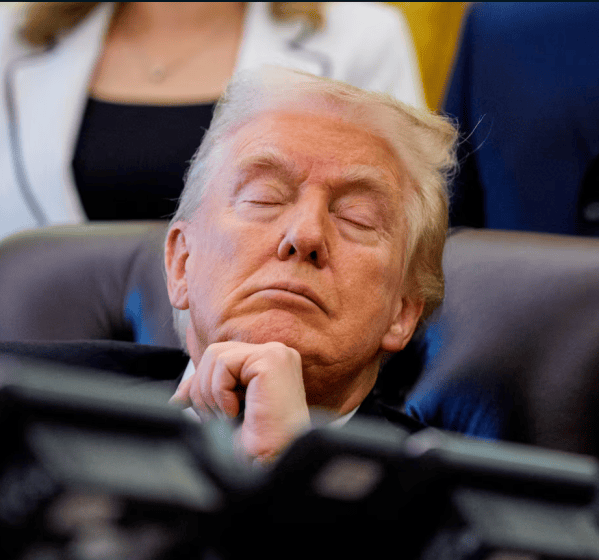
If anything could keep sleep-deprived President Trump busy threatening new tariffs it is likely to be Europe’s decision to remove Microsoft from many government computers.
https://linuxstans.com/dutch-government-ditches-windows-for-nixos-following-frances-lead/
Dutch Government Ditches Windows for NixOS, Following France’s Lead
The Dutch government has confirmed it is building a full replacement for Windows and Microsoft Office, from the desktop up. The project is called DAWO, and it runs on NixOS, the meticulous, famously unusual Linux distribution that started at a Dutch university and has somehow become the shared foundation for three different European governments trying to quit Microsoft at roughly the same time.
The Netherlands is not even first. France’s digital ministry already has NixOS running on real staff laptops. Denmark has been chasing a Microsoft-free desktop since 2019, shelved it, and picked the project back up last year. This is not three unrelated experiments. It is a pattern, and the pattern has a name: digital sovereignty, which is government speak for not wanting a foreign company to hold the off switch to your public sector’s computers.
Ask the people building DAWO why this project exists, and the answer is not about Linux fandom or licensing costs. It is about early 2025, when the United States government placed sanctions on the International Criminal Court in The Hague. Microsoft, complying with those sanctions, reportedly cut off the ICC’s chief prosecutor from its services, including his email account.
For Dutch officials, that was the moment an abstract risk turned concrete. If one government’s foreign policy could reach into a Microsoft account and switch it off, the same thing could happen to any Dutch ministry running on the same infrastructure. There have since been signs the US administration is considering broader sanctions targeting the ICC.
Victor Gevers, the innovation manager and security researcher at the Ministry of the Interior who has become one of the public faces of DAWO (he also founded the Dutch Institute for Vulnerability Disclosure), describes it as the moment the realization set in: how much of the government’s digital life runs on decisions made somewhere else entirely. What followed was almost literal, a kind of digital emergency stockpile, the same instinct that makes a country keep reserves of food, water, and fuel, applied to servers and software instead.
LikeLike
FOX NEWS POLL
187b32ab-7501-4fb1-bddc-af81ecef4918
LikeLike
Bipartisan congressional support for increased sanctions against Russia? The numbers are clear.
https://www.politico.com/live-updates/2026/10/15/congress/house-lawmakers-trump-russia-diesel-deal-01120231
House 419 – 3
Senate 98 – 2
How did President Trump support the Graham Sanctions against Russia? He refused to impose them.
Where did he find his preferred source of diesel? Russia. Their supply was likely to be shipped from a port that Ukraine just attacked and disabled.
Assuming Russia does ship fuel it will cost considerably more than it would if purchased from Canada..
President Trump now insists that Ukraine’s President Zelenskyy – not Russia’s Putin – is a Dictator. He must be replaced for refusing to surrender to Russia’s invasion and terms.
What many Americans may be asking? President Trump joined with 5 politicians opposed to 517 of their colleagues’ votes.
Why?”:
===================================
A bipartisan group of House lawmakers urged President Donald Trump to follow through on the Russia sanctions law he signed last month, warning on Thursday against giving Moscow economic relief as a key enforcement deadline approaches.
In a letter led by Rep. Jim Costa (D-Calif.) and shared first with POLITICO, 22 House lawmakers asked Trump to fully implement the sanctions law named after the late Sen. Lindsey Graham by Oct. 18 and scrap his administration’s recent Russian diesel deal.
The lawmakers’ demands Thursday add to growing bipartisan pressure on Trump over his deal with Russian President Vladimir Putin, after the president announced on Friday that Russia would supply hundreds of thousands of tons of diesel to the “American and Global Marketplace.”
They also requested details on which sanctions and tariffs will take effect before Oct. 18, whether any provisions will be delayed or waived, and how the administration reconciles the diesel license with the existing statutory ban on Russian energy imports.
“Putin has repeatedly shown that he responds to pressure, not goodwill,” the House members wrote. “This will make clear that American resolve is bipartisan and durable, and that the cost of continuing this war will only grow until Russia comes to the negotiating table.
===================================
All this… right before Americans march to the polls to support the party they trust most. The Midterms will help determine how far down the rabbit hole the country descends.
LikeLike
Someone who isn’t likely to nap… Liz Oyer
While remaining remarkably composed former US Pardon Attorney Liz Oyer explains what National Security is and is not.
LikeLike
It could have been much worse…
When New Mexico’s Democratic Governor Lujan Grisham learned that Donald Trump wanted her state renamed as “New America” she laughed.
https://www.msn.com/en-us/news/other/trump-wants-new-mexico-to-change-its-name-heres-why-he-cant-rename-it/ar-AA2fGdgk?ocid=BingNewsSerp
The name of New Mexico dates back to the 1500s when the region was named Nuevo México by Spanish settlers. That makes its name older than the United States, even coming before Mexico gained independence from Spain, according to previous USA TODAY reporting.
New Mexico was an incorporated territory of the United States until becoming the 47th state in 1912.
==================================================
Given the fine a New Mexico judge just imposed people not laughing these days are the executives at META.
https://www.theguardian.com/technology/2026/oct/21/meta-fined-new-mexico-data-privacy-case1
Meta ordered to pay $25bn to New Mexico in Cambridge Analytica data-privacy case.
Jury had found Meta misled consumers after Trump’s 2016 presidential campaign obtained user data without consent.
A judge in New Mexico ordered Meta Platforms to pay $25bn on Wednesday after a jury found the company had misled consumers in a case arising from allegations that a political consulting firm involved in Donald Trump’s 2016 presidential campaign obtained data from millions of Facebook users without their consent.
“Facebook’s wrongdoing – over the course of years and systematically broadcast to the public – goes to the heart of Facebook’s core business practices,” Judge Francis Mathew wrote in his order following the verdict.
Mathew found that a penalty of more than $219bn was warranted, based on state law, but he reduced the figure to $25bn.
In court filings, Meta urged Mathew to cap the penalties at $3.45bn, saying a higher penalty ran the risk of scaring businesses out of the state. The evidence showed that Meta does not sell user data and New Mexico did not prove that any consumer had actually been misled, the company said in court filings
LikeLike