

I have seen statistics about wealth and income concentrations many times, but I was shocked when I studied the World Inequality Report for 2026. Ricardo Gómez-Carrera of the Paris School of Economics was the coordinator and lead author. The report draws from the work of more than 200 scholars.
Inequality has long been a defining feature of the global economy, but by 2025, it has reached levels that demand urgent attention. The benefits of globalization and economic growth have flowed disproportionately to a small minority, while much of the world’s population still faces difficulties in achieving stable livelihoods. These divides are not inevitable. They are the outcome of political and institutional choices…
The report explores new dimensions of inequality that define the 21st century: climate and wealth, gender disparities, unequal access to human capital, the asymmetries of the global financial system, and the territorial divides that are redrawing democratic politics. Together, these themes reveal that inequality today is not confined to income or wealth; it affects every domain of economic and social life
Global inequality — Average education spending per child in Sub-Saharan Africa stood at around just €200 compared with €7,400 in Europe and €9,000 in North America & Oceania.
Climate -— The global wealthiest 10% of individuals account for 77% of global emissions.
Gender inequality — On average, women earn only 32% of what men earn per working hour, accounting for both paid and unpaid activities.
Inequality reinforced — Wealthy economies continue to benefit from an exorbitant privilege.
Territorial divides within nations — Gaps in political affiliations between large metropolitan centers and smaller towns have reached levels unseen in a century.
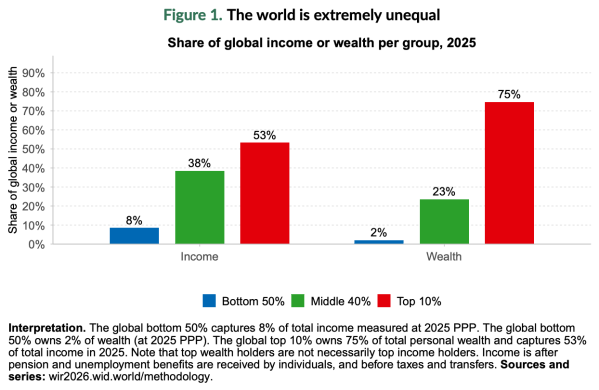
The world is extremely unequal — Today, the top 10% of the global population’s income-earners earn more than the remaining 90%, while the poorest half of the global population captures less than 10% of the total global income.
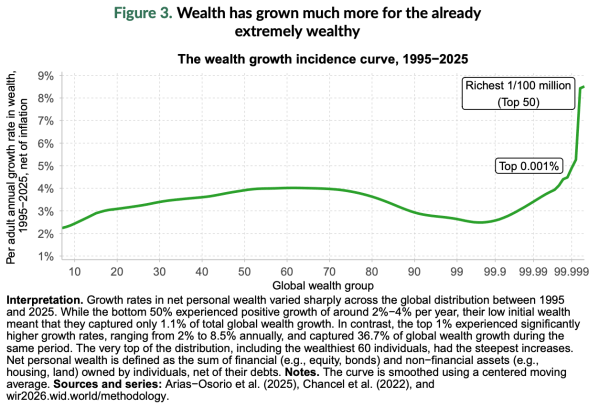
Wealth concentration — The top 10% own three-quarters of global wealth, while the bottom half holds only 2%.
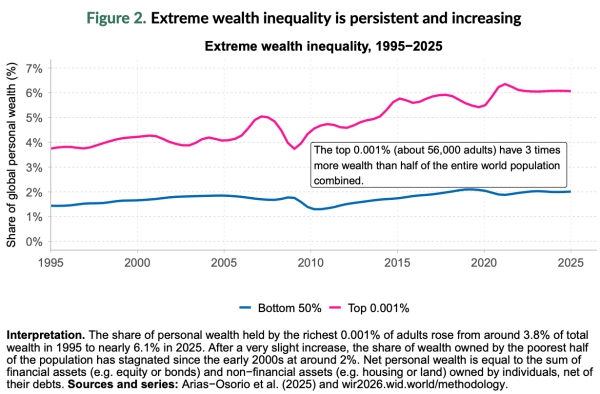
The wealthiest 0.001% — Fewer than 60,000 control three times more wealth than half of humanity combined. This concentration is not only persistent, but it is also accelerating.
Categories: Inequality


Thanks for this article Norm. The BC Greens are breaking new ground this election by promising to introduce a wealth tax on household wealth over $50 million. See link below. Mainstream parties continue to avoid talk of a wealth tax – no backbone.
https://bcgreens.ca/fair-share-act-would-unlock-22-2b-for-childcare-transit-and-housing/
I’m running for the BC Greens again this election. If anyone has any questions please reach out.
LikeLike