
It must dishearten nuclear proponents when wind energy is shown to be a low-cost, quickly installed source of electricity.

It must dishearten nuclear proponents when wind energy is shown to be a low-cost, quickly installed source of electricity.

In late January, Manitoba Hydro CEO Jay Grewal said the utility would need new sources of electricity within five or six years. She reiterated a plan to meet new demand by contracting with private electricity producers. Shortly after, the Manitoba government fired Jay Grewal.
The U.S. Department of Energy (DOE) reported that wind and solar accounted for 71 percent of U.S. electric-power capacity additions in 2022. 8.5 GW of wind power capacity was added for investments totalling C$16 billion. By comparison, Site C will cost at least C$16 billion and provide 1.1 GW of power capacity. However, the budget for the project near Fort St. John has not been updated for three years…

Private capital manager Axium Infrastructure Inc. now owns a large part of the Edwards Sanborn power facility. The company is familiar to those following private power companies that supply BC Hydro. With Manulife in 2018, Axium acquired 90% of Forrest Kerr, Volcano Creek, and McLymont Creek power generating facilities developed by AltaGas in northeast British Columbia.

Climate scientists tell us to reduce and ultimately eliminate burning of fossil fuels, products that are the dominant cause of global warming. Worldwide, the oil and gas industry and its supporters in governments and elsewhere plan for us to burn more…

Energy-systems consultant Roger Bryenton wrote an open letter to Premier David Eby, BC Hydro CEO Chris O’Riley, and BCUC Chair Mark Jaccard. It is published here with permission.

Climate change is one of the most pressing global issue in contemporary times, and dams play a substantial role in aggravating it by becoming feeding grounds for methane-producing microbes. In addition, dams fragment rivers and disrupt their natural flow, threatening the survival of aquatic fauna, especially migratory species. Dams are also culpable for disrupting the biogeochemical cycles of river ecosystems, thereby impacting their function and structure. Taking all the environmental impacts of dams into account, the apparent economic gain from them may not be worth it…

Worldwide solar energy capacity has been growing rapidly. In 2022, it was 150 times higher than in 2006 and more than double the level of 2018 when BC Hydro moved to discourage solar power systems. A tiny proportion of the utility’s accounts was feeding solar power to the grid, but BC Hydro worried about added customers embracing solar, particularly large consumers of electricity…

Methods of creating or capturing energy near demand points are gaining prominence and threatening the disruption of today’s giant utilities. A paper from Germany’s Karlsruhe Institute of Technology suggests millions of buildings can be energy self-sufficient with solar power, retrofitting, energy storage systems, and heat pumps. Many single family homes could abandon the electrical grid unless owners stayed connected to sell excess power to utilities.

Seattle based writer David Roberts reports on energy matters. Recently Roberts explored the variability of renewable energy. Opponents of wind and solar power rely on this subject to raise objections. Despite virtually all of the electricity generated by BC Hydro being dispatchable, the public utility has discouraged addition of variable renewable energy (VRE).

Over the years, clean renewable power costs have decreased steadily and efficiencies have improved. The British Columbia government and the main public utility offer few incentives for creation of energy near to points of consumption. Green electricity must displace fossil fuels but the NDP allows BC Hydro to maintain its near monopoly while it discourages local cooperatives seeking to create power for self-consumption. Provincial decision makers cling to business models rooted in the 1960s.
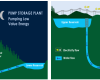
A pumped-storage hydroelectricity (PSH) facility moves water into a high-level reservoir during times of low demand, and then generates electricity by releasing water during times of high demand. Most storage occurs at night and most electricity is generated during the day. PSH is a proven method of energy storage with competitive round-trip efficiency and long life spans.

Despite false claims by organizations paid to promote false claims, clean renewable energy must replace fossil fuels. The only question is when. The inevitable is assured by crucial environmental, social and economic benefits…

On Twitter, Eudaimonia drew attention to a legal action involving the Province of British Columbia, BC Hydro and Conifex Timber Inc, a company that wants huge amounts of electricity for cryptocurrency mining. Eudaimonia sees this court case as a serious warning. If the 300 MW that Conifex wants is half of Site C’s capacity, he assumes BC Hydro is admitting the new dam may have capacity of 600 MW, not the 1,100 MW advertised.

Wind and solar are zero-carbon energy sources. When used to produce electricity, these renewables are less harmful to Earth’s climate than hydropower. U.S. Environmental Protection Agency published a lengthy Inventory of U.S. Greenhouse Gas Emissions and Sinks. It shatters the idea that hydropower is clean energy, free of greenhouse gas emissions…

Before British Columbia’s 2017 general election, a person who would be appointed to a senior position in John Horgan’s cabinet indicated that Site C would not be cancelled. He asked, “Would you eliminate 3,000 jobs?” Months of political theatre followed, directed by Horgan et all, until December 2017 when BC NDP removed all pretense that the megaproject was under review. It turns out the answer to the politician’s question should have been, “Cancel Site C and create more jobs throughout the province.”

Arguments claiming impracticability of wind and solar power integration in British Columbia never passed scrutiny. Elsewhere in the world, it has been happening rapidly. Days ago, BC NDP announced a new call for clean power. No important details were provided but it seems government will replicate the insider-friendly private power program favoured by BC Liberals. That resulted in commitments for power that lasted as long as 70 years at prices that have been multiples of market price. The province should not go that way again.

After implementation of efficiencies and conservation measures, the least destructive way to meet future energy needs may be local power generation from solar and wind sources…

The world’s long-duration energy storage installations in 2030 are projected to be 15 times the level of storage capacity at the end of 2021. These will facilitate a shift to renewable energy sources. Canada has zero interest in being a leader in this transition.

In 2016, a future NDP Cabinet Minister told me that cancelling Site C was unlikely. The person said, “Would you be prepared to eliminate 3,000 jobs?” In retrospect, I conclude the concern was less about lost employment than about who would lose the jobs.


Trump declares USA is “stupid”. https://www.independent.co.uk/news/world/americas/us-politics/supreme-court-trump-birthright-citizenship-case-b2949973.html https://www.independent.co.uk/bulletin/news/trump-supreme-court-birthright-citizenship-debate-stupid-b2950293.html?utm_source=taboola&utm_medium=related&utm_campaign=embed1 President Donald Trump has branded the U.S. “stupid” after attending Supreme Court arguments over his administration's efforts…
Justice? More posts from Liz Oyer https://www.youtube.com/shorts/l3R3QUI1J-M?feature=share LIZ why Oyer was fired. https://www.youtube.com/shorts/xs9N_2W_6CU?feature=share LIZ explains the DOJ’s abnormaIity https://www.youtube.com/shorts/9tDcGMVW0HU?feature=share LIZ…
Who benefits most from Trump's DOJ? Trump’s Justice Department Dropped 23,000 Criminal Investigations in Shift to Immigration In the first…
There are examples worldwide of methods to produce electricity that provide us with solutions; some are tried and true and…
 in-sights.ca
There are examples worldwide of methods to produce electricity that provide us with solutions; some are tried and true and…