

When Gwyn Morgan, SNC-Lavalin Chair and Encana’s founding CEO, became Christy Clark’s transition team advisor, natural gas producers knew they’d bet on a good thing.

When Gwyn Morgan, SNC-Lavalin Chair and Encana’s founding CEO, became Christy Clark’s transition team advisor, natural gas producers knew they’d bet on a good thing.
When a new government takes office, there is often a significant change at senior levels of the civil service and among OIC political appointments. One person still employed by the Horgan government may surprise more than a few people.

When British Columbia conducts LNG negotiations behind closed doors, without public statements of principles or bargaining frameworks, citizens should worry. I have written about our government’s willingness to provide the gas industry with 9-figure production subsidies and Liberal aversion to collection of natural gas royalties but there is another subject to consider. It is the safety and security of LNG facilities…

Muskrat Falls was always a done deal, and a bad one says Pam Frampton, Saint John’s Telegram. “One week the project was all about clean energy, the next it was job creation, then it was all about being an affordable energy source, then it was a means of foiling Quebec, then it was a lure for mining companies.” The Progressive Conservatives’ sales pitch was scattershot; they threw out a whole bunch of messages and hoped something would resonate with people… Many people worried that the project might be far more than we needed or could afford.
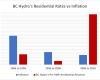
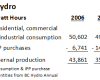
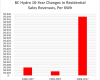
In the 20 years to 2006, BC Hydro’s charge per kilowatt-hour to residential consumers increased at 1/3 the rate of inflation. However, when Gordon Campbell’s neoliberal friends decided BC’s iconic utility was a ripe target for privatizing public wealth, things changed dramatically. In the 10 years to 2016, BC Hydro’s charge per kilowatt-hour to residential consumers increased at 5x the rate of inflation.

Every megaproject conceived and executed by BC Liberals in recent years has ended with massive cost overruns, despite the predictable “on-time and on-budget” claims. Most involved contractors with foreign domiciles. Check out the Port Mann bridge project, South Fraser Perimeter Road, BC Place renovation, Vancouver Convention Centre, Sea to Sky Highway, Northwest Transmission Line, etc.

Racism and bigotry are nothing new. In my youth, I assumed these scourges would fade away through enlightenment ensured by modern education, communication and human migration made easier in a shrinking world. I was wrong.
A message to BC Hydro: “Figure out what you are supposed to be doing, then do it. W.A.C. Bennett established this vital crown corporation to provide reliable, affordable power to British Columbians. That’s what it should be doing. Instead, it is forcing citizens to pay much higher prices to provide financial benefits to foreign owned companies and a band of me-first IPP slicksters and a group of political contributors gaining returns on their liberal investments by sitting in the boardroom of BC Hydro.

Large dams run 96 percent over budget on average, according to a University of Oxford study based on projects in 65 countries including Brazil and China. The study, published in the journal Energy Policy, showed that large dams also took about 2.3 years longer to complete than originally planned. That was about 44 percent longer than projected at the point of approval. The research was based on a study of 245 dams…
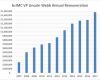
If you are a member of a public service pension, you may know that retirement benefits have been cut in recent times. What has not been cut is remuneration of top executives at pension fund manager bcIMC, where it appears that compensation rises steadily, whether investment returns are good or bad.

Agreements between Postmedia – the country’s largest newspaper chain – and the Canadian Association of Petroleum Producers (CAPP), plus an equally disgraceful deal between the company’s Vancouver Province and the LNG industry have permanently stained the organization’s journalistic credibility… Once a newspaper is committed to a controversial view, it’s like a clock that strikes 13 – it can never be trusted again.
When thinking about the Petronas LNG project (PNW LNG), we should consider which supporting claims for it were believable. The value and benefits of the project have been routinely misrepresented.
Behind the ostensible government sits enthroned an invisible government owing no allegiance and acknowledging no responsibility to the people. To destroy this invisible government, to dissolve the unholy alliance between corrupt business and corrupt politics, is the first task of the statesmanship of the day.

The trillion dollar charade has ended. The sparkle ponies are pissed. Not that the whole thing was anything but a big lie from the start, created to save a desperate Liberal party that worried it was headed for defeat at the 2013 polls. Sustaining the fantasy cost taxpayers a massive sum of money and put BC’s so-called free enterprise coalition in bed with private and foreign government-owned corporations, a few controlled by individuals with appalling records.

Today Pacific Northwest LNG announced what has been obvious for a considerable time. Unless the provincial government was prepared to guarantee profits and underwrite losses, the project was not proceeding. The writing was on the wall when this In-Sights article was published in 2014.

A preceding article contains two comments from readers who I regard highly. The contributions, from Rafe Main and Scotty on Denman, were to Overrun with dullards, bums, and hacks… Because they merit close attention, I present them here again for emphasis.

Despite deep cynicism about journalists backing BC Liberals, I had long held respect for the writing of Vaughn Palmer. My reservoir of appreciation has now run dry. He has been bright, skilled and articulate, usually worth reading throughout 35+ years with the Vancouver Sun. Now, I don’t know. Is he distracted, overburdened, grown careless or captured by his subjects?
Hunter S. Thompson: “As far as I’m concerned, it’s a damned shame that a field as potentially dynamic and vital as journalism should be overrun with dullards, bums, and hacks, hag-ridden with myopia, apathy, and complacence, and generally stuck in a bog of stagnant mediocrity.”

A bit out of date but this item first published in January 2015 is worth repeating. It shows something about the quality of political reporting in BC. January 2, an unidentified caller […]

The Auditor General’s Office has served British Columbia well but the outgoing government deprived it of resources that would have increased audit effectiveness. Politicians are inclined to inhibit the actions of authorities that might offer criticisms. Christy Clark did that but we can hope Premier Horgan will do the opposite.


Can you tell us more about this? Is anyone working on this in a meaningful way? How can we get…

Nova Scotia has been moving towards an off-shore wind project that could provide 27% of Canada’s electricity requirements. https://www.youtube.com/watch?v=sO55ZKYFQIM Offshore…

Unfortunately, the financial markets have morphed into the largest casino on the planet. Trading no longer is connected to the…
[…] Lew Edwardson prepared the following item after the webinar prepared by Canada West Forum. Lew is a keen observer…
 in-sights.ca
[…] If David Eby’s government supported or acquired the Hecate Strait project planned by Oceanic Wind Energy Inc., power could…