



Why Site C must be stopped, Wendy Holm [Consulting Agrologist], Special to the Vancouver Sun, July 28, 2014
…in the face of overwhelming evidence, the B.C. government and its private sector partners seem quite content to throw tomorrow under the bus and press ahead with the construction of Site C — economics and the public interest be damned.
Why? …In part, it’s about money: there are lots of significant piggies ’round the taxpayer trough that will make big bucks building it. In part, it’s about leverage: saddled with Site C’s high-priced power, BC Hydro will hemorrhage red ink, fuelling calls for its privatization and, as such, delivering the vision of investors.
And, in part, it may also be about the water itself. Once impounded behind the dam, the previously free-flowing water of B.C.’s Peace River becomes a NAFTA commodity if BC Hydro is privatized and American investors are involved. …Also interestingly, Site C Dam is smack where it belongs to support the Kuiper, NAWAPA and Grand Prairie schemes for continental water sharing. As water becomes increasingly scarce, the ridiculous becomes profitable…
Water and Free Trade: The Mulroney Government’s Agenda for Canada’s Most Precious Resource, Wendy Holm

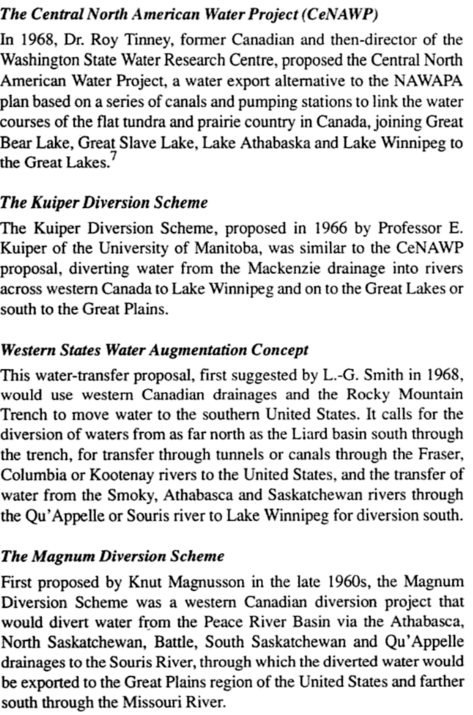
WATER FROM THE NORTH: NATURE, FRESHWATER, AND THE NORTH AMERICAN WATER AND POWER ALLIANCE, Thesis Abstract, Andrew W. Reeves, Department of Geography, University of Toronto, 2009:
…Drafted to address the anxiety of perceived ecoscarcity regarding water shortages in the early 1960s, NAWAPA [North American Water and Power Alliance] emerged after a century of increasingly large‐scale diversion projects, and seemed a logical continuation of such grandiose, “jet‐ age” type thinking. It proposed to re‐engineer the North American landscape to provide water from the North to the arid Southwest…

<
Executive Summary
Canada has twenty per cent of the planet’s total fresh water supply. Canada’s water wealth raises the possibility of shipping water in bulk, through tankers or pipelines, to regions suffering from drought. On the one hand, bulk water exports could be an economic boon for Canada and a possible solution to the rising concerns over global water security…
Canada can engage in sustainable and responsible bulk water exports if it implements necessary legal and regulatory reforms. First, Canada’s treaties should characterize bulk water exports as a “good” for purposes of international trade and investment law…
Categories: Site C


 in-sights.ca
Been saying this for a long time. It has nothing to do with power and everything to do with “water”. Don't be fooled. No to the Site C.
LikeLike
“Dirty deeds 'n' their done dirt cheap” ACDC
BC Water $2.25/million litres.
http://goo.gl/izGtzO
LikeLike
At least we now know the methodology that the BC Liberals used to decide on whether or not to go ahead with Site C. '284' respondents said that they were in favour of BC Hydro increasing its debt load 100 years earlier than required AND more importantly, but not mentioned anywhere…… they are Fortis Customers, Fortis investors, and not subject to BC Hydro rate raises to balance the BC Liberals Budgets.
LikeLike
Like the first comment, I have never believed it was about power. At least not hydro power.
http://droughtmonitor.unl.edu/
On another note;
I woke to an ugly thought.
What if all of us critics are wrong?
Hawgwash.
LikeLike
Faced with no good reasons for building Site C, we start to speculate. I would urge caution on people going too far out on a limb, to avoid being labeled kooks. Once you're out there, you've lost mainstream credibility.
I concede that there are “Mr. Smithers” types (Simpsons cartoon tycoon), who are two or three steps ahead of the peons — but why Site C water?
What's wrong with simply sticking a pipe in the Columbia River at Astoria, Oregon and sucking up a good bit of it before it drains into the Pacific Ocean? Another option: draw an increased amount of water upstream, at Grand Coulee Dam (after getting the Trail smelter to clean up its act.). If it's a fear that the Columbia might — one day — run dry… I'd think the Peace River would be afflicted at about the same time.
Fooling around with drainage basins has impact on fisheries, with invasive species given new pathways. No thanks.
LikeLike
It makes more sense to develop agriculture in the Peace River Valley, rather than spending $9+ billion on Site C, flooding thousands of acres of agricultural land, and sending the water south to supply agriculture in the US.
LikeLike
If one calculates the penstock diameters for many of the IPP projects, you will find they are far greater than required for the nameplate capacity of the generators….maybe a little diversion of the already diverted water into a waiting tanker for export? No one has definitively said that this water will not be deemed an industrial commodity under NAFTA, after all it has been used to “generate” profits for out of country investors. Things that make you go “hmmmm”…..shades of Frank Zappa Dinah Moe Humm (ha…as if quoting Frank Zappa doesn't get one out on a limb!)
https://www.youtube.com/watch?v=u4hzVpYAP-U
LikeLike
Wrong about not needing more power, that conservation can meet needs for 20+ years? Wrong that alternative energy sources like solar, geothermal, wind, tidal, etc. would cause less damage than flooding the Peace River valley? Wrong that we shouldn't provide greatly subsidized electricity to foreign mining and gas companies with no job guarantees or resource rents or corporate taxes in return?
LikeLike
“Since the water resources of the continent were placed by nature without regard to political boundaries, it seems logical…to figure out a distribution system maximizing the use of water resources without regard to these boundaries.”
And if logical for water, then why not for other resources placed by nature? Natural gas, oil, forests, or homo sapiens for instance? Corporate behemoths like Parsons could then dine unfettered at a global smorgasbord of natural resources.
“Hi. I’m Christy Clark and I’ll be your server today.”
LikeLike
Beyond the concerns of work-a-day citizens is a sinister plot to bankrupt public enterprise, regardless democratic instruction to the contrary. BC Hydro is a case in point: neo-right ideologues look at the savings BC citizens enjoy by owning their own electricity producer as money that should rightly be private profit; they think it's wrong that BC citizens have decided to run a public-enterprise, so wrong it's alright to unethically parasitize the enterprise, alright to consider these ill-gotten dollars legitimate profit even though it makes citizens' hydro bills much higher.
Gordon Campbell embarked on the neo-right agenda wholeheartedly with sale of BC Rail and the FastCat ferries. It was the thrashing of his heroic model, Mike Harris' so-called “Common Sense Revolution”, over its attempted privatization of Ontario Hydro, and not the later BC Rail corruption scandal, that shrank Gordo's ardour and replaced his whole-hog approach with a piecemeal one. The overt privatization of BC Hydro was cleverly shifted to gradual starvation by way of IPP parasitism—there can be no other description for a program that forces the Crown Corp to buy power it doesn't need at rates up to several-fold more costly than what it can generate on its own. IPPs are widely dispersed, insidiously effective for the neo-right, and diabolically protected by poison-pill contractual obligations. Site-C affects much the same, its very unfeasibility potentially the last straw that topples the already debt-staggered Crown Corp.
But I submit Site-C also has a more immediate purpose: to present a very big and distracting wedge issue for the 2017 election when the BC Liberals will shout a single-note paean that their rival, the Opposition NDP, wants to squander the money already committed—whatever that is by election time—and to take away all the jobs the BC Liberals say they are creating by building a dam BC doesn't really need. In other words, the BC Liberals are trying to build a gigantic election campaign election-prop that has no other real purpose—a massive misappropriation of public money for partisan purposes.
The audacity of this gambit is astounding. It's clever in the sense that it will be very difficult for the NDP to explain why shutting down the project—if they get elected—when billions have already been irrevocably spent—is actually much, much better than completing it (costing billions more) and losing billions more in unfeasible operations or needlessly increased consumer electricity rates.
The ethical, environmental and economic ramifications of the BC Liberals' biggest misappropriation of public money yet boggles the mind. A triple-E scam. Makes one wonder what makes such a gambit worth the risk for the BC Liberals; is the prospect of losing the election so terrible they have to affect one of the biggest scams in Canadian history to avoid it?
LikeLike
Well said, Geoffrey — but the challenge is “how to wake the electorate to this scam?” How do we get people to stop watching cat videos and actually pay attention to something pertinent to their future?
I spend hours per day on BC provincial issues, to understand and stay current. Most people don't have the time… or have more frivolous priorities. For them, the message needs to be simple and repeated often to the masses.
For those who have the time but lack the knowledge… we need to get more and more readers to this site and others in the blogosphere. Make them think… give them a link.
LikeLike
Was wondering why Black Press reporter Tom Fletcher’s editorials were always so neoliberal and in support of Site C dam and all other industrial development. Was he associated with the Fraser Institute, which was singled out in the book ‘Dark Money’ as a front for the dissemination of neoliberalism? Is David Black, owner of Black Press associated with that organization? David Black wants to build a Kitimat refinery and is a “strident supporter” of Site C (which explains Fletcher’s support for his bosses projects-not exactly unbiased reporting). Does he hope the energy from Site C will power the refinery? Following these threads led me to your posts. And the comment regarding Site C’s importance for its water rather than electricity resonates. Investor Michael Burry, who predicted the collapse of the US housing market, is betting that the next big trading commodity will be water. Indeed, China and Wall Street Mega-Barons are already buying up water resources worldwide. With Canada holding 20 percent of the worlds fresh water we were bound to be targeted at some point. If an investigative report could tie all these together, unveil the international billionaires hoping to profit off Canadian resources, and the subsequent loss of control of its own resources Canada will experience if this happens, such a report might get the attention of the broader public.
LikeLike