


Over the years, clean renewable power costs have decreased steadily and efficiencies have improved. The British Columbia government and the main public utility offer few incentives for creation of energy near to points of consumption. Green electricity must displace fossil fuels but the NDP allows BC Hydro to maintain its near monopoly while it discourages local cooperatives seeking to create power for self-consumption. Provincial decision makers cling to business models rooted in the 1960s.
Salish Sea Renewable Energy Co-operative (SSREC) is a member-run co-operative of residents and property owners in the Southern Gulf Islands of British Columbia. Its purposes:
- To promote, support, and/or facilitate the installation of low-carbon renewable energy systems on the Gulf Islands.
- To advocate for low-carbon renewable energy policy by governments and public agencies.
- To support training and education on the islands related to low-carbon renewable energy systems.
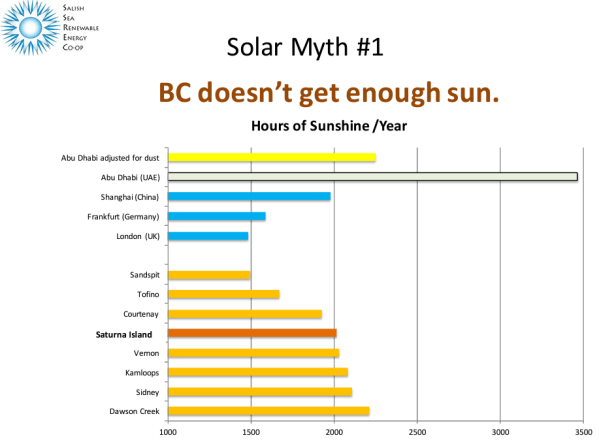
In 2014, a few Galiano Island residents decided to collaborate on a “bulk buy” of high quality solar equipment. They decided to work with Viridian Energy Co-operative, which is based in Duncan. The majority of the systems were designed to be connected to the electricity grid (“grid-tied”), although some were off-grid.
Progress was impeded when the Canada Border Services Agency imposed duties of up to 286 percent on Chinese-sourced solar panels.
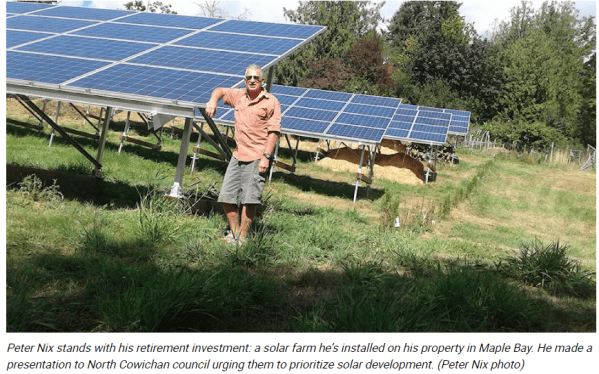
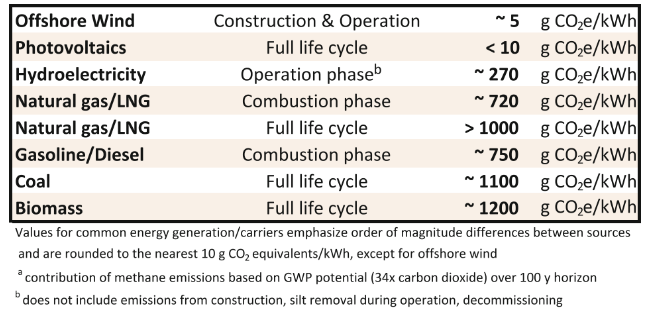
Speaking to North Cowichan council, solar power enthusiast Peter Nix said that hydro electricity is not nearly as clean as BC Hydro makes it out to be. That’s because of methane emitted from reservoirs. In addition, about thirty private power producers sell electricity to BC Hydro that is generated by burning gas and wood.
Renewable power and storage systems are researched around the world. Solutions are hitting the market now and more will come in the near future. Here is one example from Euronews:
The future of solar has just got brighter with this ‘ultra-thin’ device for converting stored energy into electricity.
Solar-powered electronics are one step closer to becoming an everyday part of our lives thanks to a “radical” new scientific breakthrough.
In 2017, scientists at a Swedish university created an energy system that makes it possible to capture and store solar energy for up to 18 years, releasing it as heat when needed.
Now the researchers have succeeded in getting the system to produce electricity by connecting it to a thermoelectric generator. The concept was developed at Chalmers University of Technology in Gothenberg in 2022. It could pave the way for self-charging electronics that use stored solar energy on demand.
Euronews, Major solar breakthrough means energy can be stored for up to 18 years
“This is a radically new way of generating electricity from solar energy. It means that we can use solar energy to produce electricity regardless of weather, time of day, season, or geographical location. It is a closed system that can operate without causing carbon dioxide emissions,” says research leader Kasper Moth-Poulsen, Professor at the Department of Chemistry and Chemical Engineering at Chalmers.
Chalmers University, Converting solar energy to electricity on demand
International consultants McKinsey reports:
Developments are propelling the market for battery energy storage systems (BESS). Battery storage is an essential enabler of renewable-energy generation, helping alternatives make a steady contribution to the world’s energy needs despite the inherently intermittent character of the underlying sources. The flexibility BESS provides will make it integral to applications such as peak shaving, self-consumption optimization, and backup power in the event of outages. Those applications are starting to become more profitable as battery prices fall.
We expect utility-scale BESS, which already accounts for the bulk of new annual capacity, to grow around 29 percent per year for the rest of this decade—the fastest of the three segments. The 450 to 620 gigawatt-hours (GWh) in annual utility-scale installations forecast for 2030 would give utility-scale BESS a share of up to 90 percent of the total market in that year.
[Another] subsegment is public infrastructure, commercial buildings, and factories. This subsegment will mostly use energy storage systems to help with peak shaving, integration with on-site renewables, self-consumption optimization, backup applications, and the provision of grid services. We believe BESS has the potential to reduce energy costs in these areas by up to 80 percent.
BC Hydro will soono extend its purchase of private power. Existing programs have resulted in payments of billions of public dollars above market value with to private producers that enjoy lone terms and inflation protection. Prices are not tied to market values in western North America. So, if BC Hydro locks in the cost of electricity supplies in 2025, and improved technology arrives subsequently, consumers will be the losers and mostly out-of-province power companies will be the winners, again.
I think it makes sense for the public utility to cooperate with local rural groups — many would be Indigenous communities — offering expertise to develop the best solutions and its buying power to minimize equipment costs. Large power sources such as onshore or offshore wind farms and pumped-storage hydroelectricity should be developed by the public utility.
BC Hydro worked well until political objectives of BC Liberals and BC NDP led to replacement of competent management with political lapdogs and people stuck in the way of the last century.
BC Hydro needs to be reformed. Its Board should include technical expertise, but also representatives of Indigenous people, residential, commercial and industrial consumers, and labour groups. The CEO should be replaced by a new recruit with a strong background in low-carbon renewable power systems and a commitment to democratized smart grids.
Categories: Energy


 in-sights.ca
Thanks for this article, Norm — and, more importantly — all the best in your recovery from surgery.
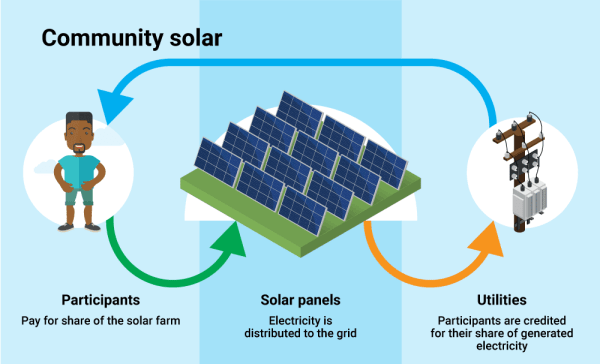
As a homeowner who has toyed with the idea of installing solar arrays on my suburban home… community solar makes so much more sense.
Hobbyists and off-grid folks are welcome to forge ahead, but as far as $ and efficiency go, a larger array on a hillside, parking lot or commercial roof put the monitoring and maintenance out of the homeowner’s hands. Just invest your $ and collect the dividends.
A similar comparison could be home gardens versus small acreage farms. It can be fun and fulfilling to have a home garden — but a small acreage farm can produce far more on the same aggregated space, using fewer resources.
If government rebates are involved, I’d favour them going to community installations over private homeowner installations… or at least at a higher value of rebate.
LikeLike