


I have copies of British Columbia’s Public Accounts for every year dating back to the 1990s. Along with annual Budget and Fiscal Plans, these BC Government documents provide useful information once a reader gets through the bureaucratic and political bafflegab.
After issuance of Public Accounts for the fiscal year ended March 31, 2023, one of the sections I read reported contractual obligations. These commitments are preferred by politicians because they allow real public debt to be understated. The Auditor General states in his qualified opinion:
Under Canadian public sector accounting standards, contractual obligations that commit government to make certain expenditures, for a considerable period into the future, are required to be disclosed so that financial statements users understand the nature and extent to which government’s resources are already committed to meet its future obligation. The [Province’s] Summary Financial Statements do not provide the required disclosures in relation to certain contracts…
Emphasis added above.
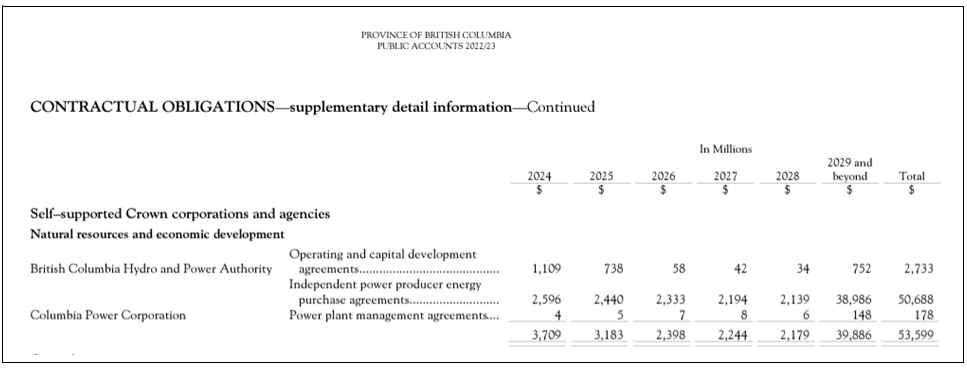
In what ought to embarrass the high-paid staff involved in issuing these important financial documents, contractual obligations at BC Hydro for private energy purchase agreements were shown as $2.733 billion. That was down from $46.182 billion in the preceding year.
I knew immediately the current year’s number was incorrect. I sent an email to the BC Ministry of Finance and filed an FOI request with BC Hydro for clarification.
My message to the Ministry went unanswered, which is typical. However, a media relations officer at BC Hydro responded quickly. He said:
The FOI team passed along your request about BC Hydro’s contractual obligations to IPPs.
Thank you for flagging this item. There has been a mix up in how our financial statements have been presented in Public Accounts. Government is in the process of correcting this in the online version. We will let you know when this has occurred.
In the meantime, here are BC Hydro’s contractual obligations for IPPs:
- Fiscal 2022: $46,182 million
- Fiscal 2023: $50,688 million
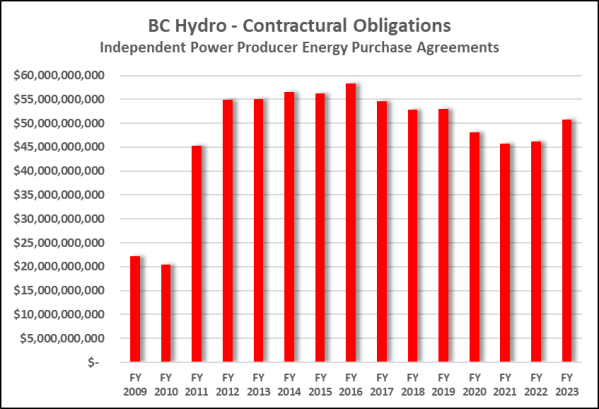
For the record, here is a chart showing BC Hydro’s obligations to make future payments:
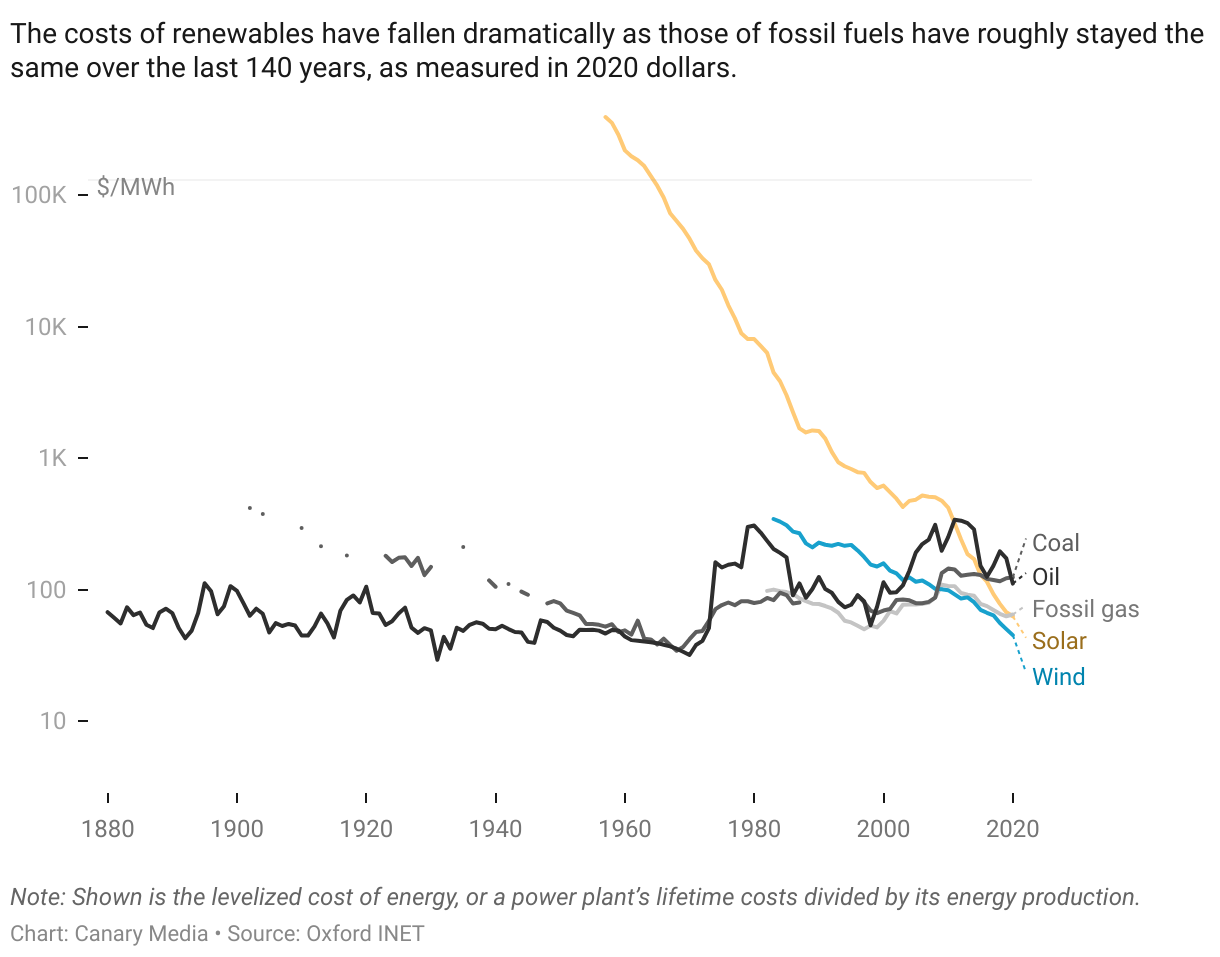
Unfortunately, government seems determined to continue the present model for the intended 2024 call for additional electricity. The difference in 2024 will be that large contracts for wind power will be issued. U.S. Department of energy predicts that by 2050, wind power costs could fall as much as 50 percent below 2015 levels. Those savings should end up in the pockets of BC consumers, not in the accounts of IPPs.
While power generating costs were dropping, BC Hydro issued contracts to IPPs that paid increasing prices because of inflation protection clauses. They should be allowed to make the same mistake again.
Government knows that citizens would not, and should not, tolerate privatization of the entire public utility. The arrangements with Independent Power Producers, which are largely owned outside of British Columbia, amount to partial privatization by stealth.
For notification of new posts at In-Sights, you can subscribe using the follow widget and receive emails whenever new posts are published. That widget appears on the top left on computer screens and somewhere below if you are reading on a smartphone. However, articles are sometimes corrected or updated, so reading posts on the website will be more informative than reading only the email.
Categories: BC Hydro, Independent Power Producers (IPP)


 in-sights.ca
Again Norm, thank you for taking the trouble to clarify just what BC citizens are financially liable for.
It should be understood by the reader that big investors always are in search of a “monopoly” and if unsuccessful, they can make do with contracts issued to them by a “monopoly” , like BC Hydro.
LikeLike
Well its only money and its not like its coming out of their personal pockets, just the citizens of the province.
Erik seems to have it right!
IPPs, weren’t those really given a hand up/out by el gordo with the run of the river projects. At the time either you or Rafe Mair wrote something along the lines of B.C. Hydro purchasing power from these IPPs at 5 cents and selling it to consumers for 3 cents. Well that works well for some body, but not the corporation. Guess that was a great big thank you to some one.
When there are contractual obligations, that is money which is already spent and can’t be used for other things, like health care, affordable housing, etc.
I remember when WAC Bennett took over B.C. Electric, the day after Dal Grauer’s funeral. (Dal Grauer was the C.E.O. of B.C. electric which became, B.C. Hydro)
Mom was not amused.
LikeLike