


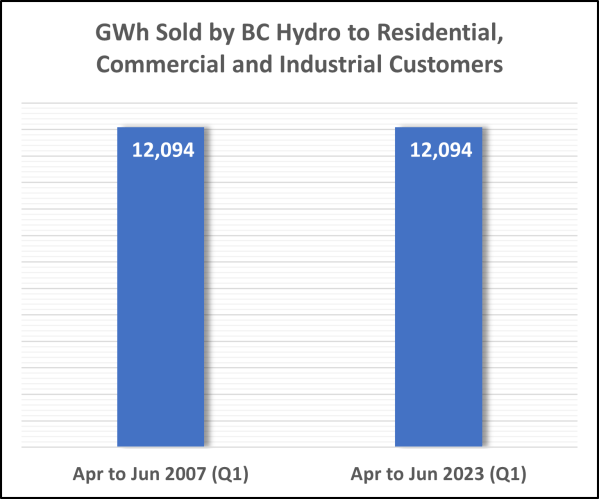
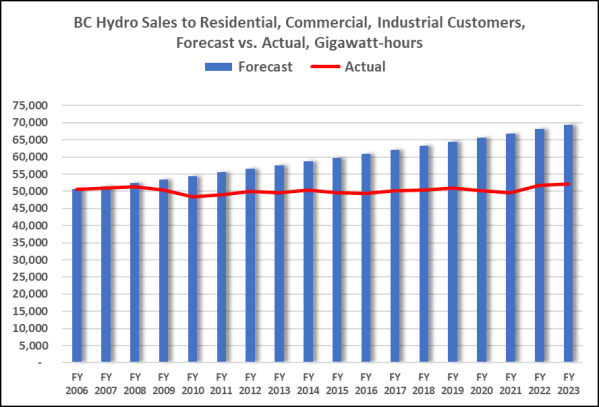
Economist Erik Andersen emails an informal newsletter offering opinions, sometimes about how organizations and individuals use political influence to extract wealth from the public. He gave an example that was bad by itself but set the stage for secret private power contracts worth more than $60 billion despite expansion of the BC Hydro’s own generating capacity and a decade and a half of flat demand by consumers.

The following is by Erik:
In 2004, a shell company in Alberta signed a contract with BC Hydro to build and operate a natural gas fired electricity generation plant at Duke Point on Vancouver Island. The Calgary company put up $2 million in seed capital (their own number according to direct evidence at the BCUC). On the strength of the deal with BC Hydro, the CPP fund and others agreed to finance $300 million for construction of the power plant.
The BC Hydro contract provided the operator with a guaranteed annual payment of $25 million for 25 years regardless of whether or not power was delivered. Costs of natural gas above $3 MCF and any pollution related costs were to be paid by BC Hydro to the operator.
Now if one makes a present value calculation using the provincial long bond yields (BC Hydro’s credit rating is equal to that of the BC Government) the value of the contract when signed was about $500 million.
So, for $2 million of working capital the developer was to get a contract with a present value that guaranteed it a $200 million profit.
Fortunately, we ratepayers forced abandonment of this project.
Several of us stood in opposition to the gas-powered generating plant. BC Hydro and the BC Utilities Commission had accepted the proposal. What was different was that we had access to the contract between BC Hydro and the operator. This gave us detailed knowledge of the deal.
To get a decision reversal, we had to challenge this contract in several different ways. The most effective was to examine the financials of the contract. The present value of income assured to the producer over the 25-year term was $200 million above the cost to build, as given in evidence by the producer. The contract also called for extra payments if the price of natural gas increased.
It also stipulated that if BC Hydro did not draw down electricity because of weak demand, full payments were still to be made. These were the main features of a sweetheart deal. It was a private equity transaction of the sort that appeals to the CPP Investment Board, which invests money taken from Canadian workers.
The next episode in this dark saga was made by the BC government when they made all subsequent BC Hydro contracts secret. I tested this with a written request to see the contracts covering some generation sites behind Lund. I still have the letter answering that the contracts are not available to the public.
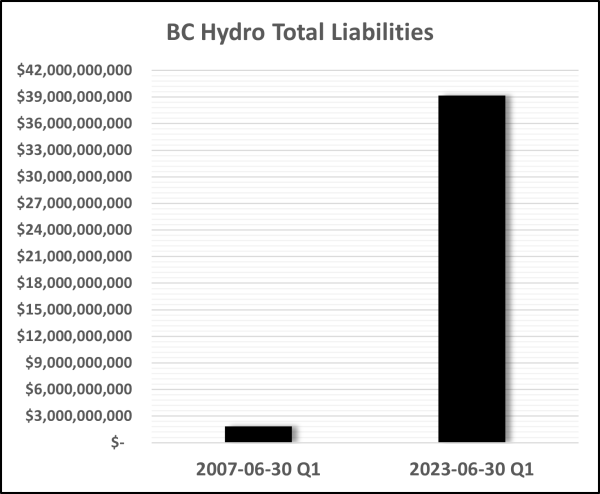
If you were to read one of the recent postings by Norm Farrell you can discover the enormity of the current extent of BC Hydro indebtedness. [In addition to $39.2 billion dollars in liabilities shown on BC Hydro’s financial statements, the utility’s contractual obligations, largely to private power producers, exceeded $50 billion in 2023.]
Making financial deals secret, with the many financial parasites we have in Canada, seems to be a large part of the reason for growing levels of anger and impoverishment. These circumstances don’t happen by accident…

If you find value in posts and dialogue at IN-SIGHTS.CA, please consider financial support. It is a simple process explained HERE.
Categories: BC Hydro


 in-sights.ca
Right from the get go I always said the non-disclosure clause was or should have been exposed. Was the BC rail deal also the same way. Totally corrupt if you deal with public funds and the deal is private. Will vote for any party that would bring in legislation to expose those in hand and to ban the use of them in the future.
LikeLike
Hind sight is 20/20 and the BC Rail deal had so many intrigues. The first being Gordon Campbell’s divesting of BC assets to politcal friends and insiders and give another politcal friend, the Rocky Mountaineer group a monopoly on all passenger train services in BC, with their hugely expensive “Hotel Train” program.
Everything Campbell touched was like Midas for his politcal friends.
LikeLike
Dear “Evil Eye”. Hind-sight is how economists are able to identify who is responsible for social challenges humans create. In the 1960s a Royal Commission was struck to investigate unfairness of our income tax system. Usually RCs are formed by governments to take socially contentious issues away from the front pages of newspapers. A cynical person could be also right when saying nothing good comes out of a RC, much as was the case about unfairness in taxation and then the RC commission on bribery used to sell Airbus aircraft to Air Canada.
Now in the case of BC Hydro and contracts with want-a-be sellers of electricity to BC Hydro, the first test of what kind of a commercial deal the private parties wanted was the contract applying to Duke Point. This contract showed how the contract excessively favored the private investor. The next best condition of owning a monopoly is having a contract with a monopoly, owned by all the taxpayers in BC.
Mr. Campbell was never short of ideas so after our getting the proposal dismissed he changed the rules governing disclosure of electricity purchase contracts. Like all economists I have a reasonable memory and that is why I can connect the dots from 2006 to Norm’s frightening debt/liability charts.
What can be had for the population when the greedy bunch are taking more than their fair share.
I saw this in spades at ICO where the Director would not allow me to publish figures showing the terrible state of income distributions in all countries in South and Central America. The financial incapacity to consume international air travel was no where near European and north American populations. This flawed thinking was a big part of the reason CP Air went bankrupt but I knew folks who wanted to believe this fiction.
The first thing one usually does when trying correct a socially unfair condition is to know who and why we have it so we don’t ask the same people to fix what they allowed or made to happen .
I hope this adds relevant context to this discussion. Erik
LikeLike
An article from 2005 after the project Erik references was finally knocked on the head illustrates that BC Hydro has been credibly accused of lying to the public for decades. Substitute the Peace River Valley and citizens of BC in general and the quote applies equally to the Site C project today.
“Also disappointed was Nanaimo Mayor Gary Korpan. ‘It has been a total waste of everyone’s time, money and worry,’ he said. ‘How BC Hydro management has any credibility in the business community or with the public now, eludes me. If there is any vestige of decency left at BC Hydro, those executives who did this need to apologize to the citizens of Vancouver Island and resign.’
He called for an enquiry. ‘Time after time, BC Hydro said to the public that Vancouver Island was at severe risk of insufficient electricity supply. It is absolutely clear that we on Vancouver Island have been lied to for these last several years.’”
Click to access Hydro_June30_05.pdf
Norm has been reminding us (with receipts) of the continuing culture of deception at BC Hydro, and Erik has been reminding us of the lengths government and its creations (including Hydro) are willing to go to ensure their respective milking of the public teat is done in the dark. We should be grateful for the expertise and effort Norm and Erik expend in an attempt to illuminate the scene. It must seem a thankless task at times.
LikeLike