



To reduce global greenhouse gas emissions we need to shift towards a low-carbon energy system. Large reductions in the cost of renewable technologies such as solar and wind have made them cost-competitive with fossil fuels. But to balance these intermittent sources and electrify our transport systems, we also need low-cost energy storage. Lithium-ion batteries are the most commonly used.
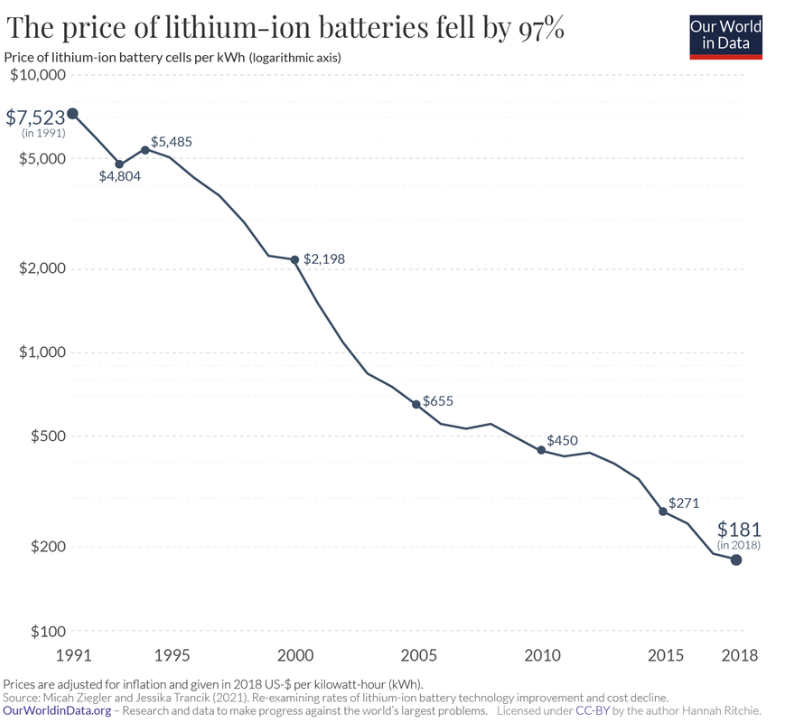
Lithium-ion battery cells have also seen an impressive price reduction. Since 1991, prices have fallen by around 97%. Prices fall by an average of 19% for every doubling of capacity. Even more promising is that this rate of reduction does not yet appear to be slowing down.
The World’s largest EV battery maker is set to cut costs in half by mid 2024. Chinese battery storage maker CATL is set to reduce the cost per kWh of its lithium iron phosphate (LFP) cells by a stunning 50 percent by mid 2024, paving the way for lower-cost electric cars.
It is not just battery technology that is evolving.
MIT engineers have developed ultralight fabric solar cells that can quickly and easily turn any surface into a power source.
These durable, flexible solar cells, which are much thinner than a human hair, are glued to a strong, lightweight fabric, making them easy to install on a fixed surface. They can provide energy on the go as a wearable power fabric or be transported and rapidly deployed in remote locations for assistance in emergencies. They are one-hundredth the weight of conventional solar panels, generate 18 times more power-per-kilogram, and are made from semiconducting inks using printing processes that can be scaled in the future to large-area manufacturing.
Because they are so thin and lightweight, these solar cells can be laminated onto many different surfaces.
Categories: Energy


 in-sights.ca
This is very encouraging news. Meanwhile, are we seeing doubling in efficiencies or halving of prices for components of ICE vehicles?
Hint: no.
LikeLike
Here’s my idea to negate the need for batteries to store energy.
Generate power using hydroelectric power plants like we do now. Instead of letting all the water run down the river, store some of it in a reservoir at the bottom of the dam. Recharge the upper reservoir from the lower reservoir with pumps run by wind and solar generated electricity. Aside from water lost through evaporation, this could be a closed system. You wouldn’t even need to build it on a river. Just temporarily divert water into the system until the reservoirs are full.
Has anybody thought of this?
LikeLike
Indeed. However, it requires a particular landscape to be useful.
Pumped storage hydropower (PSH) is a type of hydroelectric energy storage. It is a configuration of two water reservoirs at different elevations that can generate power as water moves down from one to the other (discharge), passing through a turbine. The system also requires power as it pumps water back into the upper reservoir (recharge). PSH acts similarly to a giant battery because it can store power and then release it when needed.
LikeLike
And further on G. Barry’s point…
That’s some axis, that logarithmic axis!
LikeLike
pumped storage would also work for potable water supply backup?
LikeLike