


In 1963, former JFK administration officials Marcus Raskin and Richard Barnet formed the Institute for Policy Studies. The American organization became involved in civil rights, feminism, economic reforms, peace movements, and military draft resistance. Uncomfortable with promotion of radical causes, the Nixon administration added Raskin and Barnet to their lengthy enemies list.
Now in its seventh decade, IPS remains focused on social justice. The organization recently published Gilded Giving 2024: Saving Philanthropy from Wall Street. The authors:
- Chuck Collins, author of The Wealth Hoarders: How Billionaires Pay Millions to Hide Trillions.
- Bella DeVaan, associate director of the Charity Reform Initiative at IPS.
- Helen Flannery directs research at the Charity Reform Initiative.
For decades, a secret army of tax attorneys, accountants and wealth managers has been developing into the shadowy Wealth Defence Industry. These ‘agents of inequality’ are paid millions to hide trillions for the richest 0.01%.
Chuck Collins
The IPS report argues that philanthropists may not be guided by a spirit of generosity toward the less fortunate. Instead, they use charities to accrue, preserve, and defend their wealth.
Wealthy donors use donor-advised funds (DAFs) and private foundations to get tax deductions immediately but maintain control over the disbursement of the money.
…The nonprofit sector has gone from being broadly supported by many donors of all classes (think March of Dimes or Easter Seals) to becoming more and more dependent on the wealthiest donors. This poses several perils for the independent nonprofit sector, including mission drift to accommodate the priorities of wealthy donors and diminished investment in cultivating a small-dollar donor base. And as more donations flow anonymously through donor-advised funds,some nonprofit charities are completely left out of the process because they don’t have connections to DAF account holders.
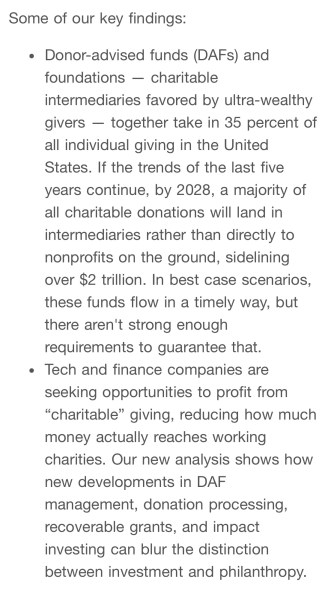
As in the USA, Canadian DAFs have proliferated. Charities compete to attract cash from donors and this may result in contributors gaining excessive influence over fund management. Loose regulations allow some DAFs to use no money for charitable purposes and accumulate wealth. This is possible because disbursement quotas are calculated on an aggregate basis, not fund by fund.
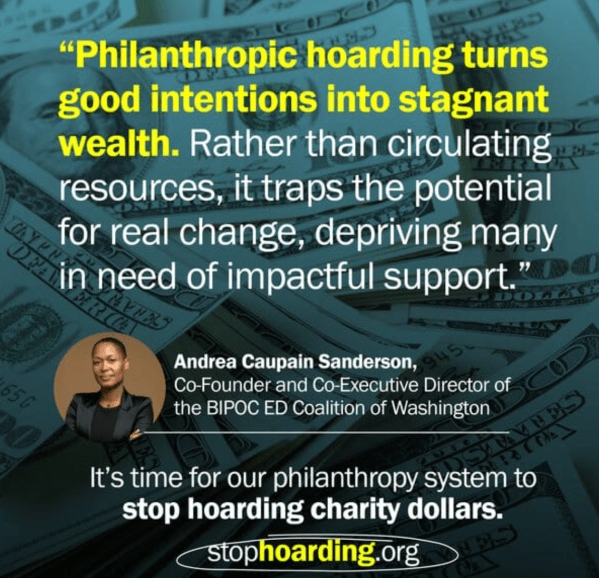
Organizations and politicians beholden to wealthy individuals call for less regulation of donations. Groups not obliged to the same interest groups ask for stricter oversight but generally lack the influence to stimulate the reform of charities. Similar imbalances result in current taxation policies.
According to Oxfam:
- Super-rich outstrip their extraordinary grab of half of all new wealth in past decade.
- Billionaire fortunes are increasing by $2.7 billion a day even as at least 1.7 billion workers now live in countries where inflation is outpacing wages.
- A tax of up to 5 percent on the world’s multi-millionaires and billionaires could raise $1.7 trillion a year, enough to lift 2 billion people out of poverty.
If a man has an apartment stacked to the ceiling with newspapers, we call him crazy. If a woman has a trailer house full of cats, we call her nuts. But when people pathologically hoard so much cash that they impoverish the entire nation, we put them on the cover of Fortune magazine and pretend that they are role models.
Former Canadian Prime Minister Lester B. Pearson
When wealth is passed off as merit, bad luck is seen as bad character. This is how ideologues justify punishing the sick and the poor. But poverty is neither a crime nor a character flaw. Stigmatise those who let people die, not those who struggle to live.
Author Sarah Kendzior
Categories: Wealthcare


 in-sights.ca
Humanity is inhumane, and sick!
LikeLiked by 1 person