



The preceding post linked to an article in The Guardian about China’s underwater data centre. British Columbia is well positioned to follow this innovation, if it is interested in using clean energy to power these debatable projects. From The Guardian:
In a traditional, land-based datacentre, anywhere between 25% and 40% of the total electricity demand comes from the need to pipe chilled water around the servers to prevent them from overheating. …Having datacentres in the sea reduces the need for freshwater supplies.
This week the United Nations University Institute for Water, Environment and Health warned that the water footprint of datacentres could reach 9.3tn litres by 2030—enough to service the annual domestic water needs of all 1.3 billion residents of sub-Saharan Africa.
China is the first country in the world to operate an underwater data center. It is part of a strategy to reduce dependence on fossil fuels and reduce the environmental impact of powering artificial intelligence facilities.
This is a partnership between HiCloud Technology and state-owned China Communications Construction, which involved an investment of about C$330 million. Project Manager Pu Ding from Shenzhen HiCloud Data Centre Technology explains the primary benefit of the underwater location.
We put the entire data cabin in the deep sea because seawater can help cool down the temperature. Compared to their land-based counterparts, underwater data centres can reduce the energy consumption needed for cooling, helping to lower operational costs.
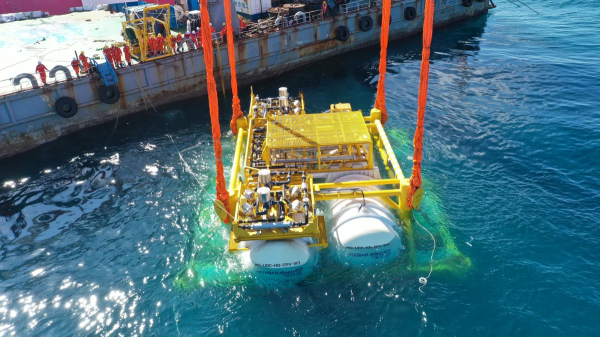

China’s province of Hainan has a 5-year plan to add up to 100 underwater data cabins to serve the region’s AI facilities.
China’s commitment to renewable energy has outpaced every other nation. In the following chart, Canada doesn’t even make the top ten of countries deploying solar and wind.
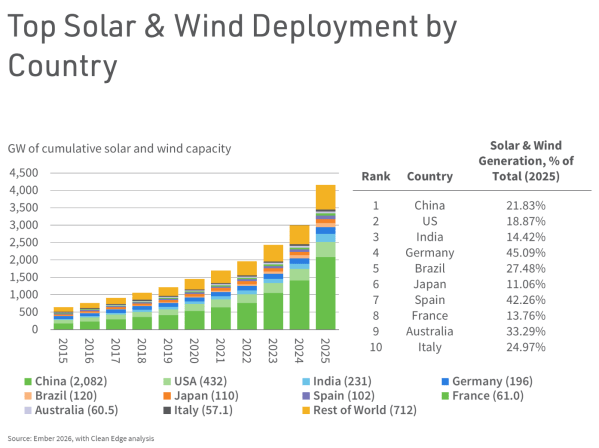
In 2022, China installed roughly as much solar photovoltaic capacity as the rest of the world combined, then went on in 2023 to double new solar installations, increase new wind capacity by 66 percent, and almost quadruple additions of energy storage.
How China Became the World’s Leader on Renewable Energy
Categories: Energy - Wind


Add more heat sources to an already overheated ocean…What could go wrong?
LikeLike
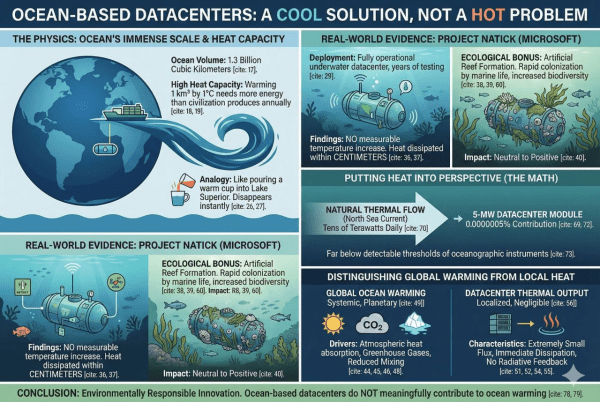
Submerging AI data centres in the ocean does not directly accelerate net global ocean warming, as the total heat generated is equal to air-cooled facilities. However, it shifts where that heat is released.
I imagine the question that humans should be asking is, “Do we really need AI everywhere in everything?”
For as long as anyone alive today can remember, governments have taxed products—alcohol, for example—that caused problems for society. When it comes to AI and the immense energy needs, governments are rushing to subsidize these and tearing up environmental regulations and policy papers.
Albert Einstein: “Two things are infinite: the universe and human stupidity, and I’m not sure about the universe.”
LikeLike
We’re lucky that people like “Dan” sees where the real problems with Chinese underwater data centres might lead.
“Add more heat sources to an already overheated ocean…What could go wrong?”
What, indeed.
First, let’s consider a thought-experiment with scale.
Exhibit A. In my hand there’s an exceptionally hot super-sized container of Tim Horton’s coffee. Simultaneously I’m standing beside an Olympic-sized swimming pool. It is Exhibit B.
If I pour Exhibit A directly into Exhibit B how long will it take to have any discernible scientific effect? If instead of emptying the contents I submerge the container? Then what? How many containers must be submerged before this causes catastrophic effects?
As the article states – “China’s province of Hainan has a 5-year plan to add up to 100 underwater data cabins to serve the region’s AI facilities.”
======================================================================
Fortunately for China the enormous ocean adjoining it is larger than any theoretically imaginable swimming pool. Is it capable of containing 100 data cabins? Wouldn’t Chinese scientists have considered that?
BC? The idea that we will ever see 10 underwater data centres in our very own Pacific Ocean? Not with the politicians we’ve got.
Is the ocean off BC very cold already? See for yourself. Go for a swim without a wet suit. That numbness? That’s hypothermia.
In sum: by implication you’ve raised a problem that doesn’t exist for an ocean.
=======================================================================
Want to see something else we can’t do? I recommend…
China Pumped BILLIONS Of Litres Of Ocean Water Into A Dead Desert — What Happened Next Was Shocking
Yes Dan, to cope with the Gobi Desert various seemingly unrelated Sciences were merged: Physics, Hydrology, Desalination, Engineering, Biology, Forestry, Biochemistry, integrated on a scale never before seen.
For stuck-in-a-Political Dark Age Canada.. It’s humiliating.
Canada and BC? Priority One! We must become a fossil-fuel Energy Superpower!
Priority none? Affordability? Poverty? Joblessness? Crime? Healthcare? Housing? Homelessness? Back burner stuff. Not relevant to a Superpower on the rise!
Yes sir, we’re busy paralyzing our Plutonomy financially trying to justify spending billions on Data Centre Mania. Because? Apparently selling information is highly profitable to investors. AKA the One Percent who really matter.
Watch the video, step back and review what was accomplished. The success of that analytical process should signal every other country to reassess what they’re doing. Why they need to understand what the effort cost, what worked, and how many millions were saved from irreparable harm.
Then? Copy the Science and implement it.
Instead? Canada first needs Pipelines? Yes! We must build pipelines to ship toxic bitumen to Asia. That said Alaska is ready to build an undersea pipeline or two — to Russia. The same Russia with multiple pipeline built to China!
[The closest distance between the mainland coast of Alaska (Seward Peninsula) and the mainland coast of Russia (Chukchi Peninsula) is approximately 55 miles (88.5 kilometers)]
The cost benefit to Alaska? No vessels involved. No vessel crew, fuel, maintenance, or insurance costs, nor bureaucratic overhead. Whatever flows through to Russia is what it costs.
Back East? What does Irving Oil do to maximize their profits? They refine crude.
How much?
[Irving Oil’s Saint John, New Brunswick facility is Canada’s largest oil refinery, with a processing capacity of 320,000 barrels of crude oil per day. Additionally, the company operates the Whitegate Refinery in Ireland, which has a processing capacity of up to 75,000 barrels per day.]
No way angry, suffering, longing to be free of Ottawa tyranny (as US State 51) Alberta, could ever imagine refining their own bitumen to maximize profit!
Politically unthinkable.
OK Dan. It’s your turn…
LikeLike
Dan brought up a point that probably occurs to many people. I think he wanted to initiate examination of the subject. A subsequent IN-SIGHTS post suggests that we have to choose between two options, neither desirable for the only planet we know that supports life.
From The Guardian: Prof Rick Stafford, a marine biologist at Bournemouth University, said: “An underwater datacentre is likely a good idea. While the cooling using seawater will result in some localised elevated temperatures, these will not be far reaching.”
LVI Associates: Because they operate offshore, underwater data centers take pressure off land and freshwater resources and can be positioned near renewable power sources such as wind or tidal energy. If developed responsibly, they have the potential to lower emissions and contribute to the industry’s shift toward cleaner, more efficient data infrastructure.
LikeLike