



Hydropower is dispatchable. It is generally reliable, can increase or decrease generation quickly, and can be shut down and restarted with relative ease. Provided the facilities are properly maintained, the system should perform well.
But what happens when drought leaves too little water to drive the turbines?
The answer is simple: electricity production declines.
In British Columbia, this is no longer a hypothetical risk. Climate change is increasing the likelihood and severity of drought, and reduced water supplies have been constraining hydropower. Today, drought affects about half the province.
The phrase “too little water” makes the central vulnerability clear from the outset. This year, large segments of British Columbia are suffering drought.
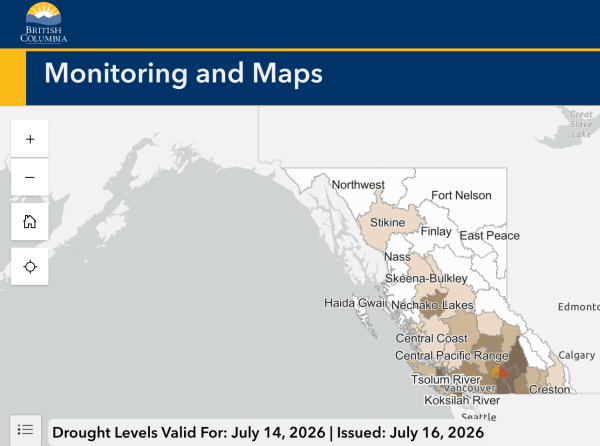
As of mid-July 2026, northeastern British Columbia—where the Peace River supplies much of our hydroelectric power—has not been severely affected. But a trend involving all of BC Hydro’s generating facilities is unmistakable.
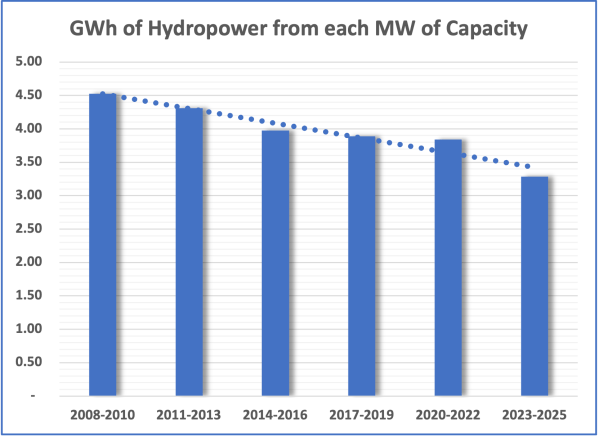
Over the past two decades, the electricity generated for each megawatt of installed capacity at BC Hydro’s dams has fallen by roughly one-third.
Hydropower has been abundant enough to meet British Columbia’s needs, but drought and low reservoir levels have exposed the danger of relying too heavily on a single source. Diversification through wind power, solar energy, and storage is no longer optional. It is essential to the province’s energy security.
Wind, solar, and battery storage are widely recognized as the cheapest options for adding supplies of clean electricity. BC Hydro’s reluctance to embrace these technologies fully reflects legitimate concerns about grid stability, but the larger obstacle is cultural resistance.
Corporate inertia is powerful. Senior executives become comfortable doing what they have always done, defend the systems they know, and resist changes that threaten established practices.
But there really is no choice. A United Nations agency published this:
Energy is at the heart of the climate challenge—and key to the solution.
Most of the greenhouse gases that trap heat in the Earth’s atmosphere come from burning fossil fuels to produce energy, mainly for electricity and heat. In 2023, the power sector was the largest source of global greenhouse gas emissions.
The science is clear: to avoid the worst impacts of climate change, emissions must be reduced by almost half by 2030 and reach net-zero by 2050.
To achieve this, we need to end our reliance on fossil fuels and invest in alternative sources of energy that are clean, accessible, affordable, sustainable, and reliable.
Renewable energy sources—such as sunlight, wind, water, organic waste, and heat from the earth—are abundant, replenished by nature, and emit little to no greenhouse gases or air pollutants.
If politicians make the right decisions, British Columbia can build a safe, reliable energy system capable of supporting widespread electrification. But provincial action alone will not halt the relentless advance of climate change. Renewable energy is expanding, yet global emissions are declining far too slowly to prevent dangerous temperature thresholds from being crossed.
Canada cannot export vast quantities of fossil fuels while pretending to confront the climate crisis. Carbon released by burning Canadian oil and gas abroad is every bit as destructive as carbon released here.
Yet Canadian political leaders continue to place immediate financial returns ahead of the long-term protection of the planet. They act as though exporting fossil fuels also exports responsibility for the damage they cause.
Unfortunately, the world has only one atmosphere.
Categories: Climate Change, oil and gas, Uncategorized


 in-sights.ca
Calculating greenhouse gas emissions generally focuses on the combustion of fossil fuels. As we are witnessing this summer, another major source of GHG emissions is wildfire smoke. This is not an insignificant contributor and only increasing as we slide deeper into the climate crisis.
Other side effect contributors include the increased release of methane from decomposing forest debris and thawing permafrost. We are rapidly crossing irreversible tipping points that will snatch any chance of the global community from reversing our self inflicted climate crisis.
LikeLiked by 1 person