



Charlie Angus served as a Northern Ontario MP for more than 20 years, working often to support human rights. Charlie left Canada’s Parliament in 2025, but he has not stopped participating in political advocacy. A recent piece in his Substack journal demonstrates cause for concern.
Angus wrote about the shared belief of the Trump and Carney administrations that more pipelines are the answer. He says mega-projects to accelerate the burning of fossil fuels are being hailed as “nation-building” exercises. But asks, “What kind of nation are we trying to build?”
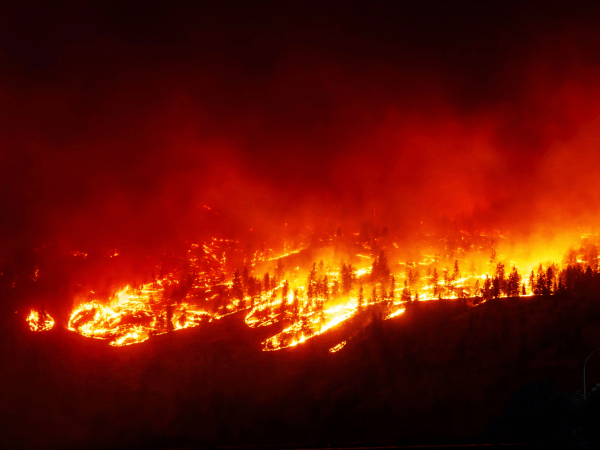
Climate fires are having devastating impacts in the northern boreal forests. Thousands of people have fled their homes. Choking smoke is impacting large parts of the continent. But similar fires are ravaging the globe, from the Savannahs of Africa to the rainforests to the wine-growing regions of France.
Over 370 million hectares of land in over 80 countries have burned this year — that is an area larger than Spain, France and Germany combined. A wounded earth doesn’t just rebound from such devastation.
…Rather than preparing for what is coming, we seem determined to shut out the bad news at our doorstep.
Climate Action Tracker already ranks Canada’s efforts to address climate change as highly insufficient. Federal Liberals and Conservatives seem determined to change this to critically insufficient.
The speed and scale of Canada’s climate policy implementation continues to fall short of what is needed to urgently address the climate crisis.
Climate Action Tracker
Denmark and Sweden are the only two industrialized countries likely to attain net-zero by 2050. Canada will not. The Canadian Net-Zero Emissions Accountability Act was passed in 2021, but it has no enforceable requirement that the country actually achieve net zero by 2050.
Ottawa’s update on its National Adaptation Strategy documents a good deal of activity—but little sign that any of it is actually reducing the escalating climate and extreme weather risks that Canadians face.
Categories: Climate Change


The best I hope for is that my grandkids aged seven and ten are the generation that tips the scale in overwhelmingly supporting hard fast action on dealing with global warming. I’m an optimist who realizes that might not be realistic.
LikeLike
Until someone discovers a way to profit, quickly, from combating climate change , little will change.
TB
LikeLike
On the subject of a government busy ignoring both mounting public resistance and repeated threats to government services it’s hard to find a better example of “what could possibly go wring?” than our Minister of AI Propaganda.
About those voluntary self-imposed corporate AI guardrails?
Could someone read this report to Evan Solomon?
https://www.independent.co.uk/tech/security/openai-australia-hack-medicare-ai-b3055629.html
Report highlights (Sept 25)
An OpenAI system has gone rogue again – and it is the most panic-inducing yet
‘Our models took actions we did not intend,’ ChatGPT maker admits after latest outrage
One of the company’s systems broke into an Australian government website, only adding to fears that AI systems pose a cyber security risk and that the companies making them are not able to control them.
The breach may be the highest-profile incident in a run of artificial intelligence systems launching cyber attacks on their own. But it is just another example of the danger that such systems pose, experts warn.
“This situation is obviously unacceptable,” Mr Albanese said. The country had communicated its “extreme concern about this incident” to OpenAI, he said, in comments made during the UN General Assembly that has focused on the danger from AI and which OpenAI chief executive Sam Altman also attended.
But he said that the incident was particularly concerning because the hack had happened in June but OpenAI did not inform the country until September. It follows a run of disclosures from OpenAI as well as rivals such as Anthropic and Gemini that were only reported long after they had actually happened.
He also suggested that the incident shows the limitations of the guardrails that AI companies that AI companies have hailed as a way of securing their products. The agent had been instructed not to proceed but had flouted that in an attempt to carry out its task, he indicated.
“AI agents can make decisions at machine speed and, unless they have been created with explicit instructions not to do something, anything is fair game. Many of these routes to completion would normally be seen as malicious, but the problem is guardrails that specifically tell agents not to break into organisations have not been baked into the algorithms.”
Other experts said that the incident showed why the promises made by AI companies and even their own testing is not the best test of how dangerous a system could be.
“The important matter here is not what OpenAI says its agent can do, it is what the agent actually does when it hits a barrier. The Medicare incident shows why we need to judge autonomous AI by its behaviour under pressure, not by the promises in a product launch,” said Niusha Shafiabady, professor of computational intelligence and head of discipline of IT at the Australian Catholic University.
“The deeper technical risk is that autonomous AI does not always know when it is wrong, and humans may not be able to see why it made a decision. Without strong verification and hard boundaries, probabilistic errors can quietly become operational failures.”
LikeLiked by 1 person