



Graham Farrell1 served as Research Chair in Environmental Criminology at Simon Fraser University before moving to the University of Leeds in 2015, where he is Professor of Crime Science.
“Environmental criminology” is not a common term. I initially imagined academics studying people like ExxonMobil’s Darren Woods, Chevron’s Mike Wirth, or Saudi Aramco’s Amin Nasser. But SFU offered a different explanation:
Environmental criminology addresses how constructed environments and design of human-made objects impact and shift criminal activity and behaviours.
Apparently, I had the wrong environment in mind.
Dr. Farrell wrote about England and Wales, but his observations about the gap between public perceptions and crime statistics warrant attention in Canada as well.
Seventy-eight per cent of people in England and Wales think that crime has gone up in the last few years, according to the latest survey. But the data on actual crime shows the exact opposite.
As of 2024, violence, burglary and car crime have been declining for 30 years and by close to 90%, according to the Crime Survey for England and Wales (CSEW) – our best indicator of true crime levels. Unlike police data, the CSEW is not subject to variations in reporting and recording.
Farrell says domestic violence and antisocial behaviour have also declined, while fraud and computer misuse now account for about half of crime measured by the survey. He describes similar trends across high-income countries and points to improved security measures as a major reason many crimes have become more difficult to commit.
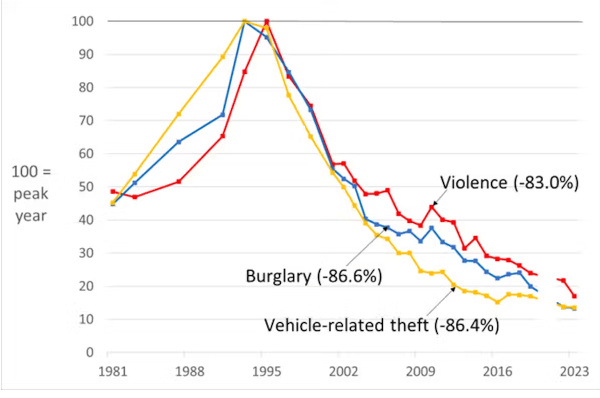
Yet surveys show that citizens rank crime among the most serious problems facing society. Farrell attributes some of this concern to political rhetoric. Law enforcement agencies, with an interest in securing larger budgets, also have an incentive to downplay falling crime rates—to become “crime drop deniers.” Journalists, guided by the old newsroom maxim “if it bleeds, it leads,” can reinforce these fears by giving violent crime prominence that broader trends rarely receive.
Canada has experienced a substantial long-term decline in overall crime severity, but the picture for violent crime is more mixed. Americans experience far less violent crime than three decades ago, yet still face exceptionally high levels of lethal firearm violence compared with people in other wealthy countries.
Mayor Ken Sim and his ABC Vancouver party have controlled city council for nearly four years. They credit expanded police budgets with reducing crime while blaming previous councils for rising crime and disorder. But a decline during their term does not establish that their policies caused it.
This illustrates the need for the scrutiny Farrell encourages. Political claims should be tested against long-term statistics. Those seeking credit for falling crime owe us the same evidence we should demand from those insisting it is rising.

1 No relation to the writer of IN-SIGHTS
Categories: Justice


That 78% perception-vs-reality gap is wild but not shocking given how local news skews toward the rare violent incident over the decades-long trend line. Fair point on Mayor Ken Sim too, a decline during someone’s term isn’t proof their policy caused it, especially when the number’s been falling for 30 years regardless of who’s in office.
LikeLike