


Had they paid attention to science years ago, political and industrial leaders would have known the world was heading for a crisis. Climate change is widely recognized as an existential threat, but they paid no attention and did not care…

Had they paid attention to science years ago, political and industrial leaders would have known the world was heading for a crisis. Climate change is widely recognized as an existential threat, but they paid no attention and did not care…

Methods of creating or capturing energy near demand points are gaining prominence and threatening the disruption of today’s giant utilities. A paper from Germany’s Karlsruhe Institute of Technology suggests millions of buildings can be energy self-sufficient with solar power, retrofitting, energy storage systems, and heat pumps. Many single family homes could abandon the electrical grid unless owners stayed connected to sell excess power to utilities.

According to the godfather of climate science, the 2015 Paris Agreement’s goal of limiting warming to 1.5 degrees Celsius above preindustrial levels, is “deader than a doornail.” Every person who cares about future generations should be sad and angry.
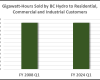
BC Hydro’s own numbers provide evidence that increased demand by domestic consumers over 20 years was less than one-third of that predicted and was double covered by the utility’s purchases from private power producers. But those facts did not stop the empire-builders from expanding their empire.

Revenues of Chevron Corporation in 2022 were one-third of a trillion Canadian dollars and the company’s comprehensive income was C$50 billion. Chief Executive Officer Mike Wirth’s 2022 compensation was C$32 million. So it is not surprising that Chevron’s CEO recently defended his company, saying “We are not selling a product that is evil. We’re selling a product that’s good.”

Seattle based writer David Roberts reports on energy matters. Recently Roberts explored the variability of renewable energy. Opponents of wind and solar power rely on this subject to raise objections. Despite virtually all of the electricity generated by BC Hydro being dispatchable, the public utility has discouraged addition of variable renewable energy (VRE).

Yale political scientist and anthropologist James C. Scott, author of the whimsical 2013 book Two Cheers for Anarchism, suggested pursuit of justice demands occasional insubordination and disregard for rules. He described “…an anarchist sensibility that celebrates the local knowledge, common sense, and creativity of ordinary people. The result is a kind of handbook on constructive anarchism that challenges us to radically reconsider the value of hierarchy in public and private life, from schools and workplaces to retirement homes and government itself.”

Published five years ago at my idled website Notable Discoveries. With a few updates, it is here for a change of pace after too much negative news. Long ago mother baked regularly, but I envied our neighbours’ store-bought white bread. It had a thin soft crust and gumminess perfect for spitballs. And children in those homes did not wear pajamas sewn from flour sacks…

After BC voters told Christy Clark to find a more suitable occupation, I planned to transition from blathering about politics to writing about travel and dining. I opened a site called Notable Discoveries and expected to let IN-SIGHTS go idle. That didn’t happen. COVID, inflation and health issues ensured that outside activities were limited. At the new website, I might have been writing about ways of poaching eggs on a hotplate…

In Canada, more than $100 billion is now being spent to expand fossil fuel production. Meanwhile, other nations are working to mitigate climate change and enable long-term human survival. For example, Airbus ordered new vessels to transport aircraft subassemblies across the Atlantic. The low-emission ships are powered by dual-fuel engines that can run on e-methanol produced from renewable sources. More importantly, propulsion is assisted by six Flettner rotors sails.

Today, charts about BC Hydro showing information that ought to alarm citizens of British Columbia. It will not of course, because corporate media does not bother to report meaningful data about the province’s largest crown corporation. Despite their continuous claims that demand was growing by 40 percent over 20 years, the company’s own sales records show that demand was slowly growing until 2005 and since then has been stable. But that fact did not prevent the utility from amping up their spending machine…

With disputes and condemnations over coverage of the mayhem in Gaza, it is worth considering the ethics of journalism. Whether or not generally accepted rules are followed by media is a subjective evaluation. But I believe there has been a general decline in ethical behaviour as ownership of mass communications has concentrated in the hands of financial elites…

Mark Jaccard, recently appointed Chair and CEO of the BC Utilities Commission, argued in 2017 for Site C, when BC could have stopped the project and saved about $15 billion. Jaccard said that supporters of other renewables did not account for dispatchability, which he claimed was a key obstacle to using alternatives. People expecting their pockets to bulge from the Site C megaproject told us that less destructive energy sources were unworkable in British Columbia. The world has proven them wrong…

People outside the United Kingdom should pay attention to opinion pieces by The Guardian’s Jane Martinson. The article that caught my attention today was ‘Why own a newspaper in 2023? Ask the very rich men trying to buy the Telegraph.’ This desire says a lot more about power than profit.

Canada a world leader? Sometimes that headline is good news. This time it is not…

The Economist, a 180-year-old newspaper published in Britain, has been tracking deaths from COVID-19. They examine fatalities reported by official sources, but also look for how many people have actually died because of the covid-19 pandemic. A lot depends on how “because” is defined…

Decarbonization is a catchword used by the fossil fuel and nuclear power industries. But those groups cannot eliminate inherent dangers. Unless we develop safe, carbon-free energy sources, we cannot sustain current standards of living. And, perhaps we cannot sustain human life in the long-term. But, as billions of public dollars pour into subsidies of dangerous energy sources, promising technologies seem to get minimal support from governments…

Since 1990, Canada’s emissions have decreased by a modest 3.1 tonnes per person. However, when we look at the distribution of emissions, we find that the bottom 90% reduced their emissions by almost 5 tonnes per person, while the top 1% increased their emissions by 34 tonnes per person.

I began following the Washington Post decades ago, when journalists often held the feet of powerful people to the fire. Today, that is unlikely since many media owners rank among the world’s wealthiest people. In general, they oppose changes to the status quo that do not provide personal benefits. That may partly explain why newspapers have about one-third the number of serious readers per capita than they had in the days of my parents…

In 2017, construction of Site C could have been halted without wasting more than $10 billion. But influential promoters of the megaproject — including Marc Jaccard, the newly appointed head of the “independent” regulator of BC Hydro — were misinforming citizens about the viability of alternatives…


No reason to get nervous. It's only speculation, an estimate, a rumour. I’m sure there are many recovery plans, incredible…
Is there an Iron Law of Panic? MAGA patriots and NRA enthusiasts will just love this! https://www.rawstory.com/karoline-leavitts-stunning-admission-on-trump-war-plans-sends-shockwaves-unbelievable/ White House Press Secretary…
Miracle how Mr Trump elevates the masses and saves money https://www.youtube.com/shorts/9-LJc9ywrMc?feature=share Trump’s actual rank at Wharton... not as advetized https://www.youtube.com/shorts/g7VXobnxaH0?feature=share…
Et Tu Vladdie? Is Russia providing military intel to Iran? Intel that could harm Americans? Are Trump and Putin just…
 in-sights.ca
Only the top thinkers, the best people money can buy are in on this, you say? And it's No Risk?…