



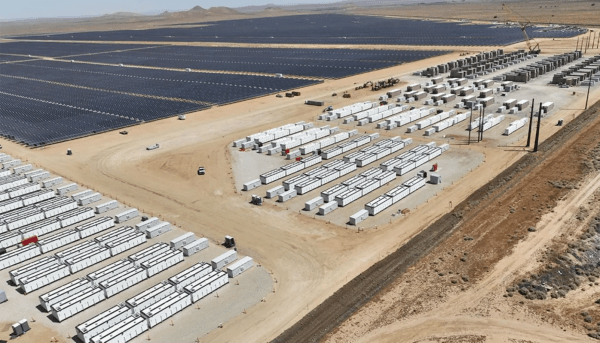
The C$2.7 billion Edwards Sanborn Solar and Energy Storage Project occupies 4,600 acres on and near California’s Edwards Air Force Base. Construction began in 2020 and the first phase came online in 2021.
As of January 2024, phases one and two were fully online, with 875 MW of solar PV and 3,287 MWh of battery energy storage system (BESS) capacity. For at least a short while, Edwards Sanborn is the highest capacity solar farm in the USA, with the largest battery storage system in the world.
Private capital manager Axium Infrastructure Inc. now owns a large part of the Edwards Sanborn facility. The company is familiar to those following private power companies that supply BC Hydro. With Manulife in 2018, Axium acquired 90% of the Forrest Kerr, Volcano Creek, and McLymont Creek generating facilities developed by AltaGas in northeast British Columbia.
I have written previously about the sweet deals made by AltaGas. The company was to be a sponsor when Liberal Premier Christy Clark decided to close the Burrard Bridge in Vancouver for a mass yoga class.
While BC Hydro is buying power for its grid from AltaGas for roughly $143 million, under the provincial policy of selling cheap power to large industrial users, AltaGas could buy the same volume of electricity from BC Hydro for about $75 million.
Back scratching
When making its purchase announcement, Axiam boasted that its newly acquired BC facilities are supported by 60-year, fully indexed electricity purchase agreements with BC Hydro. That is more information than BC Hydro is willing to release about secret agreements with private power producers.
Not surprising that a private equity firm is interested in long-term, no-risk investments. If the first year of operations returned $143 million to AltaGas, and inflation indexing improved the selling price by 1.5% each year, sixty years of payments would total almost $14 billion.
As opaque private capital investors acquire more and more generating facilities, what will happen to the price of electricity? On Twitter, retired Richmond council member Harold Steves said this on Twitter:
Buying out the opposition & shutting them down is the norm for monopoly capitalism. Steveston had many canneries. Big fish ate the little fish until there was only one cannery left. Weston bought it, shut it down & sold the land from all the canneries for houses & apartments.
If you find value in posts and dialogue at advertising-free IN-SIGHTS.CA, please consider financial support. Significant annual payments for site hosting and subscriptions for software and news sources are looming. Medium CEO Tony Stubblebine said, “It’s expensive to write about things that you don’t already know.”
Supporting this work is a straightforward process explained HERE.
Categories: Energy


I would really really like a moment for the taxpayers to open every deal Hydro made since Gordon Campbell told them to look after his friends. NDA should be illegal to any agreement between private enterprise and any level of government. This includes the Trans Mountain pipeline. There is so much corruption out there we could balance the books if it was dealt with.
LikeLike
Am I seeing some circular jiggery-pokery going on here? “While BC Hydro is buying power for its grid from AltaGas for roughly $143 million, under the provincial policy of selling cheap power to large industrial users, AltaGas could buy the same volume of electricity from BC Hydro for about $75 million.“
So: If AltaGas SOLD their run-of-river power to BC Hydro for $143 million — but then needed the equivalent power to run their operations in the Montney Basin … you’re saying Hydro is (or would be) selling it back to them at the ‘commercial’ price of $75 million?
Is it simplistic of me to ask: Why doesn’t Hydro just say. “Use your own power and we’ll take any excess”? I expect the answer would be “lucrative long-term contracts already signed.”
IF the Woodfibre LNG plant gets off the ground, this trickery will be even more obvious, as there’s a left-over hydro plant at Woodfibre from the old pulp mill days and Woodfibre LNG has an IPP contract with Hydro. Hydro will be buying high-priced Woodfibre IPP power… but it will literally be sending the power straight to the LNG plant, and it will have the ‘industrial’ rate applied to it.
Woodfibre CEO thought process: “We could just be using our own dammed power — but if Hydro wants to pay us double, then sell it back to us at half price… how can we refuse?!”
I just found an article from the (Sunshine) Coast Clarion from 2017, where Eoin Finn was interviewed. The IPP deal is even worse than I thought! Finn says, “BC Hydro pays Woodfibre $158 per megawatt hour, about twice the rate to break even. But last November, it was announced that Woodfibre will be able to buy electricity from BC Hydro for $54 per megawatt hour.”
The article adds: “Finn has estimated that if Woodfibre LNG would have been operating, this new rate would have resulted in a $34 million-a-year subsidy to the plant, worth $860 million over 25 years.”
LikeLiked by 1 person